The honest starting point
Ethiopia is a difficult destination for travelers with reduced mobility, and we are not going to dress that up. Step-free access is uncommon, pavements where they exist are often uneven or obstructed, and the FCDO records plainly that health and safety precautions such as protective railings at historical sites are rarely in place.
That does not mean a trip is impossible. It means the planning has to be specific, the itinerary has to be shorter than you might want, and the operator has to be asked direct questions and held to the answers.
Healthcare, which shapes everything else
This matters more here than the ramps do. The FCDO's assessment is that only private hospitals in Addis Ababa offer a reasonable standard of basic care for minor health problems, that ambulance services are limited, that dentistry is especially scarce, and that outside the capital medical facilities are extremely poor. Its instruction is to carry a comprehensive medical pack when traveling out of Addis Ababa.
For anyone with a condition that may need attention, the practical consequences are:
- Confirm medical evacuation cover in writing before you book anything, and check how it treats a Level 3 advisory and an advised-against region.
- Carry more medication than the trip requires, in original labeled packaging, split across bags, with a copy of the prescription.
- Assume that spares, repairs and replacements for equipment are not available outside Addis Ababa, and pack accordingly.
- Bear in mind that the State Department lists communications disruptions among its concerns, so do not build a plan that depends on being able to call someone.
Altitude is an accessibility issue
Addis Ababa stands at 2,400 m and the FCDO lists altitude sickness as a risk in parts of Ethiopia including the capital. For anyone with a cardiac or respiratory condition this is a question to put to a doctor before booking, not a detail to manage on arrival. It also means that a first day which would be gentle elsewhere is not gentle here.
Getting around
Addis Ababa
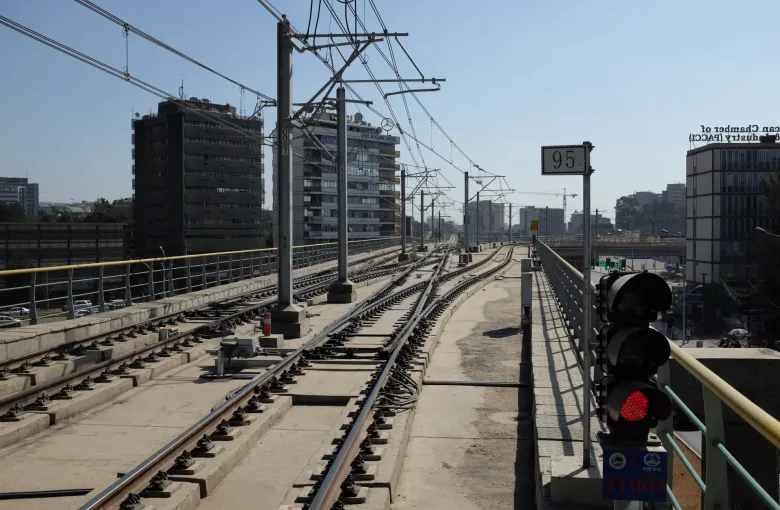
The light rail is the most predictable way to cross the city and avoids traffic, though stations involve stairs and services are crowded at peak times. For door-to-door travel, a vehicle and driver arranged through your hotel or operator is the realistic option, and it is also what the FCDO advises for safety reasons regardless of mobility.
Between cities
Domestic flights avoid long road journeys, which is worth a great deal: the FCDO describes driving standards and vehicle maintenance as often poor, and there is currently a nationwide fuel shortage causing delays outside the capital. Expect assistance at airports to be willing but improvised rather than systematic, and confirm arrangements directly with the airline in advance.
The sites, assessed honestly
Manageable with planning
Addis Ababa's museums and churches, the coffee culture, restaurants and markets. A city-based trip with a driver, a short itinerary and rest days built in is the shape most likely to work.
The Royal Enclosure at Gondar, pictured at the top of this page, is largely open ground between standing buildings rather than stairs and trenches, which makes it the most approachable of the major historic sites in principle. It is in Amhara region, and both the US and UK governments currently advise against all travel there, so it is not a realistic plan today.
Genuinely difficult
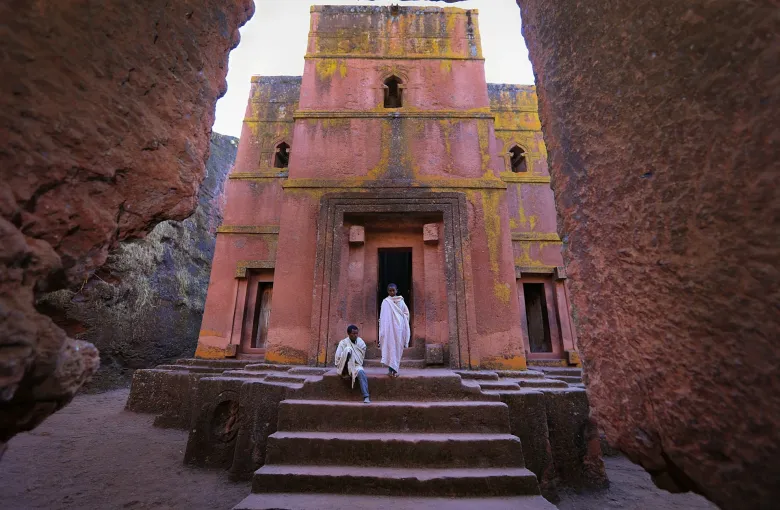
Lalibela is trenches, cut steps, tunnels, uneven rock and repeated removal of shoes. We would not present it as accessible to anyone with significant mobility limitations, and an operator who tells you otherwise is selling rather than advising.
Aksum involves uneven ground and tombs entered by descending narrow steps, though parts of the stelae field are on the level. The Simien is high-altitude mountain walking.
Vision, hearing and other access needs
- Vision. Uneven surfaces, unmarked edges and unlit interiors are the recurring hazards, and the absence of railings makes a sighted guide more necessary than it would be elsewhere.
- Hearing. Written confirmation of every arrangement is the single best adaptation, and it also protects against the calendar and clock confusion described in Ethiopia Culture and Etiquette.
- Neurodivergent travelers. Markets, festivals and city traffic are loud, crowded and unpredictable. Build in quiet days and choose accommodation away from main roads.
- Dietary needs. Ethiopia is unusually easy for vegetarian and vegan travelers because of the Orthodox fasting tradition. See Ethiopia Food Guide.
Questions to put to an operator, in writing
- Which specific sites on this itinerary have step-free access, and which do not?
- What vehicle will be used, and how do I get in and out of it?
- Where is the nearest facility capable of dealing with a medical problem, at each overnight stop?
- What happens if I cannot complete a day as planned? Is there a fallback that does not strand the rest of the group?
- Has your guide worked with a traveler with my specific requirements before?
- How are you handling the current fuel shortage on this route?
A good operator will answer these in detail and will tell you which parts they cannot do. Treat vague reassurance as a refusal.
And the regional picture
All of the above assumes a trip is going ahead at all. Both governments advise against all travel to several regions, including Tigray and Amhara, which covers most of the historic north. Read Ethiopia Travel Safety Guide first, because it determines which of these questions you will even need to ask.
Sources
- UK Foreign, Commonwealth & Development Office: Ethiopia safety and security: terrorism, kidnap, crime, road travel, local laws and the Ethiopian calendar. Accessed 14 September 2026.
- UK Foreign, Commonwealth & Development Office: Ethiopia health advice, including the end of the Marburg outbreak and the standard of healthcare. Accessed 14 September 2026.
- UK Foreign, Commonwealth & Development Office: Ethiopia travel advice: the areas it advises against traveling to, and the nationwide election. Accessed 14 September 2026.
- US Department of State: the Ethiopia travel advisory, currently Level 3, Reconsider Travel. Accessed 14 September 2026.
Other Articles

Ethiopia for Senior Travelers
Lalibela: Visitor and Heritage Guide