The quick answer
Ethiopian food is served on a single large round of injera, a soft sourdough flatbread, with the dishes spooned directly onto it. Everyone eats from the same plate, with the right hand, tearing pieces of injera to pick up the food. There is no cutlery and none is expected.
If you have eaten Ethiopian food abroad you already know the shape of it. What is harder to know in advance is how much the religious calendar changes what is on the plate on any given day.
Injera
Injera is fermented batter cooked on a wide clay griddle, which gives it its characteristic pitted surface and a distinct sour note. It is the plate, the utensil and the staple all at once. The platter in the photograph at the top of this page is the standard presentation: injera underneath, mounds of different dishes arranged around it, and more injera rolled up alongside for eating with.
The sourness surprises some first-time visitors. Give it three meals rather than one.
Wot, and the dishes you will meet
The stews are called wot. The best known is doro wot, a long-cooked chicken stew with berbere, the red spice blend that defines a great deal of Ethiopian cooking. Key wot is the red, berbere-based family generally; alicha is the milder, turmeric-yellow one without the chilli heat, which is the thing to ask for if berbere is too much.
Alongside those you will meet shiro, a smooth spiced chickpea or broad bean purée that is many people's favorite thing in the country; misir, red lentils; gomen, cooked greens; tibs, sautéed meat; and kitfo, minced raw beef with spiced butter, which is a delicacy and which you should think about in the light of the food safety section below.
Fasting, and why it is good news
The Ethiopian Orthodox tradition observes a large number of fasting days, on which observant people eat no animal products at all. Wednesdays and Fridays are fasting days through much of the year, and there are long fasting seasons besides.
The result is that Ethiopia has one of the most developed vegan cuisines anywhere, not as a modern accommodation but as a centuries-old norm. A fasting platter, ye tsom beyaynetu, brings a selection of lentil, pulse and vegetable dishes on injera, and it is genuinely one of the best things to eat in the country. That is what is pictured above.
For a vegetarian or vegan traveler this makes Ethiopia unusually easy. It also means that on a fasting day a restaurant may simply not serve meat, which is worth knowing before you plan a celebratory dinner on a Wednesday.
Eating from a shared plate, correctly
- Use your right hand only.
- Tear a piece of injera, use it to pinch up food, and do not let your fingers touch the food directly if you can avoid it.
- Eat from the section of the platter nearest you rather than reaching across.
- Wash your hands first. A basin is often brought to the table, and that is part of the meal rather than a formality.
- You may be offered gursha, a mouthful of food placed into your mouth by another person. It is a gesture of friendship and affection, and accepting it graciously matters more than managing it elegantly.
Coffee is a ceremony, not a drink
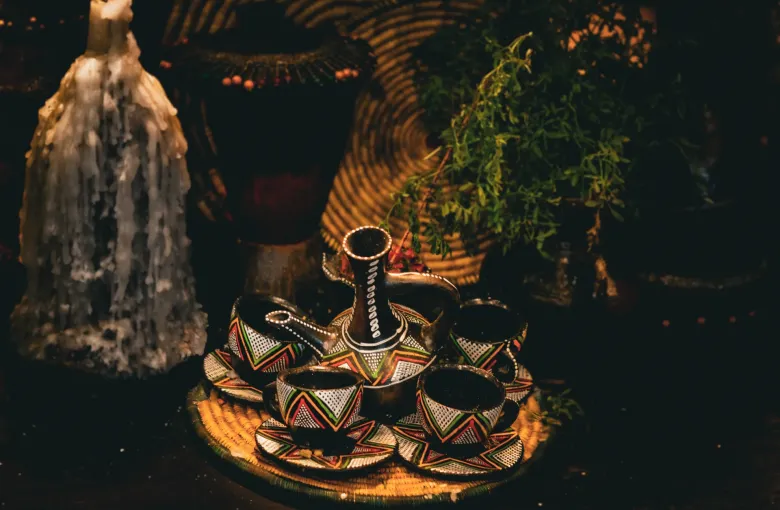
Coffee originates here, and the way it is served reflects that. Green beans are roasted in front of you, ground, and brewed in a clay jebena, then poured from height into small handleless cups. Grass is often strewn on the floor and incense burned. It is served in three rounds, and leaving before the third is a mild discourtesy.
Set aside real time for it. A coffee ceremony is not a coffee break, and being invited to one is an act of hospitality. Ethiopia Culture and Etiquette goes into how to take part well.
Food and water safety
This part is not optional in Ethiopia and the sources are unusually direct about it.
- Drink only boiled or bottled water, and avoid ice in drinks. The FCDO describes water-borne disease as common.
- Cholera is active. The CDC describes active cholera transmission as widespread in Ethiopia; the FCDO records an ongoing outbreak in the south and new cases in the northwest. Hand washing is the main protection, so carry sanitizer for when a basin is not available.
- The CDC recommends hepatitis A vaccination for unvaccinated travelers and typhoid vaccination for most travelers to Ethiopia, both of which are food and water borne.
- Raw meat dishes, kitfo among them, carry a risk that cooked food does not. Make that choice deliberately rather than at the table.
- Do not swim to cool off after lunch without asking. The FCDO says bilharzia is present in the vast majority of lakes in Ethiopia.
None of this is a reason to eat timidly. It is a reason to drink bottled water and wash your hands, which costs nothing and removes most of the risk.
Where this fits
Food is one of the strongest reasons to come to Ethiopia and one of the easiest things to enjoy wherever you are in the country. Note only that both governments advise against all travel to certain regions, including Tigray and Amhara, so some regional specialties sit in places you may not be able to reach on this trip. See Ethiopia Travel Safety Guide.
Sources
- UK Foreign, Commonwealth & Development Office: Ethiopia health advice, including the end of the Marburg outbreak and the standard of healthcare. Accessed 14 September 2026.
- UK Foreign, Commonwealth & Development Office: Ethiopia safety and security: terrorism, kidnap, crime, road travel, local laws and the Ethiopian calendar. Accessed 14 September 2026.
- US Centers for Disease Control and Prevention: Travelers’ Health, Ethiopia: vaccination guidance, malaria, cholera and rabies. Accessed 14 September 2026.
Other Articles
Ethiopia Culture and Etiquette Guide

Ethiopia Festivals and Celebrations