The quick answer
The United States places Ethiopia at Level 3, Reconsider Travel, and names a long list of regions within it at Do Not Travel. The United Kingdom issues no blanket warning against the country as a whole, but it advises against all travel to several regions outright.
On the regions that matter most to visitors, the two governments agree, and that agreement is the single most important thing on this page. Both of them say do not travel to Tigray region and to Amhara region.
Why that matters more in Ethiopia than almost anywhere
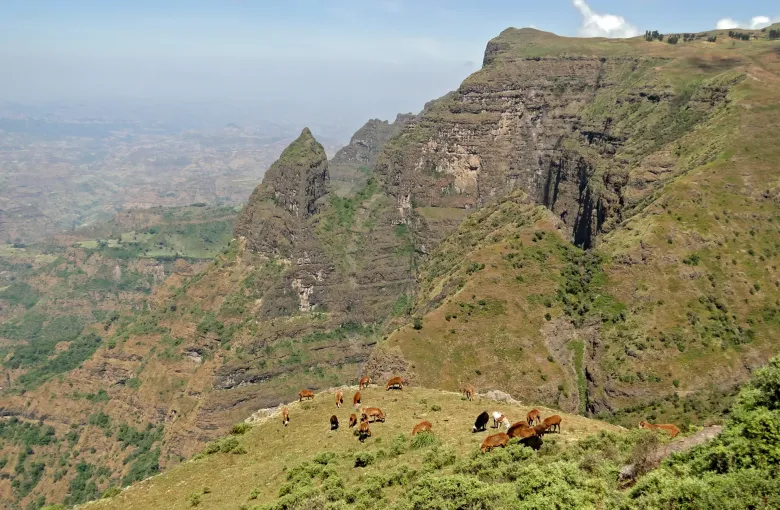
In most countries a regional warning covers a border strip or a remote province. In Ethiopia it covers the itinerary. Lalibela, Gondar, Bahir Dar, Lake Tana and the Simien Mountains are in Amhara. Aksum is in Tigray. The route usually sold as the historic north runs through both.
We have written full guides to those places anyway, because they are what people want to know about and because advisories change. Each one opens by saying exactly what this page says. What we will not do is describe an itinerary without telling you what your own government currently thinks of it.
What each government says, as of September 2026
The United States
The State Department advisory is Level 3, Reconsider Travel, citing unrest, crime, kidnapping, terrorism, landmines, communications disruptions and exit bans. Within that, it lists Do Not Travel areas including Tigray region, Amhara region, Gambella, Benishangul Gumuz, the Oromia region with the exception of Bishoftu and Bale Mountains National Park, specified parts of Afar, Somali, Central Ethiopia, South Ethiopia and Southwest Ethiopia, and the borders with Eritrea, Somalia, Sudan, South Sudan and Kenya.
The United Kingdom
The FCDO advises against all travel to Tigray region, to Amhara region and to Gambela region, each entire, and to a list of border strips: within 20km of Sudan, 10km of South Sudan, 10km of Eritrea, 10km of Kenya except principal roads and towns, and 100km of the Somalia and Kenya borders inside the Somali region. It advises against all but essential travel to further zones in Oromia, Somali and Benishangul-Gumuz.
Read both in full before you commit to anything. Your travel insurance is very likely written against one of them, which makes the difference practical rather than academic.
Kidnapping
The FCDO describes kidnapping as widespread in parts of Ethiopia, with incidents in the Oromia, Amhara and Somali regions and on the southern border with Kenya, and recent incidents in the Adama special zone south of Addis Ababa and in the western Wollega zones. The motivation it gives is extortion. It advises varying your movements, using secure locations for meetings and traveling only in daylight.
Terrorism
The FCDO states that terrorists are very likely to try to carry out attacks in Ethiopia, that attacks could target westerners, that they could occur at any time including at religious events and public holidays, and that they could be indiscriminate. The places it names are the ordinary ones: restaurants, hotels, bars, markets, supermarkets, shopping centers, stations and airports.
The political calendar
A nationwide general election is due on 1 June 2026. A public holiday has been declared, public buildings and banks will be closed, and there will be heavy security around polling stations with vehicle and identity checks. Allow extra time, carry identification, and stay away from gatherings and demonstrations.
The risks that do not make headlines
- The road. The FCDO describes driving standards and vehicle maintenance as often poor and accidents as frequent, particularly in Addis Ababa and on the Addis Ababa to Djibouti road. A driver involved in an accident can face a custodial sentence. See Getting Around Ethiopia.
- Fuel. Fuel availability is currently limited nationwide, with queues and shortages reported, which disrupts travel outside Addis Ababa in particular.
- Railings and life jackets. The FCDO puts this plainly: health and safety precautions such as life jackets in boats and protective railings at historical sites are rarely in place in Ethiopia. Behave accordingly at edges and on water.
- Healthcare. Only private hospitals in Addis Ababa offer a reasonable standard of basic care. Outside the capital, the FCDO describes medical facilities as extremely poor. Carry a comprehensive medical pack when you leave the city.
- Disease, which is a safety question here. The CDC describes active cholera transmission as widespread in Ethiopia, and records that rabid dogs are commonly found and that rabies vaccines are typically not readily available in the country if an exposure occurs. Both are worth raising at a travel clinic well before departure. See Ethiopia Weather Guide, which sets out how the health risks follow the seasons and the altitude.
The law
Same-sex acts are illegal in Ethiopia for both sexes and carry penalties of between 1 and 15 years in prison. The FCDO records that local authorities intimidate and detain owners and clients of establishments in Addis Ababa where same-sex activity is alleged to take place, that the public are not generally accepting, and that some religious leaders have called for violence against the LGBT+ community. It describes being openly or covertly LGBT+ in Ethiopia as dangerous and a source of great personal risk.
We state this plainly because a travel guide that leaves it out is not a travel guide. Further local law, including photography restrictions and the rules on drones, satellite phones and binoculars, is covered in Ethiopia Culture and Etiquette and Ethiopia Visa and Entry Requirements.
Practical precautions
- Carry comprehensive travel insurance and confirm in writing how it treats a Level 3 advisory and an advised-against region. This is the most consequential item on the page.
- Confirm medical evacuation cover before you fly.
- Use transport arranged by your hotel or operator, especially from the airport.
- Carry a copy of your passport photo page, visa and entry stamp. The original is not required.
- Avoid demonstrations and large gatherings entirely, particularly around 1 June.
- Register with your own government's traveler service before departure.
How to read this page
Ethiopia is one of the oldest continuously inhabited places on earth and holds twelve World Heritage properties. It is also a country where both of the governments we quote tell you to stay out of the two regions that hold most of them. Both sentences are true at once. We would rather give you the advisories, the law and the health picture and let you decide with the same information we have.
Sources
- US Department of State: the Ethiopia travel advisory, currently Level 3, Reconsider Travel. Accessed 14 September 2026.
- UK Foreign, Commonwealth & Development Office: Ethiopia travel advice: the areas it advises against traveling to, and the nationwide election. Accessed 14 September 2026.
- UK Foreign, Commonwealth & Development Office: Ethiopia safety and security: terrorism, kidnap, crime, road travel, local laws and the Ethiopian calendar. Accessed 14 September 2026.
- UK Foreign, Commonwealth & Development Office: Ethiopia regional risks, region by region. Accessed 14 September 2026.
- UK Foreign, Commonwealth & Development Office: Ethiopia health advice, including the end of the Marburg outbreak and the standard of healthcare. Accessed 14 September 2026.
- US Centers for Disease Control and Prevention: Travelers’ Health, Ethiopia: vaccination guidance, malaria, cholera and rabies. Accessed 14 September 2026.
Other Articles
Getting Around Ethiopia
Ethiopia Visa and Entry Requirements