⚠ Read this before anything else
Aksum is in Tigray region, which is how UNESCO's own record locates it. As of 14 September 2026, the UK Foreign, Commonwealth and Development Office advises against all travel to Tigray region, entire. The US State Department places Ethiopia at Level 3, Reconsider Travel, and lists Tigray region and the border with Eritrea among the areas it tells Americans do not travel to.
Tigray was the center of the conflict fought between November 2020 and November 2022, and the FCDO records that tensions have remained high since, with occasional clashes, and that the security situation in northern Ethiopia may deteriorate quickly. Read Ethiopia Travel Safety Guide and both government sources directly before planning anything at all.
What Aksum was
Situated in the highlands of northern Ethiopia, Aksum symbolizes, in UNESCO's words, the wealth and importance of the civilization of the ancient Aksumite kingdom, which lasted from the first to the eighth centuries AD. The kingdom sat at the crossroads of three continents: Africa, Arabia and the Greco-Roman world.
This was one of the great powers of the ancient world and it is routinely left out of the story most people are taught. Aksum minted its own coinage, traded across the Red Sea and the Indian Ocean, and adopted Christianity in the fourth century, which makes the Ethiopian church one of the oldest anywhere.
What survives
The massive ruins date from between the first and the thirteenth centuries AD and include monolithic obelisks, giant stelae, royal tombs and the ruins of ancient castles.
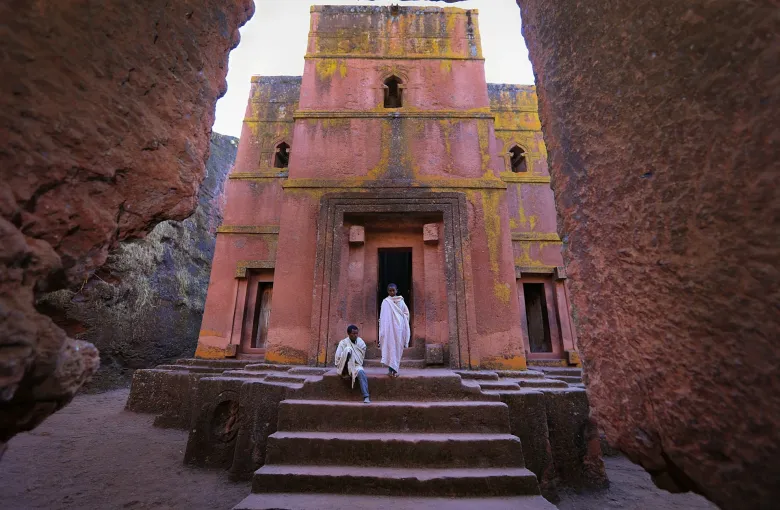
The stelae are the reason most people come. They are single pieces of carved granite, the largest of them among the biggest single blocks of stone ever quarried and raised anywhere, and they are carved to represent multi-story buildings: story lines, rows of beam ends, and at the base a false door complete with a lock, as in the photograph at the top of this page. They mark royal graves.
UNESCO notes that long after Aksum's political decline in the tenth century, Ethiopian emperors continued to be crowned there. The site's significance to Ethiopian Christianity did not end with the kingdom, and has not ended now.
What UNESCO recognized
Aksum was inscribed on the World Heritage List in 1980 under cultural criteria (i) and (iv). UNESCO's record places it in the Tigrai Region.
A working religious center
Aksum is a living town and an important place of pilgrimage, not an archaeological park. Church precincts have their own rules about who may enter where, and those rules are not negotiable and are not aimed at visitors in particular. Follow Ethiopia Culture and Etiquette: dress conservatively, take your shoes off where others do, and ask before photographing anything or anyone.
Practical notes, for whenever the advice changes
- Altitude and sun. Northern highland conditions: strong sun, cold nights, very little shade among the stelae fields.
- Footing. Uneven ground, excavated tombs and steps cut in stone. The FCDO notes protective railings are rarely in place at historical sites in Ethiopia.
- Underground. Several of the tombs are entered by descending; they are dark and confined. A light is worth carrying.
- Context. Aksum rewards a guide more than most sites, because much of what matters is the reading of the carvings and the layout rather than the visible fabric.
Where this leaves you
Of the three heritage guides in this cluster, Aksum is the one where the gap between what the place is and what the current advice says is widest. It is a first-millennium world capital, and it is in the region both governments restrict most tightly. Both of those things are true, and we would rather say so than quietly drop one.
Sources
- UNESCO World Heritage Centre: the inscription of Aksum. Accessed 14 September 2026.
- UNESCO World Heritage Centre: Ethiopia’s State Party record and its twelve inscribed properties. Accessed 14 September 2026.
- UK Foreign, Commonwealth & Development Office: Ethiopia travel advice: the areas it advises against traveling to, and the nationwide election. Accessed 14 September 2026.
- UK Foreign, Commonwealth & Development Office: Ethiopia regional risks, region by region. Accessed 14 September 2026.
- US Department of State: the Ethiopia travel advisory, currently Level 3, Reconsider Travel. Accessed 14 September 2026.
Other Articles
Ethiopia Travel Safety Guide
Ethiopia Culture and Etiquette Guide