⚠ Read this before anything else
The Simien massif is in Amhara region. As of 14 September 2026, the UK Foreign, Commonwealth and Development Office advises against all travel to Amhara region, entire. The US State Department places Ethiopia at Level 3, Reconsider Travel, and names Amhara region among the areas it tells Americans do not travel to.
Read both sources directly, and read Ethiopia Travel Safety Guide, which sets out the regional picture and what it means for insurance.
A note on the name
UNESCO inscribed it as Simien National Park. It is very widely called the Simien Mountains National Park, including by us, and both refer to the same place. If you are searching UNESCO's own records, use the shorter name.
What it is
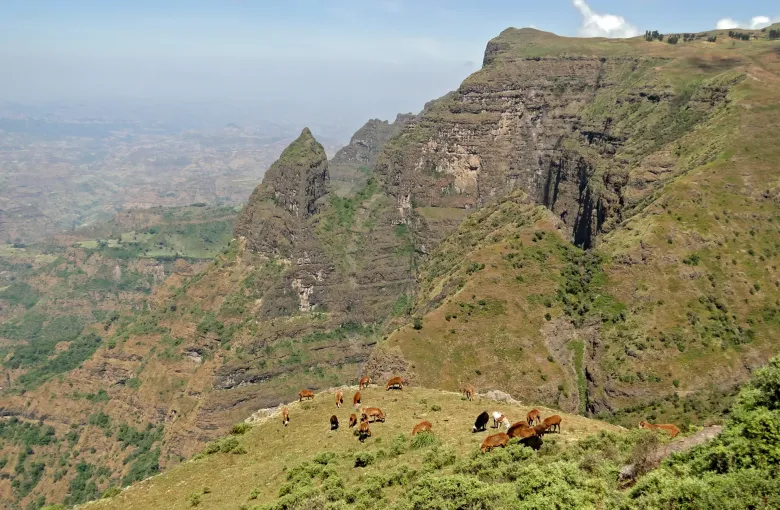
UNESCO's description is short and does the work: massive erosion over the years on the Ethiopian plateau has created one of the most spectacular landscapes in the world, with jagged mountain peaks, deep valleys and sharp precipices dropping some 1,500 m.
That is the escarpment in the photograph at the top of this page. What makes the Simien unusual among great mountain landscapes is that it is inhabited and farmed right up to the edge of it. The livestock in the picture are not incidental; people have lived and grazed here for a very long time, and that is part of why the park's conservation history has been complicated.
What lives there
UNESCO names three animals in particular: the gelada baboon, the Simien fox and the Walia ibex, which it describes as a goat found nowhere else in the world.
The Walia ibex is the reason the park exists. The gelada is the animal most visitors actually spend time with, because they graze in large troops on the grassland at the top of the escarpment and are tolerant of people at a respectful distance. The giant lobelias that stand above that grassland, tall rosettes on bare stems, are the other thing everyone photographs.
What UNESCO recognized, and the Danger list
Simien National Park was inscribed on the World Heritage List in 1978 under natural criteria (vii) and (x), making it one of the first natural properties inscribed anywhere.
It was placed on the List of World Heritage in Danger in 1996. It came off that list on 4 July 2017, when UNESCO announced that the Ethiopian World Heritage site was no longer in danger.
Twenty-one years on the Danger list and then a removal is a conservation success story, and those are rare enough to be worth stating plainly. It is also the fact most likely to be wrong in older guidebooks, which is why we checked it against UNESCO's own announcement rather than repeating it.
Practical notes, for whenever the advice changes
- Altitude is the main physical constraint. This is high country and the walking is at altitude from the start. The FCDO lists altitude sickness as a risk in parts of Ethiopia including Addis Ababa, which is lower than much of the park.
- Cold. Near-freezing before dawn is normal on the plateau. A real insulating layer, not a fleece. See Ethiopia Packing List.
- Edges. The escarpment is sheer and, as the FCDO notes of Ethiopian sites generally, protective railings are rarely in place. Treat every viewpoint accordingly.
- Sun. At this height it burns fast on a cold, breezy day, which is exactly when people forget it.
- Malaria. The high park is above the transmission altitudes both authorities give, but the roads in and out are not. Take the advice for your whole itinerary rather than your highest point. See Ethiopia Weather Guide.
- Getting there. Access is through Amhara, and the FCDO records armed attacks on vehicles on the A3 road, usually in the early hours. This is not a detail.
Where this leaves you
The Simien is one of the great mountain landscapes and, uniquely among the three sites in this cluster, it carries a documented record of successful conservation. It is also in a region under a do not travel warning from both governments. We have written the guide so that it is ready when that changes, and so that you are not the last person to hear that it has not changed yet.
Sources
- UNESCO World Heritage Centre: the World Heritage List export, which carries Simien National Park’s inscription year, criteria and description. Accessed 14 September 2026.
- UNESCO World Heritage Centre: the announcement that Simien National Park is no longer in danger, 4 July 2017. Accessed 14 September 2026.
- UNESCO World Heritage Centre: Ethiopia’s State Party record and its twelve inscribed properties. Accessed 14 September 2026.
- UK Foreign, Commonwealth & Development Office: Ethiopia travel advice: the areas it advises against traveling to, and the nationwide election. Accessed 14 September 2026.
- UK Foreign, Commonwealth & Development Office: Ethiopia regional risks, region by region. Accessed 14 September 2026.
- US Department of State: the Ethiopia travel advisory, currently Level 3, Reconsider Travel. Accessed 14 September 2026.
Other Articles
Ethiopia Travel Safety Guide
Ethiopia Packing List