The quick answer
Ethiopia is a rewarding destination for an older traveler who plans it properly, and a demanding one for anyone who treats it as an ordinary trip. Three things deserve more weight than they would elsewhere: altitude, the standard of healthcare outside Addis Ababa, and pacing.
Altitude starts at the airport
Addis Ababa stands at 2,400 m, and the FCDO lists altitude sickness as a risk in parts of Ethiopia including the capital. You do not travel up to altitude here. You land at it.
That is a conversation with your doctor before you book, particularly for anyone with a cardiac or respiratory condition or on blood pressure medication. It is also an argument for making your first day genuinely empty. Sleep, drink water, walk gently, and let the itinerary begin on day two.
Healthcare, stated plainly
The FCDO's assessment is that only private hospitals in Addis Ababa offer a reasonable standard of basic care for minor problems, that ambulance services are limited, that dentistry is especially scarce, and that outside the capital medical facilities are extremely poor. It advises carrying a comprehensive medical pack whenever you leave the city.
For an older traveler the consequences are concrete:
- Get medical evacuation cover and read what it says about a Level 3 advisory and about regions your government advises against. Do this before paying a deposit.
- Carry medication in original labeled packaging, in more than one bag, with a copy of the prescription, and bring more than the trip requires.
- Carry a written summary of your conditions, medications and allergies, and give a copy to whoever you are traveling with.
- The CDC notes that rabies vaccines are typically not readily available in Ethiopia if an exposure occurs. Raise pre-exposure vaccination at your travel clinic.
Pacing an itinerary
The common mistake is an itinerary built on distances rather than on days. Ethiopia is large, road travel is slow and currently complicated by a nationwide fuel shortage, and internal flights involve early starts.
- Fewer places, more nights in each. Three bases beat six.
- Prefer internal flights to long road transfers where the option exists.
- Build a rest day after any travel day, not just after arrival.
- Plan the demanding thing for the morning. Afternoons at altitude are harder than they look.
- Accept that some sites will be a view rather than a climb, and choose accordingly rather than discovering it on the day.
The slower pleasures, which are the real ones
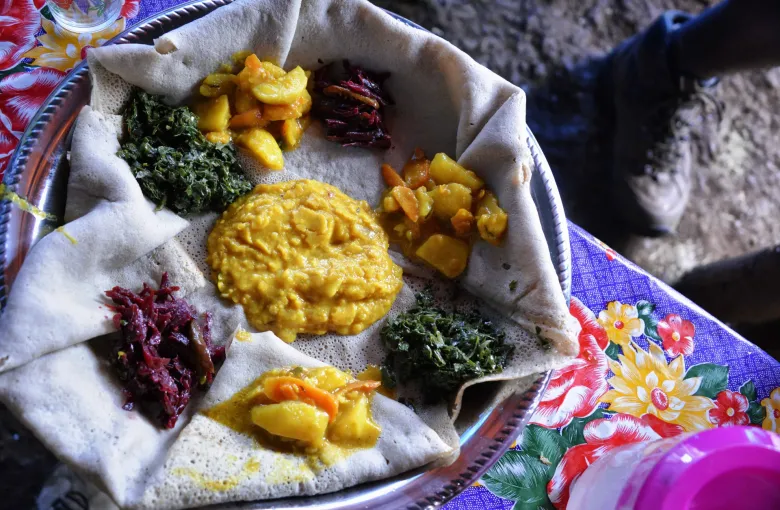
The coffee ceremony takes an hour and is meant to. A shared platter of injera is a long meal. A boat on a lake, like the one in the photograph at the top of this page, is a morning rather than an activity. An Orthodox service is something to sit at the edge of and let happen.
Ethiopia is unusually generous to a traveler who is not in a hurry, and much of what makes it remarkable is available sitting down. That is not a consolation prize for an older visitor; it is what the country is actually like.
On water, and a caution
If a boat trip is part of your plan, note two things the FCDO records. Life jackets in boats are rarely in place in Ethiopia, so ask before boarding and be willing to decline. And bilharzia is present in the vast majority of Ethiopian lakes, so do not swim without local advice.
Food and diet
Ethiopia is one of the easiest countries anywhere for a vegetarian or vegan traveler, because of the Orthodox fasting tradition rather than as a modern accommodation. Food is shared from one plate and eaten with the hands, which is worth knowing in advance if dexterity is a concern; a fork can be asked for and nobody will be offended. Water discipline matters: boiled or bottled only, and no ice. See Ethiopia Food Guide.
Practical comfort
- Highland nights are cold and rooms are generally unheated. Pack a real insulating layer. See Ethiopia Packing List.
- Sun at altitude burns faster than it feels. Hat, sunscreen, sunglasses.
- Uneven ground and missing railings are the norm at historic sites. A walking pole is more useful here than it would be in Europe.
- Carry cash. Ethiopia is a cash-based society and ATMs are unreliable outside cities. See Ethiopia Currency and Money Guide.
Where to go, given the advisories
Much of the historic north sits in Amhara and Tigray, and both the US and UK governments currently advise against all travel to those regions. For a trip planned now that points toward Addis Ababa and what can be reached from it, with the north kept in mind for later. Read Ethiopia Travel Safety Guide and take the insurance question seriously; at this stage of life the cost of an uncovered medical episode abroad is the risk that matters most.
Sources
- UK Foreign, Commonwealth & Development Office: Ethiopia health advice, including the end of the Marburg outbreak and the standard of healthcare. Accessed 14 September 2026.
- UK Foreign, Commonwealth & Development Office: Ethiopia safety and security: terrorism, kidnap, crime, road travel, local laws and the Ethiopian calendar. Accessed 14 September 2026.
- US Centers for Disease Control and Prevention: Travelers’ Health, Ethiopia: vaccination guidance, malaria, cholera and rabies. Accessed 14 September 2026.
- US Department of State: the Ethiopia travel advisory, currently Level 3, Reconsider Travel. Accessed 14 September 2026.
Other Articles
Accessible Travel in Ethiopia
Getting Around Ethiopia