What it is
Nyungwe is one of the oldest rainforests in Africa and the largest tract of forest in Rwanda, covering steep Afromontane ridges in the southwest. UNESCO inscribed it on the World Heritage List in 2023, as a natural property, for its biodiversity.
It is one of only two World Heritage properties in Rwanda, and the country has no sites at all on its Tentative List, which is unusual. Nyungwe and the memorial sites are, for now, the whole of Rwanda’s World Heritage.
What lives there
UNESCO’s inscription describes intact forest, peat bogs, moors, thickets and grasslands, and singles out species found nowhere else: the globally threatened Eastern Chimpanzee, the Golden Monkey, and the Critically Endangered Hills Horseshoe Bat. It records twelve mammal and seven bird species that are globally threatened, and states that with 317 species of birds recorded, Nyungwe is one of the most important sites for bird conservation in Africa. Under criterion (x) it records 1,468 species of vascular plants, including 73 globally threatened.
African Parks, which manages the park, publishes different figures: over 1,100 plant species, 345 bird species, 85 known mammals and 13 primates. Both are given here because both are published by authorities with a claim to know, and choosing one to print would be tidier and less true. The direction of travel is the same either way: this is one of the richest forests in Africa.
African Parks also records that the number of endemic species in Nyungwe is greater than in any other forest in the Albertine Rift.
Who runs it
African Parks signed a twenty year management agreement with the Rwanda Development Board in October 2020, following its earlier partnership at Akagera. The park now sits within a wider conservation financing arrangement with the World Bank covering Nyungwe and Gishwati Mukura.
Over 1,600 local people are engaged through community cooperatives, benefiting several thousand household members, and the eco ranger team includes community members who previously took from the forest illegally.
The road, which the inscription itself raises
This is the part of Nyungwe that almost nothing written for visitors mentions, and it is in UNESCO’s own text.
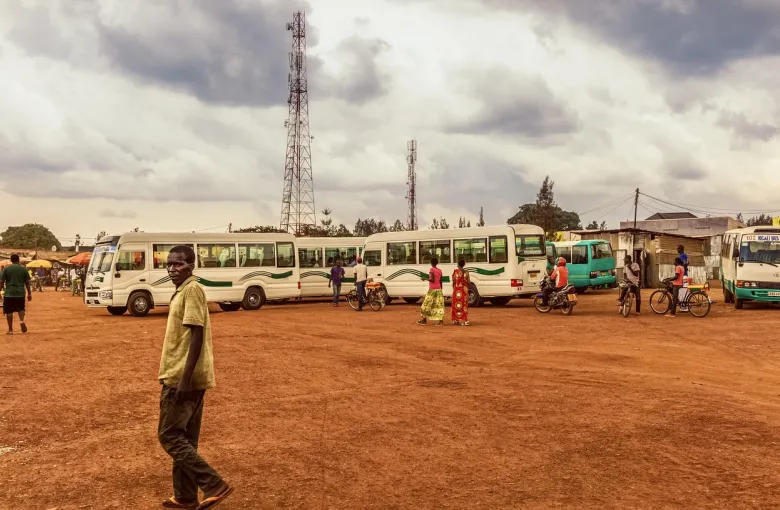
An international road crosses the property. UNESCO describes it as completely illuminated and used by heavy truck and bus traffic, leading to disturbances, wildlife mortality and pollution. An upgraded alternative road to the north of the park is expected to reduce traffic through the property by around sixty per cent.
There is a second reason to know about that road. The FCDO records that on 18 June 2023, two people were killed and six injured when suspected militants opened fire on a public passenger bus on the Nyamagabe to Rusizi road, in Nyungwe Forest. Our safety guide sets out what both the UK and US governments currently advise for the southwest, and they do not say the same thing.
Neither fact is a reason not to come. Both are reasons to travel with an operator who is reading the advisories.
What a visit involves
Chimpanzee trekking is the headline activity and it is demanding: an early start, steep ground and no guarantee, because chimpanzees move fast and far. Golden monkey and colobus tracking is gentler. The park has a network of forest trails of varying difficulty, a celebrated canopy walkway suspended above a ravine, and one of Africa’s longest ziplines.
Birders should give it several days. The Albertine Rift endemics here are the reason serious bird travelers come to Rwanda at all.
Practical notes
- It rains. This is a rainforest and the dry season only changes the odds. Bring proper waterproofs and boots with grip.
- Permits and park fees are arranged in advance through the Rwanda Development Board, and no figures appear on this page because they change.
- Stay near the park. Treks start early and the drive from Kigali is a half day.
- Altitude and steepness make this harder walking than the distances suggest.
- Caves. Standing FCDO advice after Rwanda’s Marburg outbreak, declared over in December 2024, is to wear gloves, protective clothing and a mask in caves inhabited by fruit bat colonies.
Planning with LABUSA Travel
We build Nyungwe as more than a single trek, because a forest with this bird list and these trails rewards the extra day, and we route around the advisory areas.
Sources
- UNESCO World Heritage Centre: the inscription of Nyungwe National Park, and its account of the park’s species, buffer zone and the road that crosses it. Accessed 13 September 2026.
- African Parks: Nyungwe National Park, which it manages under a twenty year agreement with the Rwanda Development Board. Accessed 13 September 2026.
- UNESCO World Heritage Centre: Rwanda’s State Party record: two inscribed properties and a Tentative List of none. Accessed 13 September 2026.
- UK Foreign, Commonwealth & Development Office: Rwanda travel advice: regional risks, local laws, health and entry requirements. Accessed 13 September 2026.
Other Articles
Volcanoes National Park: Visitor and Heritage Guide
Rwanda Packing List