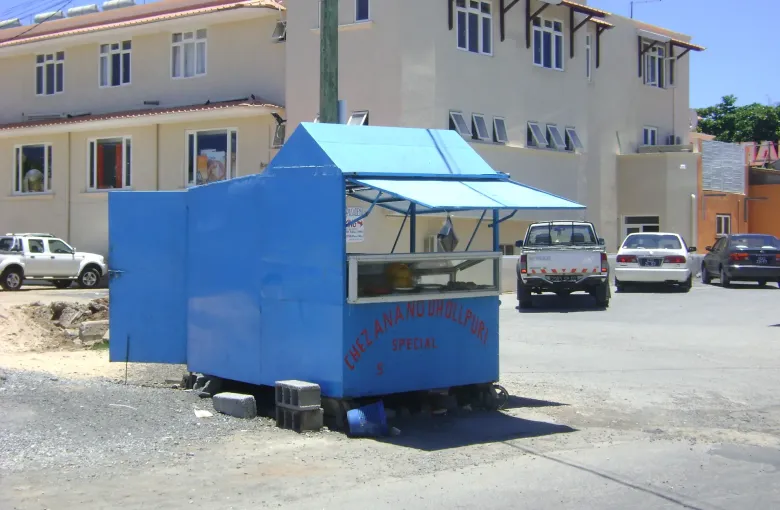
Who lives here, and why
Mauritius had no indigenous human population. Everybody on the island descends from someone who arrived, and the two World Heritage properties record the two largest arrivals: the enslaved people whose resistance is inscribed at Le Morne, and the indentured laborers whose depot is inscribed at Aapravasi Ghat.
That is not background. It is the organizing fact of Mauritian social life, and it is why the calendar carries Hindu, Muslim, Christian and Chinese observances as public holidays.
Language
- Mauritian Creole is what almost everyone speaks to almost everyone. It is a language in its own right, French-lexified, and it is the true lingua franca.
- French dominates media and much of business.
- English is the language of government and law, and is widely understood.
- Bhojpuri, brought by indentured laborers from northern India, survives in song and in older speech. Its folk songs, Geet-Gawai, are UNESCO inscribed.
You can travel comfortably in English. A greeting in Creole, "ki manière", is disproportionately well received.
The four inscribed traditions
Mauritius has four elements on UNESCO's intangible heritage lists, and three of the four are sega.
- Traditional Mauritian Sega. The music and dance that descends directly from the enslaved population: the ravanne drum, the triangle, and a step danced without lifting the feet.
- Sega tambour of Rodrigues Island. The distinct Rodriguan form.
- Sega tambour Chagos. Inscribed on the Urgent Safeguarding List, and carried by the Chagossian community, who were removed from the Chagos Archipelago and many of whom live in Mauritius. It is a tradition maintained in displacement, and that is the whole point of the inscription.
- Bhojpuri folk songs in Mauritius, Geet-Gawai, sung at weddings by women of the Bhojpuri-speaking community.
A hotel sega show is a real form performed commercially. A village sega is a different thing. Both exist; do not mistake the first for the whole.
Visiting places of worship
Temples, mosques, churches and pagodas are often within a few streets of each other, and visitors are generally welcome at the appropriate times.
- Cover shoulders and knees. Carry something to put on over beachwear.
- Remove shoes where indicated, and often hats.
- Ask before photographing anyone, and do not photograph worship in progress without permission.
- At Ganga Talao, the sacred crater lake, behave as you would at a temple: it is a pilgrimage site, not a viewpoint.
Everyday manners
- Greet before you transact, in a shop or an office.
- Dress modestly away from the beach. Beachwear in a town reads as discourtesy rather than as informality.
- Bargaining is expected in markets and not in shops, and it should stay good-humored.
- Alcohol is widely available and public drunkenness is not well regarded.
Two things worth being careful about
The Chagos Archipelago is a live political and legal question and the Chagossian community in Mauritius has a direct stake in it. The honest position for a visitor is to know that Sega tambour Chagos is inscribed as the tradition of a displaced community, and to listen rather than to hold forth.
Same-sex sexual activity was decriminalized in October 2023. The FCDO also describes Mauritius as a relatively conservative society with varying local attitudes. Both facts are true at once.
Sources
- UNESCO Intangible Cultural Heritage: Mauritius’s four inscribed elements: Traditional Mauritian Sega, Sega tambour of Rodrigues Island, Bhojpuri folk songs known as Geet-Gawai, and Sega tambour Chagos. Accessed 14 September 2026.
- UNESCO World Heritage Centre: the inscription of Aapravasi Ghat, the immigration depot from which the modern indentured labor diaspora emerged. Accessed 14 September 2026.
- UNESCO World Heritage Centre: the inscription of Le Morne Cultural Landscape and its statement of Outstanding Universal Value on maroonage. Accessed 14 September 2026.
- UK Foreign, Commonwealth & Development Office: Mauritius safety and security: crime, the accommodation-registration advice, drug law, police investigations and the decriminalization of same-sex sexual activity in October 2023. Accessed 14 September 2026.
Other Articles
Mauritius Festivals and Celebrations
Aapravasi Ghat: Visitor and Heritage Guide