The honest starting point
Malawi is a difficult destination for travelers with reduced mobility, and we are not going to dress that up. Step-free access is uncommon, pavements where they exist are often uneven or obstructed, and adapted vehicles are rare outside a small number of specialist operators.
That does not mean a trip is impossible. It means the itinerary needs to be shorter and more lake-centered than an able-bodied one, the operator has to be asked direct questions, and the healthcare question has to be settled before anything else.
Healthcare, which shapes everything
The FCDO's assessment is that general medical facilities throughout Malawi are unable to provide the standard of healthcare available in the UK, that facilities in rural areas are basic, that emergency services are limited, and that you should carry basic medical supplies.
And the detail that matters most for planning: many medical facilities expect up-front payment. The FCDO advises making sure you have adequate travel health insurance and accessible funds to cover treatment, medical evacuation and repatriation.
For anyone with a condition that may need attention, that means:
- Confirm medical evacuation cover in writing before you book anything.
- Know how you would pay on the day, in the country, and make sure a companion knows too.
- Carry more medication than the trip needs, in original labeled packaging, split across bags, with a copy of the prescription.
- Assume that spares and repairs for equipment are unavailable outside Lilongwe and Blantyre.
Getting around
A vehicle with a driver, arranged in advance, is the realistic option for the whole trip. Domestic flights between the main centers remove long road transfers and are worth the cost; road journeys take longer than the distances suggest, and the FCDO records frequent fuel shortages with long queues.
Malawi is at least compact. The distances between the things worth seeing are short by regional standards, which helps a great deal when each transfer is tiring.
The sites, assessed honestly
Manageable with planning
The lakeshore is the strongest option in the country. Lodges are often single-story, the ground is flat, and a great deal of what makes Lake Malawi worth visiting can be enjoyed from a chair, a veranda or a boat. Ask specifically about the path from room to water and about how you would get into a boat.
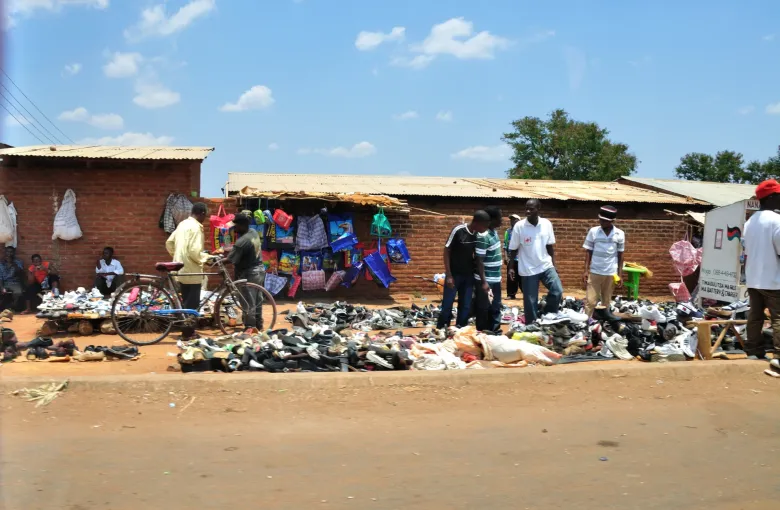
Towns and markets, including the covered market in the photograph at the top of this page, are level but crowded and uneven underfoot. Go early, go with someone, and pick a quieter day.
Tea estates around Mulanje and Thyolo generally have vehicle access and level areas around the buildings, and give you the view of the massif without going onto it.
Genuinely difficult
Chongoni Rock Art requires walking over rough ground and up granite hillsides to reach scattered, unmarked sites. We would not present it as accessible, and an operator who does is selling rather than advising.
Mount Mulanje's massif is multi-day mountain walking. The estates at its foot are a different matter and are covered above.
Lake Malawi National Park is mixed: the shore is approachable, the hill walking behind it is not.
Other access needs
- Vision. Uneven surfaces and unlit paths are the recurring hazards, and few sites have handrails or marked edges. A sighted guide is more necessary here than in most destinations.
- Hearing. Get every arrangement in writing. It is also the best protection against a schedule changing because a road closed.
- Neurodivergent travelers. Markets and bus stations are loud and crowded; the lake is the opposite. Build the itinerary around that contrast deliberately.
- Dietary needs. Straightforward for vegetarians. Nsima with beans and greens is an everyday meal. See Malawi Food Guide.
Health considerations that intersect with disability
- Malaria covers the whole country, and prophylaxis interacts with other medication. Raise it with your own doctor rather than a travel clinic alone if you take anything regularly.
- Bilharzia is in the lake, and anyone who will be in the water, including for therapeutic reasons, needs the advice in Lake Malawi National Park first.
- Heat. The lakeshore and the Shire Valley are hot and humid, which matters for anyone whose condition is heat-sensitive. The highlands are much cooler.
Questions to put to an operator, in writing
- Which specific places on this itinerary have step-free access, and which do not?
- What vehicle will be used, and how exactly do I get in and out of it?
- At each overnight stop, where is the nearest facility that could deal with a medical problem, and does it expect payment up front?
- What is the fallback if I cannot complete a day as planned?
- Has your guide worked with a traveler with my requirements before?
- How are you handling the current fuel situation on this route?
Vague reassurance is a refusal. A good operator will tell you plainly which parts they cannot do.
Sources
- UK Foreign, Commonwealth & Development Office: Malawi health advice, including cholera and the standard of healthcare. Accessed 14 September 2026.
- UK Foreign, Commonwealth & Development Office: Malawi safety and security: crime, kidnap, road travel, fuel, local laws and the rainy season. Accessed 14 September 2026.
- US Centers for Disease Control and Prevention: Travelers’ Health, Malawi: malaria, schistosomiasis, cholera, rabies and routine vaccination. Accessed 14 September 2026.
- US Department of State: the Malawi travel advisory, currently Level 2, Exercise Increased Caution. Accessed 14 September 2026.
Other Articles
Malawi for Senior Travelers
Lake Malawi National Park: Visitor and Heritage Guide