What you can plan around
Madagascar's calendar is less festival-driven than some destinations, and the honest advice is to plan your trip around weather and roads rather than around dates. That said, several occasions are worth knowing about, and one is worth actively seeking out.
Independence Day, 26 June
The national day, marking independence in 1960. Expect parades, music, street food and, in the evening, paper lanterns. It is the largest public celebration of the year and it fills Antananarivo.
Two practical notes. Accommodation in the capital is tight around it, so book early. And the FCDO's standing advice about avoiding large gatherings and demonstrations still applies: a national holiday crowd is not a protest, but crowds are crowds, and the political situation since the 2025 protests and the transitional government formed on 17 October 2025 makes that advice worth taking seriously. See Madagascar Travel Safety Guide.
Alahamady Be, the Malagasy new year
The traditional new year of the highland calendar, observed in March. It has had a growing public profile in recent years, with gatherings, music and ceremonies in Antananarivo and elsewhere. Dates move, so confirm locally rather than assuming.
Hiragasy, which is the one to look for
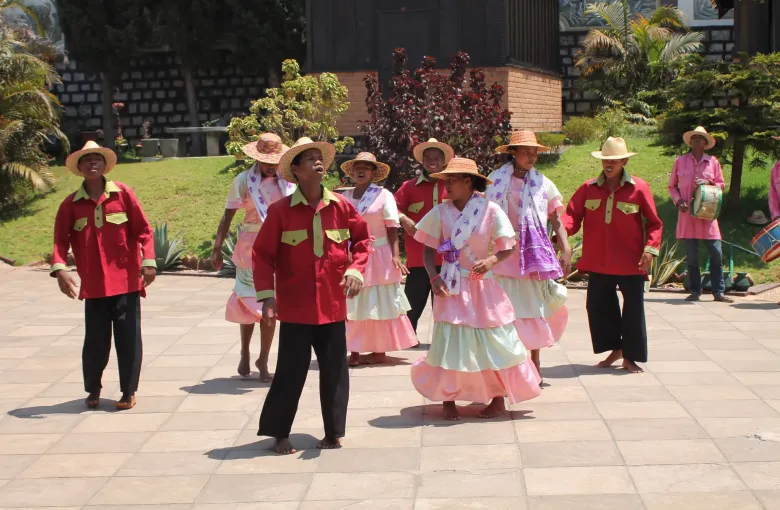
Hiragasy is a performing art of the central highlands, inscribed by UNESCO on the Representative List of the Intangible Cultural Heritage of Humanity. Troupes perform in the open, combining formal speech, music and dance, often competitively and usually for several hours, in bright costume.
It is not a festival with a fixed date. It is a living form that happens at weekends, at public occasions and at family events around Antananarivo and the highlands. Ask your accommodation or a local guide whether anything is on while you are there. It is the single most rewarding cultural thing a visitor can stumble into in Madagascar, and it is easy to miss entirely by not asking.
⚠ Famadihana is not an attraction
Famadihana, the turning of the bones, is a highland family rite in which ancestors are exhumed, rewrapped in fresh shrouds and honored with music and dancing before being returned. It is usually held between roughly June and September.
It is a family occasion, arranged and paid for by a family, for its own dead. Visitors do sometimes attend, and they attend because they were invited by the family, generally through a long-standing local relationship. Buying a place at one through an operator turns a funeral rite into a ticketed event, and we will not point anyone at that.
If you are invited: dress well, bring a contribution, follow the family's lead exactly, ask before photographing anything, and accept a refusal without negotiation. See Madagascar Culture and Etiquette Guide.
Natural events worth timing for
- Humpback whales, roughly July to September off the east coast, around Île Sainte-Marie and the Baie d'Antongil. A genuine seasonal spectacle and a real reason to choose those months.
- Jacaranda in Antananarivo, usually October, when the city's avenues turn purple.
- Lemur activity through the warmer months, when many species are with young.
Religious observances
Christianity is widely practiced, often alongside ancestral observance rather than instead of it, and Christmas and Easter are marked. Expect reduced services and closures on major holidays, and confirm opening times for sites and parks rather than assuming.
For which months suit the rest of the trip, see Best Time to Visit Madagascar.
Sources
- UNESCO Intangible Cultural Heritage: Madagascar’s four inscribed elements: Tsapiky, Hiragasy, Malagasy Kabary and the woodcrafting knowledge of the Zafimaniry. Accessed 14 September 2026.
- UK Foreign, Commonwealth & Development Office: Madagascar travel advice, including the political situation and the 17 October 2025 transitional government. Accessed 14 September 2026.
- UK Foreign, Commonwealth & Development Office: Madagascar safety and security: crime, beaches, vehicle crime, the advice against taxi-brousses and the false-police warning. Accessed 14 September 2026.
Other Articles
Madagascar Culture and Etiquette Guide
Royal Hill of Ambohimanga: Visitor and Heritage Guide