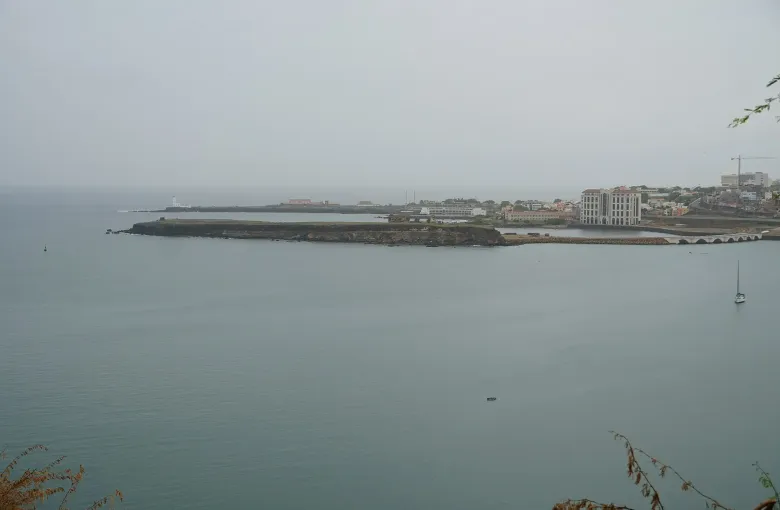
The short version
Warm all year. Dry for most of it. The rain, such as it is, falls in a short window around August to October, and even then it is modest by tropical standards. The wind blows almost always.
Why it is so dry
Cape Verde sits in the Atlantic off the coast of West Africa, on the same latitude as the Sahel, and it is dry for the same reason the Sahel is. The islands are technically in the tropics but they do not have a tropical climate in the sense most people picture. Expect a semi-arid landscape of volcanic rock, terraced valleys where there is water, and a great deal of brown between the green.
That is the single biggest gap between the brochure and the place. The postcard image is turquoise water against pale sand, which is entirely accurate for the eastern islands, and the interior of the mountainous ones is dramatic rather than lush.
The wind
The northeast trade wind blows across the archipelago for most of the year. It is the reason Sal and Boa Vista are among the better-known windsurfing and kitesurfing destinations in the Atlantic, and it is also the reason a beach day can feel cooler than the temperature suggests and why an umbrella is a losing proposition. Pack a light windproof layer even in the hottest months.
The islands are not one climate
The archipelago divides roughly into the flat eastern islands and the mountainous western ones. Sal, Boa Vista and Maio are low and sandy, and they are the driest. Santo Antão, São Nicolau, Fogo and the interior of Santiago rise high enough to catch cloud, hold water and support real cultivation, which is why the valleys there are green when everything around them is not.
If you want beach, you want the east. If you want mountains, terraces and walking, you want the west. Most good itineraries take one of each rather than trying to average them. See the best time to visit for how that maps onto the calendar.
Dust
Between roughly December and February the harmattan can carry Saharan dust out over the islands. Locally it is called bruma seca. It reduces visibility, softens the light and occasionally disrupts inter-island flights. It is not dangerous for most people, but if you have a respiratory condition it is worth knowing the season exists.
Mosquitoes and the wet window
The short rainy season is also when standing water appears, and standing water is where the dengue mosquito breeds. The Cape Verde government has raised the civil protection warning level for dengue on Santiago, Fogo and Brava. Repellent belongs in the day bag rather than the bathroom bag, because the mosquito that carries dengue bites in daylight.
Sources
- UK Foreign, Commonwealth & Development Office: Cape Verde health: shigella, salmonella and dengue, and the civil protection warning level for dengue on Santiago, Fogo and Brava. Accessed 14 September 2026.
- UK Foreign, Commonwealth & Development Office: Cape Verde travel advice: the FCDO restricts no part of the country, and Global Health Insurance Cards are not accepted. Accessed 14 September 2026.
- UNESCO World Heritage Centre: Cape Verde’s State Party record: one property inscribed on the World Heritage List. Accessed 14 September 2026.
Other Articles
Best Time to Visit Cape Verde
Cape Verde Packing List