The quick answer
Uganda's climate is equatorial and moderated by altitude. Most of the country is a plateau well above sea level, so it is far more temperate than "on the equator" suggests. Daytime temperatures are warm rather than hot for most of the year and they do not vary much between months.
What varies is rainfall, and it varies in two peaks rather than in a single wet season.
The rainfall pattern
Broadly, the wetter spells fall around March to May and again around September to November, with drier spells between them. Rain in this pattern typically arrives as heavy afternoon downpours rather than all-day drizzle, so a wet-season day is often a clear morning, a violent hour and a bright evening.
Treat those month ranges as a tendency rather than a timetable. They shift, and in recent years they have shifted noticeably.
Altitude changes everything
The lake basin and Kampala
Warm and humid, tempered by Lake Victoria. This is the climate most visitors experience first, and it is the warmest part of a typical itinerary.
The southwest
The gorilla forests sit high, and the hills around them are higher still. Days are mild and nights are cold. Visitors regularly arrive equipped for the equator and spend the evening wearing everything they brought.
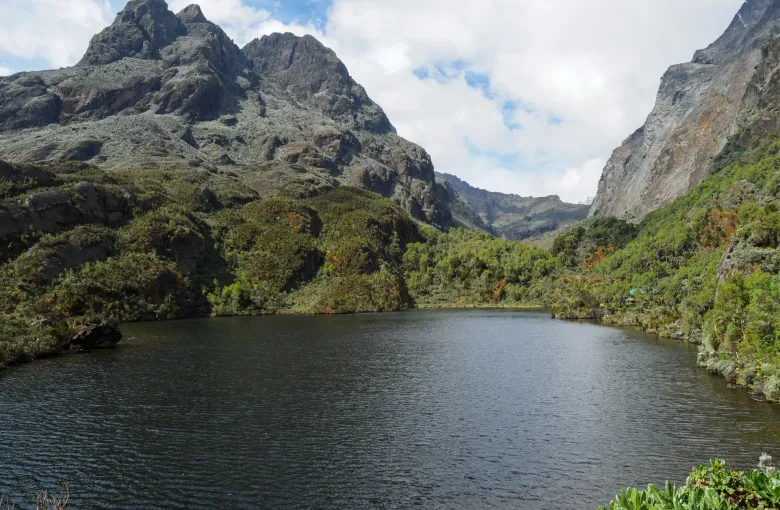
The Rwenzori
A genuine alpine environment with permanent glaciers and snow just a few kilometers from the equator. UNESCO records the third highest summit in Africa here at 5,109 m, with about seventy percent of the park above 2,500 meters and a vegetation sequence that runs from forest through bamboo and giant heather into an alpine zone of groundsels and lobelias found nowhere else. If your itinerary includes this, it is a mountaineering climate, not a safari one.
The north and northeast
Hotter and markedly drier than the rest of the country, with a single rainfall peak rather than two.
What this means for your bag
The single most useful principle is that you are packing for altitudes, not for a country. A trip that takes in Kampala, Bwindi and a Rwenzori foothill covers three different climates in a week. Layers, a genuine waterproof, and something warm for the evenings in the southwest. The full list is in Uganda Packing List.
A note on what we do not publish
You will find month-by-month temperature and rainfall tables for Uganda on many sites. We have not reproduced one, because the figures circulating are frequently unattributed, they vary widely between sources, and the pattern has been shifting. What we can tell you reliably is the shape of the year and the effect of altitude, and those are the two things that change what you pack and when you walk.
Sources
- UNESCO World Heritage Centre: the inscription of Rwenzori Mountains National Park. Accessed 14 September 2026.
- UNESCO World Heritage Centre: the inscription of Bwindi Impenetrable National Park. Accessed 14 September 2026.
- UK Foreign, Commonwealth & Development Office: Uganda travel advice: entry requirements, safety and security, health and local laws. Accessed 14 September 2026.
Other Articles
Best Time to Visit Uganda
Uganda Packing List