The short version
Seychelles is close to the equator and warm and humid all year. The temperature is not the variable. The wind is.
Two seasons alternate. The northwest monsoon runs roughly December to March and is the hotter, wetter, stiller period. The southeast trades run roughly May to September and are cooler, drier and breezier. April and October and November are the turning months, when the wind drops and the sea is at its calmest on both sides.
⚠ What the wind does to the water, which is the part that matters
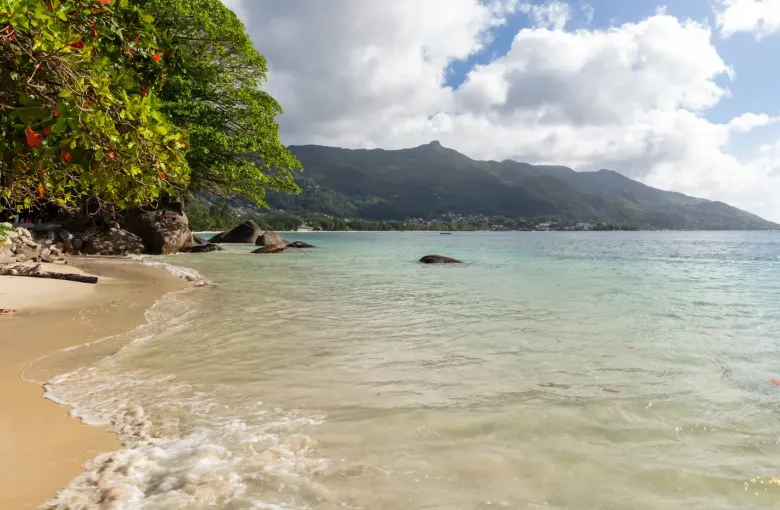
The wind decides which coast is usable. The FCDO puts it as a safety rule rather than a comfort one: the west coast is generally unsafe during the northwest monsoon, around December to March, and the east coast is generally unsafe during the southeast wind season, around May to September.
The practical consequence is the most useful sentence on this page: in almost any week of the year, one side of the island is calm. A trip planned around that fact is a good trip in any month. A trip that books one beach and hopes is a gamble.
The beaches at the southern tip are not suitable at any time of year, in any season.
Rain
Rain here arrives as heavy, short downpours rather than as a gray day, and the wettest period is the northwest monsoon. It rarely removes a day. It does make granite slippery, which matters on the forest paths, and it makes the uplands wetter than the coast in every season.
Humidity, and why the uplands feel different
Humidity is high all year and it is what tires people rather than the heat. The interior of Mahé rises into forest and cloud and is noticeably cooler and wetter than the beach twenty minutes below it. Pack for both. See Seychelles Packing List.
Cyclones
Seychelles sits close enough to the equator that direct cyclone strikes are rare, which is a real difference from the Mascarenes to the south. Distant systems can still put swell onto a coast and make inter-island boats uncomfortable or cancel them. Build one spare day into any itinerary that depends on a ferry. See Getting Around Seychelles.
What it means for the two heritage sites
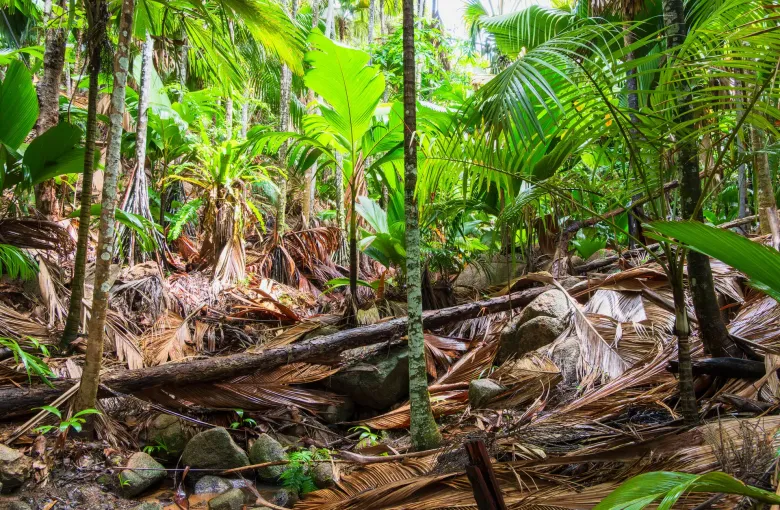
The Vallée de Mai on Praslin is forest, so it is shaded and comfortable in any season, and wettest in the northwest monsoon when the paths are at their most slippery. Aldabra is a different question entirely: it is not reached by choosing a month, because every visitor needs prior authorisation from the Seychelles Islands Foundation and an escort throughout.
For the recommendation rather than the mechanism, see Best Time to Visit Seychelles.
Sources
- UK Foreign, Commonwealth & Development Office: Seychelles safety and security: opportunistic crime, the drug law and its penalties, the coast-by-season swimming rules, rip currents at Beau Vallon and the shortage of lifeguards. Accessed 14 September 2026.
- UK Foreign, Commonwealth & Development Office: Seychelles travel advice, which warns against travel to no part of the country. Accessed 14 September 2026.
- UNESCO World Heritage Centre: the inscription of the Vallée de Mai, 19.5 hectares of palm forest on Praslin holding the world's largest population of endemic coco-de-mer. Accessed 14 September 2026.
Other Articles
Best Time to Visit Seychelles
Seychelles Packing List