The shape of the country
Seychelles is an archipelago, but almost every trip uses three islands: Mahé, where the airport and the capital are, Praslin, which holds the Vallée de Mai, and La Digue, which is small, flat along its west side, and largely without cars.
Everything else is either a day trip or a different kind of expedition. Aldabra is over a thousand kilometers away and requires prior authorisation rather than a ticket.
Between the islands
- Ferry. The scheduled catamaran between Mahé, Praslin and La Digue is how most people move, and it is the backbone of any itinerary. Book ahead in the busy months.
- Domestic flight. Mahé to Praslin takes a few minutes and is the reliable option when the sea is up. It costs more and carries less baggage.
- Small boat. Local operators run the shorter hops and the day trips. In a windy week they are the first thing canceled.
⚠ The sea is the variable that can rearrange your week. Distant weather puts swell on a route without any bad weather overhead, so a crossing can be uncomfortable or canceled on a sunny day. Build a spare day in before the flight home rather than connecting tightly, and do not put the only ferry of the trip on the last morning.
On Mahé
- Buses cover the island, are inexpensive and are used by everyone. They are also the slow option on a mountainous road network.
- Taxis are available and are the straightforward choice for an evening or for the airport. Agree the fare first.
- Car hire gives you the interior, which is where the island stops being a coastline. Driving is on the left, the roads are narrow, steep and winding, and the parked car is one of the places opportunistic theft is named as happening. Do not leave anything in it.
On Praslin
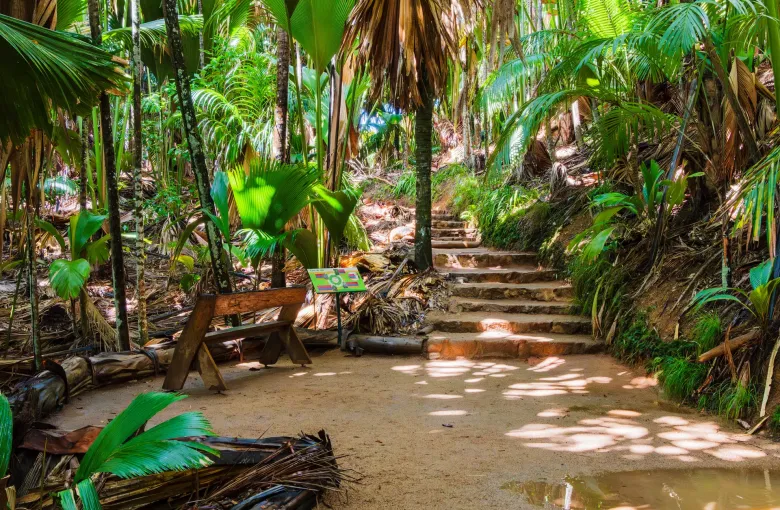
Buses and taxis cover it, and car hire is straightforward. The Vallée de Mai sits inland, so plan the visit around the transport rather than assuming a walk from the coast.
On La Digue
This is the one people enjoy most. La Digue runs on bicycles, with a small number of taxis and ox carts still in use. Hire a bike at the jetty. The main coastal road is flat and easy; the cross-island routes are not, and the granite gets slippery in the rain.
Walking
Trails are generally safe and the recurring problem is getting lost rather than anything worse. Plan a route, tell someone, take more water than the distance suggests, and start early. Bags have been taken on marked and unmarked trails, so carry little. See Seychelles Travel Safety Guide.
A workable shape
Two bases beat three. Mahé and Praslin, with La Digue as a day trip from Praslin, is the itinerary that wastes the least time on water and leaves room for the weather to have an opinion. See Best Time to Visit Seychelles.
Sources
- UK Foreign, Commonwealth & Development Office: Seychelles safety and security: opportunistic crime, the drug law and its penalties, the coast-by-season swimming rules, rip currents at Beau Vallon and the shortage of lifeguards. Accessed 14 September 2026.
- UK Foreign, Commonwealth & Development Office: Seychelles travel advice, which warns against travel to no part of the country. Accessed 14 September 2026.
- UNESCO World Heritage Centre: the inscription of the Vallée de Mai, 19.5 hectares of palm forest on Praslin holding the world's largest population of endemic coco-de-mer. Accessed 14 September 2026.
Other Articles
Best Time to Visit Seychelles
Seychelles Travel Safety Guide