Nobody here is indigenous
Seychelles had no indigenous human population. The islands were uninhabited until the eighteenth century, and everybody on them descends from someone who arrived: French settlers, the enslaved Africans brought with them, liberated Africans landed later in the nineteenth century, and Indian and Chinese traders after that.
That produced a genuinely Creole country rather than a plural one. The distinction matters. In some places several communities live alongside each other keeping separate traditions; here they largely merged into one, and the result is a single national culture with several ancestries inside it.
Language
There are three official languages.
- Seychellois Creole, or Kreol Seselwa, is what people actually speak to each other. It is French-lexified and it is a language in its own right rather than a dialect.
- English is the language of government, law and business, and you can travel comfortably in it everywhere.
- French is widely understood and used in media.
You will not need Creole. Using a word of it is received warmly, as it is anywhere.
⚠ The Moutya, and what it is
Seychelles has exactly one element on UNESCO's intangible heritage lists: the Moutya, inscribed in 2021.
It is a drum dance that descends directly from the enslaved population, danced at night around a fire to a goatskin drum heated over it, and it carried commentary and complaint that could not be said plainly. It was suppressed for much of the colonial period and for a while after. Its inscription is recent and it is a live act of cultural recovery rather than a heritage display.
If you are offered a performance, ask whether it is a community occasion or a staged one. Both exist. Only one of them is the thing UNESCO inscribed. See Seychelles Festivals and Celebrations and Seychelles and Diaspora Reconnection.
Religion
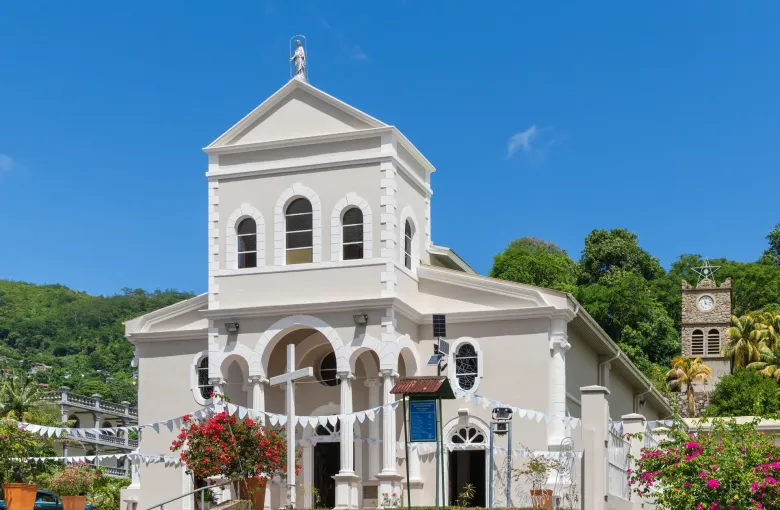
Seychelles is predominantly Roman Catholic, with Anglican, Hindu and Muslim communities. The cathedral in Victoria is the visible center of it. Church attendance on a Sunday is high and it shapes the rhythm of the week in a way that a resort will not show you.
⚠ Dress and conduct, which is where visitors go wrong
This is a socially conservative country and the beach can disguise that entirely.
- Nudism is not accepted and is likely to cause offense. Topless sunbathing is uncommon.
- Swimwear belongs on the beach. Cover up for a shop, a bus, a restaurant or a village street.
- Dress modestly for a church, and do not walk into one during a service to photograph it.
- Ask before photographing people. This is a small country and a face is recognized in it.
Ordinary courtesies
- Greet before you ask. Walking up and beginning with a question reads as rude.
- Life runs at an island pace and hurrying someone achieves nothing.
- Do not take shells, coral or sand. Beyond the ecology, some of it is an offense.
- Bargaining is not the custom at markets. The asked price is the price.
Sources
- UNESCO Intangible Cultural Heritage: Seychelles's single inscribed element, the Moutya, inscribed in 2021. Accessed 14 September 2026.
- UNESCO World Heritage Centre: Seychelles's State Party record and its two inscribed properties. Accessed 14 September 2026.
- UK Foreign, Commonwealth & Development Office: Seychelles safety and security: opportunistic crime, the drug law and its penalties, the coast-by-season swimming rules, rip currents at Beau Vallon and the shortage of lifeguards. Accessed 14 September 2026.
Other Articles
Seychelles Festivals and Celebrations
Seychelles Food Guide