Language
Portuguese is the official language, and it is the language of government, schooling and most signage. It is also, for a great many Mozambicans, a second language: Emakhuwa, Xichangana, Elomwe, Cisena, Echuwabo and others are spoken at home, and which one depends heavily on where you are.
English is common in tourist-facing businesses and much less common outside them. A handful of Portuguese words is worth more here than in most places, because it is the bridge language between regions as well as between you and everyone else.
- Bom dia, good morning. Boa tarde, good afternoon.
- Por favor, please. Obrigado if you are a man, obrigada if you are a woman.
- Desculpe, excuse me or sorry.
- Quanto custa?, how much does it cost?
Greetings come first
Do not open with the question. A greeting, a handshake and an unhurried inquiry about how someone is come before the business of asking directions or a price, and skipping that reads as brusque rather than efficient. This is consistent across the country and it costs nothing.
The capulana
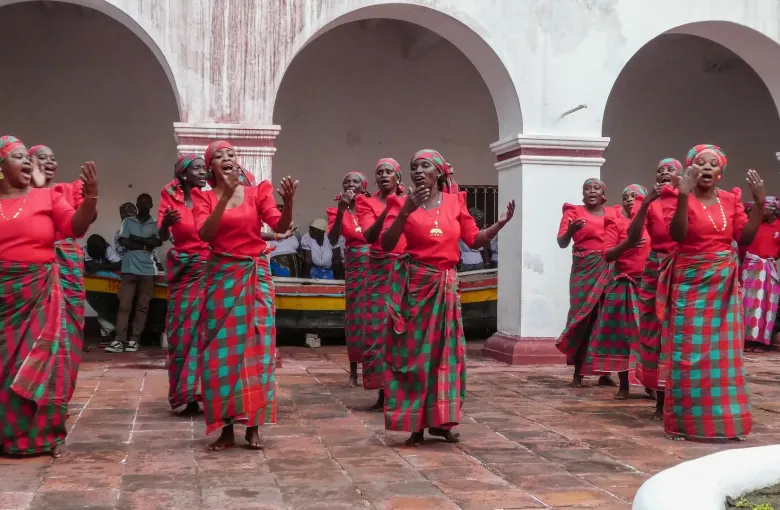
The capulana is the printed cloth you will see everywhere: worn as a wrap, tied as a baby carrier, used as a headscarf, given as a gift, and produced for weddings, funerals and political occasions in specially printed runs. It is the single most visible piece of Mozambican material culture.
Buying one is a good souvenir and an easy conversation. Wearing one as a visitor is generally taken well if it is done straightforwardly rather than as costume, and a woman visiting a conservative area may find one genuinely useful.
Religion, and why it changes as you travel
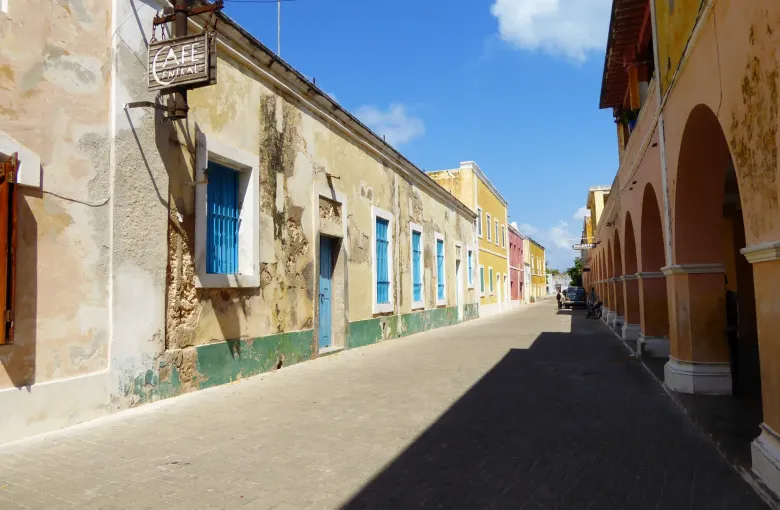
Mozambique is religiously mixed and the mix is geographic. The north and the coastal strip have a long and deep Muslim presence, which is one of the things the Island of Mozambique records in stone: UNESCO inscribed it partly for the meeting of Swahili, Arab, Indian and European traditions in one small place. The south is more heavily Christian, with traditional beliefs woven through both.
Practically, this means dress norms and rhythms differ between Maputo and a northern coastal town, and the sensible default when you move north is to cover more rather than less.
Dress
Away from beach resorts, shoulders and knees covered is the safe standard, and it is close to essential around mosques and in conservative northern towns. Swimwear belongs on the beach and not on the street or in a shop. Camouflage clothing is a bad idea anywhere with a visible military presence.
Photography
Ask first, every time, and accept no. That applies to people, to homes and to anything that looks like a ceremony. Never photograph children without a parent's clear permission.
Do not photograph military installations, police, airports, ports, bridges or government buildings. The FCDO's safety advice for Mozambique carries the usual caution about photographing official sites, and in a country with an active security operation in the north this is not a technicality.
The three traditions UNESCO lists
Mozambique has three elements inscribed on UNESCO's intangible heritage lists, and the difference between the lists is worth knowing.
- Chopi Timbila, inscribed in 2008 on the Representative List. The orchestral xylophone music and dance of the Chopi people of Inhambane province.
- Gule Wamkulu, inscribed in 2008 on the Representative List. A masked dance tradition Mozambique shares with Malawi and Zambia: it is a multinational inscription and not a Mozambican possession.
- Ingoma Ya Mapiko, inscribed in 2023 on the Urgent Safeguarding List, which is the list for traditions judged to be at risk. That is a different thing from the Representative List, and blurring the two flatters the situation.
Everyday courtesies
- Use both hands, or the right hand, to give and receive.
- Greet older people first and defer to them in conversation.
- Public displays of affection are best kept low key, more so in the north.
- Bargaining is normal in a market and not in a shop with marked prices. Do it good-humoredly and remember what the difference is actually worth to each of you.
- Time is held more loosely than a visitor may be used to. Build the slack in rather than taking it personally.
Sources
- UNESCO Intangible Cultural Heritage: Mozambique’s three inscribed elements: Ingoma Ya Mapiko, Chopi Timbila and Gule Wamkulu. Accessed 14 September 2026.
- UK Foreign, Commonwealth & Development Office: Mozambique safety and security, including the assessment of terrorism and of IS-Mozambique. Accessed 14 September 2026.
- UNESCO World Heritage Centre: the inscription of the Island of Mozambique in 1991 under criteria (iv) and (vi). Accessed 14 September 2026.
Other Articles
Mozambique Festivals and Celebrations
Mozambique Food Guide