Why this country is different
Cape Verde has a diaspora story that does not fit the usual shape, and the reason is at the beginning. The islands were uninhabited when the Portuguese reached them in the fifteenth century. There was no society here before. Everyone who is Cape Verdean descends from people who arrived: Portuguese settlers, and Africans brought against their will from the mainland coast.
So this is not a country with a creole culture. It is a country that is a creole culture, formed in the Atlantic rather than carried into it, with its own language, its own music and its own sense of itself as neither Africa nor Europe.
The trade
Ribeira Grande, now Cidade Velha, was founded as the first European colonial town in the tropics and grew wealthy as a holding and transshipment point in the Atlantic slave trade. People taken from the Guinea coast passed through here on the way to the Americas, and some stayed, and their descendants are the country.
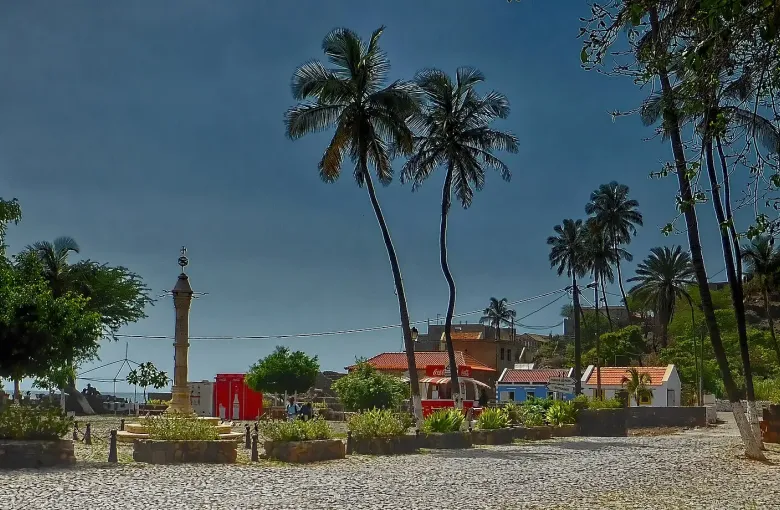
The pillory still standing in the square at Cidade Velha is the plainest surviving object from that period. For a visitor tracing a family connection, it is usually the moment the trip stops being sightseeing.
The second dispersal
The part that surprises people is that the larger Cape Verdean diaspora was not forced. It was economic, it is recent, and it is still going.
Drought and famine drove repeated waves of emigration from the nineteenth century onward. New England is the great destination: Cape Verdeans crewed American whaling ships out of New Bedford and Providence and settled there, making the United States home to one of the oldest voluntary African-descended immigrant communities in the country. Portugal, the Netherlands, France and Senegal hold large communities too.
The result is a statistic that describes the country better than any other: there are more people of Cape Verdean descent living outside Cape Verde than in it. Emigration is not a chapter in the national story here. It is the national story, and it is why the music is about absence.
Sodade
That word, in Kriolu, is the one to know. It means the ache of missing someone or somewhere absent, and it is the recurring subject of morna, the national music. When Cesária Évora sang it to audiences who did not speak the language, what carried was the feeling of a country shaped by departure. See culture and etiquette.
Visiting with a connection
If you are coming to trace family, three things are worth knowing.
Records exist and are local. Parish registers, which are the usual route for a Cape Verdean line, are held on the island of origin rather than centrally. Knowing which island your family left from changes the trip entirely, and it is the question to answer before you book.
The island matters more than the country. Cape Verdeans identify strongly by island, and a family from Brava has a different history, accent and emigration route from one from Fogo or Santiago. "My family is Cape Verdean" will be met with a friendly "from where".
Return is normal here. Unlike some destinations in this program, a visitor arriving to reconnect is not doing anything unusual. Diaspora return is a familiar and welcomed part of the year, particularly around the island saints’ days. See festivals and celebrations.
Sources
- UNESCO World Heritage Centre: the inscription of Cidade Velha, Historic Centre of Ribeira Grande, in 2009 under criteria (ii)(iii)(vi). Accessed 14 September 2026.
- UNESCO World Heritage Centre: Cape Verde’s State Party record: one property inscribed on the World Heritage List. Accessed 14 September 2026.
- UK Foreign, Commonwealth & Development Office: Cape Verde travel advice: the FCDO restricts no part of the country, and Global Health Insurance Cards are not accepted. Accessed 14 September 2026.
Other Articles
Cidade Velha: Visitor and Heritage Guide
Cape Verde Culture and Etiquette Guide