The short version
Two threads run through a Nigerian return journey and they pull in different directions. One goes back to a departure: Badagry, on the Lagos coast, where people were taken and did not come back. The other goes to something that survived and is still practiced: the Yoruba religious tradition that crossed with them and came back changed. Both are worth the trip. They are not the same trip.
Badagry
Badagry sits west of Lagos, close to the Benin border, and it was one of the ports of the transatlantic trade. What is there now is not a grand monument. It is a town, a set of small museums, a route down to the water, and a stone marker on a sand track that says, in plain letters, that this is the route of the journey to an unknown destination.
That plainness is the thing. There is no interpretive center to stand between you and it, no audio guide managing your reaction. People come here and are quiet for a long time, and then they want to talk. Build the day so there is room for both, and do not schedule anything demanding afterward.
Osun-Osogbo, and the other kind of continuity
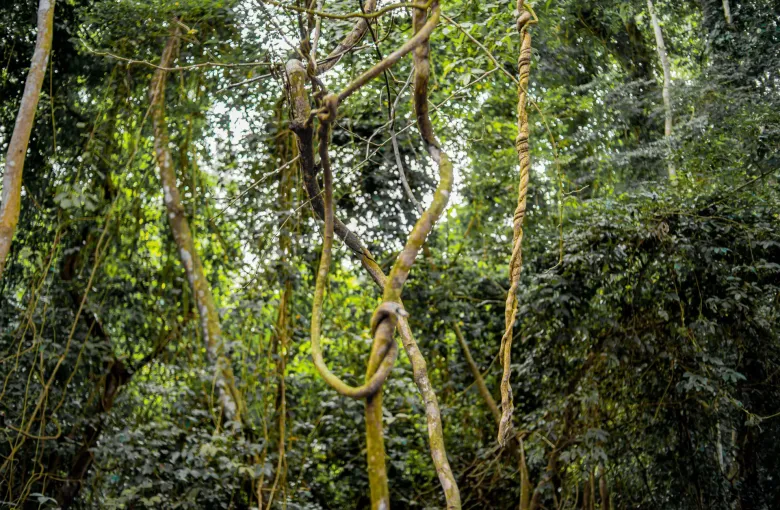
The Osun-Osogbo Sacred Grove, inscribed on the World Heritage List in 2005, is the largest surviving sacred grove in Yorubaland and an active place of worship. UNESCO records something about it that matters particularly here: the restoration of the grove by artists gave it a new importance, and it became a sacred place for the whole of Yorubaland and a symbol of identity for the wider Yoruba diaspora.
That is not a metaphor. Yoruba religious practice traveled the same route as the people who carried it and became Santería in Cuba, Candomblé in Brazil and Lucumí elsewhere, and practitioners from all three come to Osogbo. If your family's tradition has a Yoruba root, whether you grew up naming it or not, the grove is where that root is still in the ground. See the Osun-Osogbo guide.
If you are looking for a place, not a country
Many people arrive with a town name, a family name and very little else, and the honest thing to say is that Nigerian records of the period are patchy and dispersed, and that DNA testing will give you a region rather than a village. What it can give you is a direction, and a direction is enough to build a trip around.
What helps most is time and a local intermediary. A day spent with someone who can make an introduction in the right town does more than a week of archives. Tell us what you know before you travel, however thin it seems, and we will work out what is realistic before you are standing in the arrivals hall with a hope and no appointment.
The practical part
A Nigerian visa is required and must be obtained online before you travel, and a yellow fever certificate is required at the border. Those are covered in visa and entry requirements. If any part of your family story points to a state the FCDO restricts, we will tell you so early rather than late, and the travel safety guide sets out which those are.
Going with people
Most people do this better in company than alone. A small group that includes others on the same errand changes the days when it lands hard, and it makes the hours between the heavy visits easier. That is most of what we do.
Sources
- UNESCO World Heritage Centre: the inscription of the Osun-Osogbo Sacred Grove in 2005 under criteria (ii)(iii)(vi). Accessed 14 September 2026.
- UK Foreign, Commonwealth & Development Office: Nigeria travel advice: the FCDO advises against all travel to parts of Nigeria and against all but essential travel to further parts. Accessed 14 September 2026.
- UK Foreign, Commonwealth & Development Office: Nigeria entry requirements: a visa obtained before travel, the withdrawal of visa on arrival, six months of passport validity, the yellow fever certificate and the online health declaration. Accessed 14 September 2026.
Other Articles
Osun-Osogbo Sacred Grove: Visitor and Heritage Guide
Nigeria Culture and Etiquette Guide