Start with what Zambia is not
If you have traveled to Ghana or Senegal, you will have encountered a particular kind of heritage journey: the fort on the shore, the door facing the Atlantic, the return of descendants to a point of departure that can be named.
Zambia is not that, and we are not going to pretend otherwise. Zambia is landlocked. It has no Atlantic coast and was not a transatlantic embarkation region. There is no Zambian equivalent of Cape Coast Castle, and any itinerary that implies you can trace an African American ancestor to a Zambian village is selling a story rather than a history.
What Zambia does have is a different set of connections, and they are real, documented and far less widely known. There are three.
1. A different slave trade
The trade that ran through this region ran east, not west. In the eighteenth and nineteenth centuries, routes carried captives from Central Africa toward the Indian Ocean ports and the Swahili coast, alongside an internal trade within the region itself. The country that is now eastern Zambia lay across those routes.
This history produced a diaspora too — in the islands of the Indian Ocean, in the Arabian peninsula, in South Asia — and it is much less commemorated than the Atlantic trade. Standing in eastern Zambia and understanding that the caravans went the other way is a genuine reorientation for a visitor who learned this history facing the Atlantic.
The Livingstone Memorial
David Livingstone, the missionary and explorer, spent his final years documenting and campaigning against that trade, and he died in 1873 at Chief Chitambo’s village in what is now Zambia’s Central Province. His heart was buried beneath a tree there; his body was carried to the coast by his companions, Chuma and Susi, and their journey is as remarkable as anything in his own.
The Livingstone Memorial at Chitambo marks the place. It is remote, quiet and almost entirely undeveloped for visitors, which is much of its power. The Livingstone Museum in Livingstone, the country’s oldest and largest museum, holds the fuller documentary record and is the more practical stop for most itineraries.
2. Lusaka was a capital of the liberation struggle
This is the connection to the Black diaspora’s political history, and it is the one most often missed.
After independence in 1964, under Kenneth Kaunda, Zambia became a Frontline State — and paid a heavy price for it. Surrounded by white-minority and colonial regimes, it gave refuge and operating room to the liberation movements of its neighbors. The African National Congress ran its headquarters in exile from Lusaka, and Zambia hosted movements from Zimbabwe, Namibia, Angola and Mozambique through decades of war, absorbing cross-border raids and economic strangulation as a consequence.
For a traveler interested in the arc that runs from Pan-Africanism through the anti-apartheid movement to the present, Lusaka is not a stopover. It is one of the places where that history was organized. It connects directly to what you can see on our Johannesburg and Soweto and Robben Island guides — the same struggle, seen from the country that sheltered it.
3. Living lineage, not recovered lineage
The third connection is the least dramatic and possibly the most valuable.
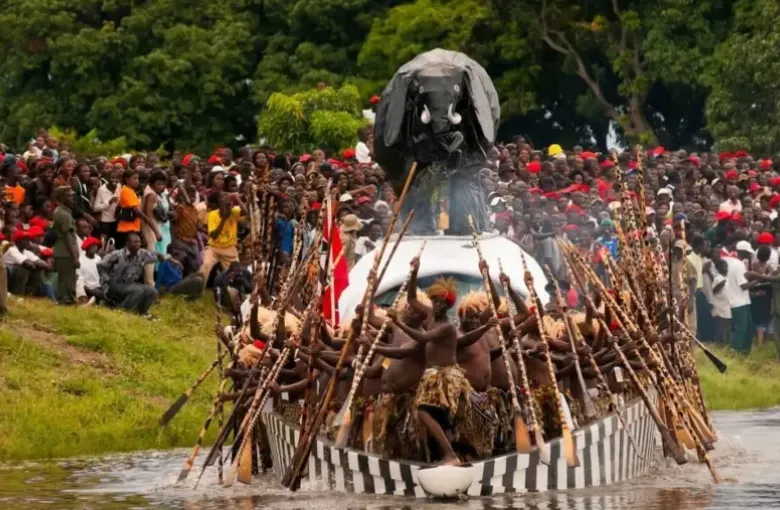
In much of the Atlantic diaspora, reconnection means recovering something that was broken. In Zambia, the thing was never broken. Chieftaincy is a functioning institution. The mukanda initiation still happens. The Kuomboka still moves a king across a floodplain, and tens of thousands of people still turn out to watch. Languages, kinship systems and ceremonies have continued without interruption.
What Zambia can offer, then, is participation in a tradition that never stopped — attending a ceremony as a guest, staying in a village, sitting in a storytelling circle, learning a language that has been spoken continuously in the same place for centuries. That is a different proposition from a pilgrimage, and for some travelers it is a more sustaining one.
What we will not do
We will not imply a documented ancestral link between an African American traveler and a Zambian community. We do not offer DNA-to-village matching, and we are skeptical of anyone who does. And we will not borrow the language of the Atlantic trade — there is no “door of no return” here, and using the phrase would be a small dishonesty in service of a bigger one.
Traveling with LABUSA Travel
If this history is why you are going, tell us. We will build an itinerary around the Livingstone Museum and the Chitambo memorial, the liberation-era sites in Lusaka, and a properly arranged community stay — and we will be clear at every point about what is documented, what is inferred, and what is simply a good story.
Other Articles
Zambia Culture and Etiquette Guide
Zambia Festivals and Celebrations