The quick answer
Zambians are, by widespread agreement among visitors, exceptionally courteous. The single most useful adjustment an American or European traveler can make is to slow down the beginning of every interaction. Greeting properly is not a preliminary to the conversation; it is part of it.
Language
English is the official language and the language of government, business, signage and schooling, so you will be understood almost everywhere a visitor goes. Alongside it Zambia has more than seventy languages, of which seven are used regionally in official and educational contexts: Bemba, Nyanja, Tonga, Lozi, Lunda, Luvale and Kaonde.
Bemba is the most widely spoken; Nyanja dominates in and around Lusaka; Lozi is the language of Barotseland in the west; Tonga is the language of the south. Learning even one greeting is received with real warmth.
- Muli bwanji? — How are you? (Nyanja)
- Mwapoleni — a welcoming greeting (Bemba)
- Zikomo — thank you (Nyanja)
- Natotela — thank you (Bemba)
Greetings and the body language of courtesy
Handshakes are usual. You will often see — and are welcome to use — the supported handshake: the left hand touches the right forearm while shaking, a gesture of respect that appears across the region.
Clapping is a courtesy in several Zambian cultures — softly cupped hands, used in greeting, in thanks and when receiving something, particularly toward elders or a chief. If someone claps as they hand you something, clapping back is the right response.
Offer and receive things with the right hand, or with both. Ask how someone is, and their family, and wait for the answer. Address elders with deference; age carries real standing.
Chieftaincy is a living institution
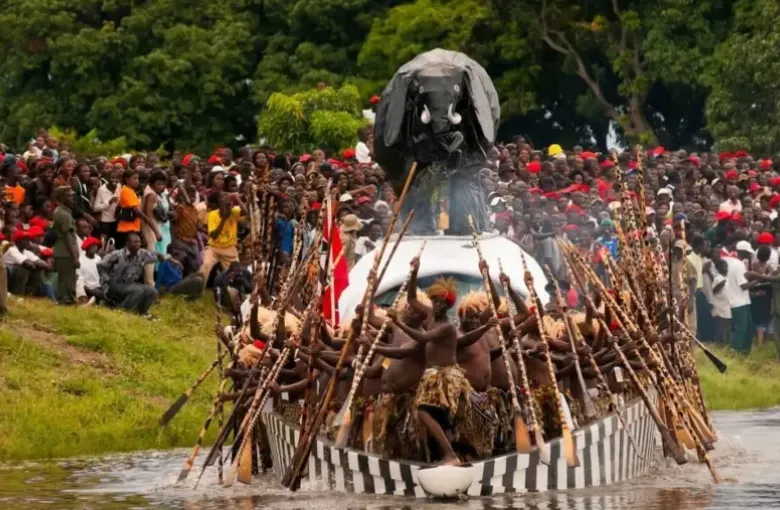
Zambia is a republic, and it also has traditional authorities who are neither ceremonial nor historical. Chiefs and, in Barotseland, the Litunga, hold genuine social authority, preside over land and custom, and lead ceremonies attended by tens of thousands of people.
For a visitor this matters practically. In a rural community, courtesy runs through local leadership: a guide or host may greet or seek permission on your behalf, and it is not a formality to be hurried. Follow their lead entirely.
Masquerade and the limits of looking
Zambia has six elements on UNESCO’s Representative List of the Intangible Cultural Heritage of Humanity, among them the Makishi masquerade and Gule Wamkulu (shared with Malawi and Mozambique), both inscribed in 2008, and the Mooba dance of the Lenje people, inscribed in 2018.
These are not folklore performances laid on for visitors. Makishi masqueraders appear in connection with mukanda, the initiation of boys, and the masked figures carry meanings that are not public property. Photography can be restricted, and permission is sometimes refused for reasons nobody is obliged to explain to you.
Ask, and accept no. That is the whole rule, and it is not a hardship.
Dress
Zambians dress neatly, and a visitor who looks like they have made an effort is treated accordingly. Modest dress is appreciated in villages, markets and places of worship — covered shoulders, and trousers or a skirt below the knee. Beachwear belongs at the lodge pool. Smart casual covers almost every evening you will encounter.
And, as elsewhere in this guide: no camouflage clothing, which is restricted for civilians.
Photography
- Ask before photographing people, always, and accept the answer.
- Do not photograph government buildings, military and police installations, or border infrastructure — including around the Victoria Falls bridge. This is taken seriously.
- At ceremonies, follow whatever the organizers say, and do not assume that a public event is a public subject.
- If you promise to send someone a photograph, send it.
Religion and public life
Zambia is a strongly Christian country and it is declared as such in its constitution’s preamble, alongside a guarantee of freedom of conscience. Sunday matters, prayer opens many public occasions, and religious observance is a normal part of ordinary conversation.
A word about “One Zambia, One Nation”
The national motto, from the country’s first president Kenneth Kaunda, is not a slogan Zambians have forgotten. In a country of more than seventy language groups that has avoided the conflicts of several neighbors, it is a claim people make about themselves with some pride. Take it seriously and you will understand a great deal about how Zambians talk about difference.
Traveling with LABUSA Travel
Where our itineraries include a community visit, it is arranged through the community and on their terms, with the introductions made properly — which is also, incidentally, what makes it worth doing.
Banner photograph by ChaloNiZambia, CC BY-SA 4.0, via Wikimedia Commons.
Other Articles
Zambia Festivals and Celebrations
Zambia and Diaspora Reconnection