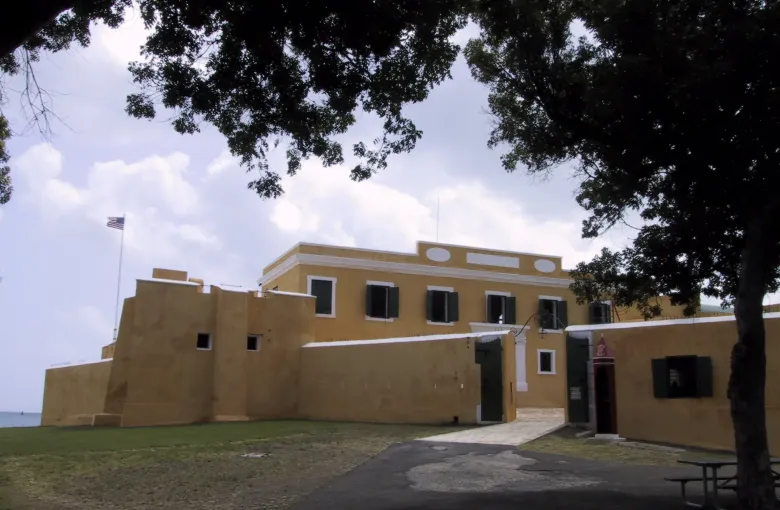
A park that is most of an island.
The National Park Service records that Virgin Islands National Park is comprised of 7,259 acres of terrestrial habitat, which is about 60 percent of the island land mass, together with 5,650 acres of adjacent submerged lands and some 800 species of plants.
Sixty percent is the figure to hold on to. This is not a park on St John; it is most of St John, and the submerged acreage means the protection runs from the ridge tops to the reefs. A visitor does not decide whether to visit the park so much as decide what to do inside it.
The 1733 Akwamu Insurrection, in the Park Service's own words.
The Park Service publishes that in the early morning of November 23, 1733, a small group of enslaved people entered the Danish West India Company fort in Coral Bay on St John under the guise of a firewood delivery for the fort's soldiers, having hidden cane knives within the stacks of wood they carried. They took the soldiers by surprise.
The Park Service calls them freedom fighters. That is a federal agency's own word for them, in its own published account, and this guide uses it because softening it would be a choice too.
The park's front page describes the events of 1733 as the first successful insurrection in the Caribbean. It happened here, at Coral Bay, and it is the reason this island's history is not interchangeable with any other in the region.
What you walk past on the trails.
The Park Service invites visitors to hike to historic plantation sites to learn about a challenging past when sugar and enslaved labor dominated life on the island.
Those ruins are the other half of the 1733 story. The mills, the terraced slopes and the walls standing in the forest are the economy the insurrection was against, and reading them that way is what the Park Service's own wording invites.
Older still: the Park Service records that a visitor can visit the Indigenous Taino's ancient petroglyphs. Human habitation here predates the Danish period by centuries.
What UNESCO does not say about it.
This is not a World Heritage Site. The United States States Party record at UNESCO lists that country's World Heritage properties, among them Everglades National Park, and the Virgin Islands appear nowhere on it, neither inscribed nor on the tentative list.
The absence is stated because a reader looking at a landscape of this quality reasonably wonders. The protection here is federal, through the National Park Service, and that is a complete answer rather than a lesser one.
Getting here, which is a boat.
The Park Service records that there are no airports on St. John: a visitor flies to the Cyril E. King Airport on St Thomas and crosses by car barge or the people ferry. From the ferry, the 1 mile long Lind Point Trail reaches Salomon and Honeymoon beaches on foot.
And once ashore, remember the rule the Park Service puts on its own basic information page: we drive on the left here in the Virgin Islands.
Sources
- National Park Service: Virgin Islands National Park basic information: the instruction that we drive on the left here in the Virgin Islands, that a visitor should pay extra attention when making turns, pulling out into traffic or crossing the road, and that a pedestrian should walk facing traffic, which here is the right side of the road; and that the park is comprised of 7,259 acres of terrestrial habitat, about 60 percent of the island land mass, together with 5,650 acres of adjacent submerged lands and some 800 species of plants. Accessed 18 September 2026.
- National Park Service: The 1733 Akwamu Insurrection: that in the early morning of November 23, 1733, a small group of enslaved people entered the Danish West India Company fort in Coral Bay on St. John under the guise of a firewood delivery for the soldiers, having hidden cane knives within the stacks of wood they carried, took the soldiers by surprise, and that the Park Service calls them freedom fighters. Accessed 18 September 2026.
- National Park Service: Virgin Islands National Park: the invitation to hike to historic plantation sites to learn about a challenging past when sugar and enslaved labor dominated life on the island, and to visit the ancient petroglyphs of the Indigenous Taino. Accessed 18 September 2026.
- National Park Service: Getting to Virgin Islands National Park: that there are no airports on St. John, so a visitor flies to the Cyril E. King Airport on St. Thomas and travels on from there, renting a car or taking a taxi to the east end of St. Thomas and then taking either a car barge to St. John or the people ferry; and that the 1 mile long Lind Point Trail runs from the ferry terminal area to Salomon and Honeymoon beaches. Accessed 18 September 2026.
- UNESCO World Heritage Convention: United States States Party record, which lists the World Heritage properties of the United States, among them Everglades National Park, and on which the Virgin Islands appear nowhere, in the inscribed list or the tentative one. Accessed 18 September 2026.
Other Articles
The Best Time to Visit the U.S. Virgin Islands
What to Pack for the U.S. Virgin Islands