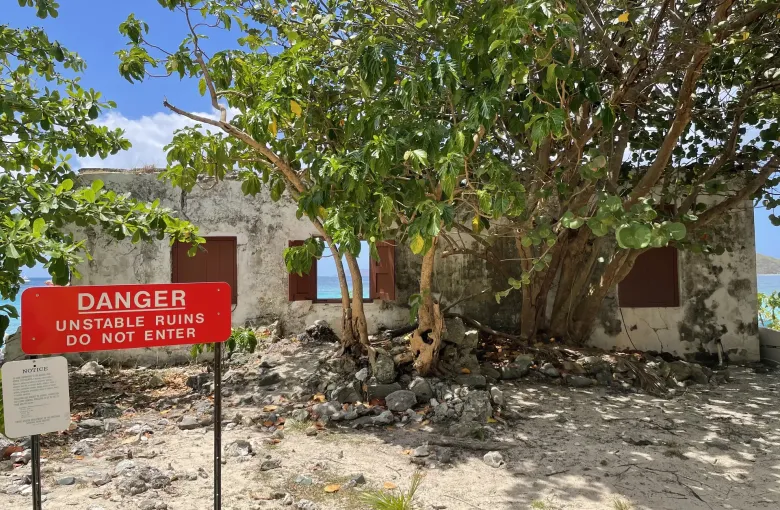
Seven acres, and all of them on the waterfront.
The National Park Service records that the park consists of seven acres centered on the Christiansted waterfront, or wharf area.
Seven acres is small, and the smallness is the point. This is not a landscape park; it is a preserved working harbor front, and everything in it stood where it stands because of what moved across that wharf.
The mandate, and why its second half matters more.
The Park Service states that the park's mandate is twofold: to preserve the historic structure and grounds within its boundaries, and to interpret the Danish economy and way of life in Christiansted between 1733 and 1917.
Preserving a fort is the easy half. Interpreting an economy is the harder one, and it is what distinguishes this site from a picturesque ruin. The Danish economy of Christiansted between those years was a sugar economy, and a sugar economy in the eighteenth-century Caribbean was built on enslaved labor. The park's own mandate is to explain that, not to decorate it.
Note the opening year. 1733 is the year the Akwamu Insurrection began on St John, and the same year appears at both ends of this territory's story. Our guide to Virgin Islands National Park sets out what the Park Service publishes about it.
1917, and what changed.
The Danish era the park interprets ends in 1917. That is the year these islands became a territory of the United States, and it is why a visitor finds Danish street names, Danish building forms and American law in the same square.
What is accessible here, and what is not.
The Park Service publishes both halves, which is rarer than it should be. The historic Fort Christiansvaern is not wheelchair accessible. The picnic area, the Scale House and the book store and visitor center are all accessible by wheelchair.
A visitor for whom that matters can therefore plan a real visit here rather than arriving to find out. The fort is one building among several, and the rest of the seven acres is reachable. Our accessibility guide sets out what the Park Service publishes for each site in the territory.
Not a World Heritage Site.
The United States States Party record at UNESCO does not list the Virgin Islands anywhere, inscribed or tentative. The protection here is federal, as a National Historic Site, and the Scale House and the fort stand because of that designation rather than an international one.
Photograph by Martin Lie, Trondheim, Norway, CC BY-SA 3.0, via Wikimedia Commons.
Sources
- National Park Service: Christiansted National Historic Site: that the park consists of seven acres centered on the Christiansted waterfront, and that its mandate is twofold, to preserve the historic structure and grounds within its boundaries and to interpret the Danish economy and way of life in Christiansted between 1733 and 1917. Accessed 18 September 2026.
- National Park Service: Christiansted National Historic Site accessibility: that the historic Fort Christiansvaern is not wheelchair accessible, while the picnic area, the Scale House and the book store and visitor center are all accessible by wheelchair. Accessed 18 September 2026.
- UNESCO World Heritage Convention: United States States Party record, which lists the World Heritage properties of the United States, among them Everglades National Park, and on which the Virgin Islands appear nowhere, in the inscribed list or the tentative one. Accessed 18 September 2026.
Other Articles
The Best Time to Visit the U.S. Virgin Islands
Accessible Travel in the U.S. Virgin Islands