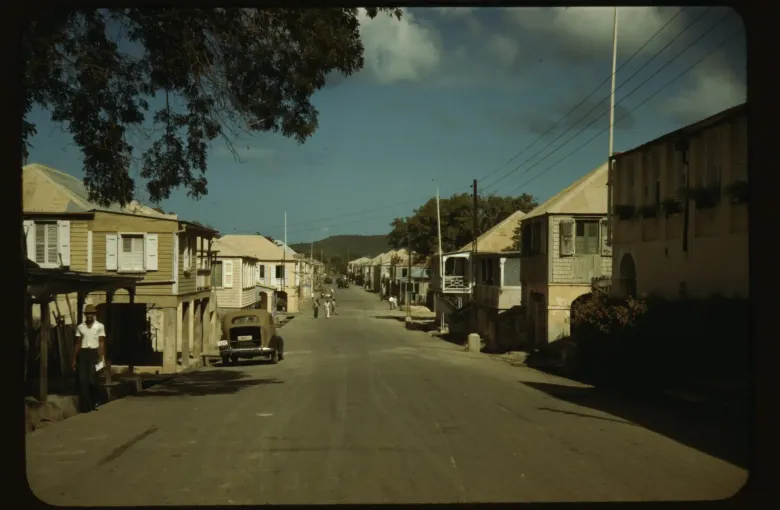
Danish for longer than American.
The National Park Service records that the mandate of Christiansted National Historic Site is to interpret the Danish economy and way of life in Christiansted between 1733 and 1917.
Read those dates. A hundred and eighty-four years of Danish administration, ending in 1917. That is why the towns are called Christiansted, Frederiksted and Charlotte Amalie, why the street names and the building forms are what they are, and why a visitor who arrives expecting an American small town finds something else entirely.
A much longer history underneath it.
The Park Service record for Salt River Bay states that every major period of human habitation in the Virgin Islands is represented there, naming several South American Indian cultures including the Taino and Island Caribs, the 1493 encounter with Columbus, the Spanish capture and removal of the island's Amerindian peoples, colonization attempts by several European nations, and enslaved West Africans and their descendants.
The Danish period is one chapter of that and not the beginning of it. The Park Service also records that a visitor to St John can visit the ancient petroglyphs of the Indigenous Taino, which is the oldest thing on this page by a wide margin.
The history that is not optional to mention.
The Park Service writes, of hiking to the historic plantation sites on St John, that they teach a challenging past when sugar and enslaved labor dominated life on the island.
That is the Park Service's own framing of the place a visitor walks through, and it is the context for the towns, the ruins and the calendar alike. Our diaspora guide and our guide to the national park follow it.
One practical courtesy that is really a safety rule.
The Park Service asks visitors to remember that we drive on the left here in the Virgin Islands and that a pedestrian should walk facing traffic, which would be the right side of the road.
Getting that right is the most visible way a visitor shows they have paid attention, and the most consequential way they can fail to. Our transportation guide explains it.
Not the British Virgin Islands.
A few miles away is a separate country with a similar name, a different government and different laws. Knowing which one you are in is not pedantry; the entry rules, the currency arrangements and the emergency arrangements are not the same. This guide is about the United States territory.
What this guide will not assert.
No greeting convention, no dress code, no tipping norm and no account of local custom appears on this page. The bodies that would publish those refuse every request from this environment, and none of the federal sources used here describes social convention.
Invented etiquette is worse than none, because a visitor will follow it. Watch what people around you do, ask when you are unsure, and treat a place somebody lives in as somewhere you are a guest.
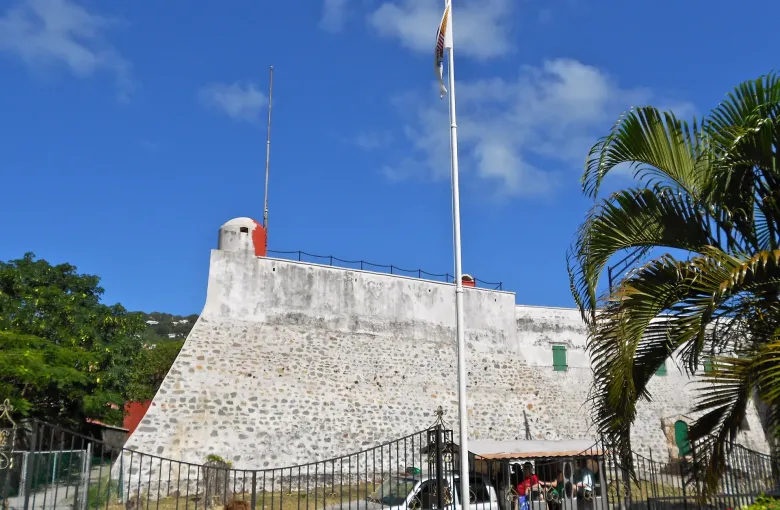
Photograph by Kathmorgo, CC BY-SA 4.0, via Wikimedia Commons.
Sources
- National Park Service: Christiansted National Historic Site: that the park consists of seven acres centered on the Christiansted waterfront, and that its mandate is twofold, to preserve the historic structure and grounds within its boundaries and to interpret the Danish economy and way of life in Christiansted between 1733 and 1917. Accessed 18 September 2026.
- National Park Service: Salt River Bay National Historical Park and Ecological Preserve: that every major period of human habitation in the Virgin Islands is represented there, including several South American Indian cultures among them the Taino and Island Caribs, the 1493 encounter with Columbus, Spanish capture and removal of the island Amerindian peoples, attempts at colonization by several European nations, and enslaved West Africans and their descendants. Accessed 18 September 2026.
- National Park Service: Virgin Islands National Park: the invitation to hike to historic plantation sites to learn about a challenging past when sugar and enslaved labor dominated life on the island, and to visit the ancient petroglyphs of the Indigenous Taino. Accessed 18 September 2026.
- National Park Service: Virgin Islands National Park basic information: the instruction that we drive on the left here in the Virgin Islands, that a visitor should pay extra attention when making turns, pulling out into traffic or crossing the road, and that a pedestrian should walk facing traffic, which here is the right side of the road; and that the park is comprised of 7,259 acres of terrestrial habitat, about 60 percent of the island land mass, together with 5,650 acres of adjacent submerged lands and some 800 species of plants. Accessed 18 September 2026.
Other Articles
Tracing African Heritage in the U.S. Virgin Islands
Festivals and Public Days in the U.S. Virgin Islands