What this page cannot tell you, and why.
This guide names no dish. That is a finding rather than an omission and it belongs first.
The bodies that would publish an authoritative account of food here are the territory's own tourism websites, and both of them refuse every request from this environment outright. There is no partial answer to work from and no cached page to read. The federal sources these guides are built on are a park service, a customs agency, a hurricane center and a heritage convention, and none of them describes a restaurant.
A page that filled that gap from general knowledge would be indistinguishable, to a reader, from a page that had checked. This one says what it knows.
What is established, and it bears on what is on the plate.
The National Park Service describes Buck Island Reef National Monument as holding endangered elkhorn coral reefs, and records that President John F. Kennedy called it the finest marine garden in the Caribbean Sea. These are federally protected waters.
Seafood in this territory therefore comes from a working fishery operating under rules rather than from whatever a visitor can reach. Eat what someone licensed has landed, and leave the reef where it is.
Why the food here has the history it has.
The Park Service record for Salt River Bay states that every major period of human habitation in the Virgin Islands is represented there: several South American Indian cultures including the Taino and Island Caribs, the 1493 encounter with Columbus, Spanish capture and removal of the island's Amerindian peoples, attempts at colonization by several European nations, and enslaved West Africans and their descendants.
That sequence is the reason a Virgin Islands kitchen is what it is, and it is the one thing about food here this guide can say with a citation behind it. The Park Service elsewhere records a past in which sugar and enslaved labor dominated life on the island. Cooking in these islands grew out of that, and our diaspora guide follows the history further.
The photograph, and what it is not.
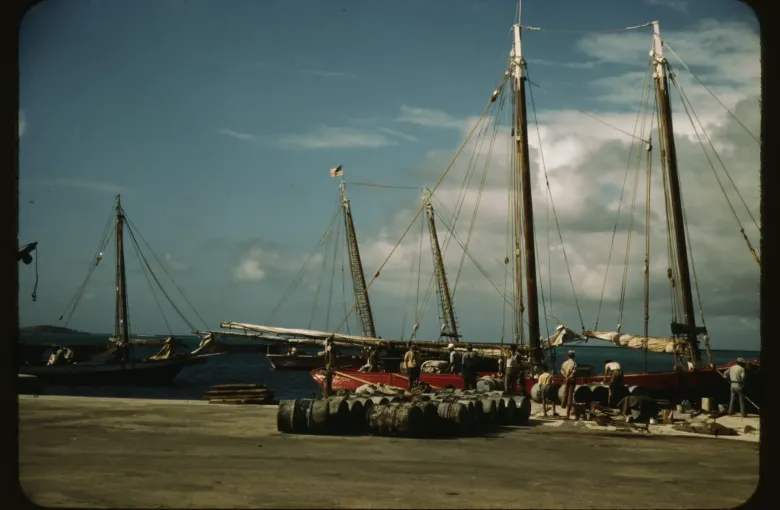
The image on this page is a street in Frederiksted on St Croix, photographed in color in 1941. It shows the wooden and masonry buildings that still line these towns. It is not a picture of a restaurant and it is not a picture of today, and both of those are stated because an undated archival frame on a food page would quietly imply otherwise.
How to find out what is worth eating.
Ask locally, on the ground, and take a recommendation from somebody with nothing to sell you. That is ordinary advice everywhere, and here it is the only honest advice, because the alternative is this guide inventing an authority it does not have.
Sources
- National Park Service: Buck Island Reef National Monument: that President John F. Kennedy called it the finest marine garden in the Caribbean Sea, that it holds a famous underwater trail and endangered elkhorn coral reefs, and that there are trails on the 176-acre island leading to an observation platform. Accessed 18 September 2026.
- National Park Service: Salt River Bay National Historical Park and Ecological Preserve: that every major period of human habitation in the Virgin Islands is represented there, including several South American Indian cultures among them the Taino and Island Caribs, the 1493 encounter with Columbus, Spanish capture and removal of the island Amerindian peoples, attempts at colonization by several European nations, and enslaved West Africans and their descendants. Accessed 18 September 2026.
- National Park Service: Virgin Islands National Park: the invitation to hike to historic plantation sites to learn about a challenging past when sugar and enslaved labor dominated life on the island, and to visit the ancient petroglyphs of the Indigenous Taino. Accessed 18 September 2026.
Other Articles
Culture and Etiquette in the U.S. Virgin Islands
Festivals and Public Days in the U.S. Virgin Islands