The short version
Layers for a day that changes altitude, real footwear, sun protection that works on snow, and four specific items the advisory asks you to carry outside urban areas. Then two things you cannot pack and must do before leaving: check the passport's issue date, and check the insurance clause.
⚠ Two things to do before you pack anything
Check your passport's date of issue, not only its expiry. It must be less than 10 years before you arrive, and its expiry must be at least 3 months after you leave the Schengen area. Both tests, independently. The issue-date test is the one people fail, because a passport renewed before October 2018 can carry extra months and look perfectly valid.
Check that your travel insurance covers what you will actually do. For skiing, potholing and mountaineering, and for anything classed as particularly dangerous, the advisory says a policy should include mountain rescue services, helicopter costs, and repatriation or transfer to a neighboring country for treatment. Check the policy against those three items now rather than after an accident, because Swiss healthcare is billed to a visitor and a helicopter is a real bill.
Worth having with you as documents: a hotel booking, proof of insurance, a return or onward ticket, and a card. Switzerland's entry page may ask for all four, along with proof of around 100 Swiss francs a day.
Clothing, for altitude rather than for season
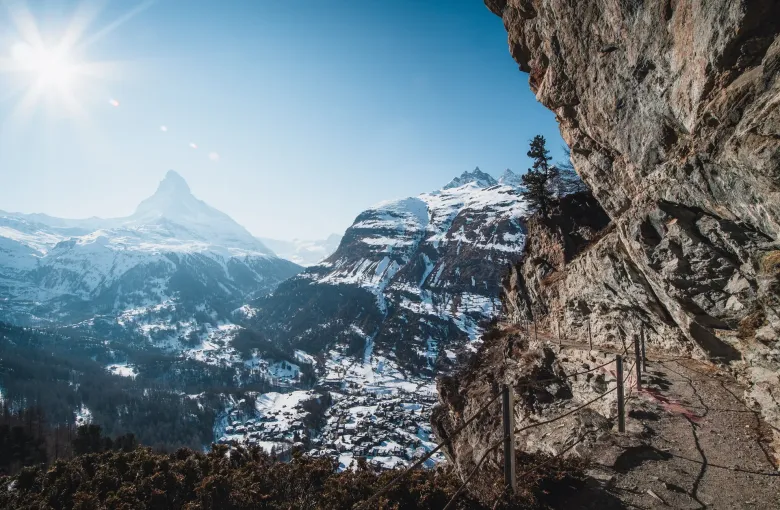
The Swiss packing problem is that one itinerary contains two climates. Pack so that a single day can go from a lakeside town to a glacier viewpoint:
- Layers you can add and shed, including a warm mid layer in every season. It is cold at the top of a cable car in August.
- A genuine waterproof and windproof shell. Sudden weather changes are on the advisory's year-round hazard list.
- Gloves and a hat even in summer if your itinerary goes high.
- Sun protection that works on snow and at altitude: high-factor cream, sunglasses that are actually dark enough, and lip protection. Sun exposure is on the same hazard list, and snow doubles it.
- Long trousers for hiking days. The health page names biting insects and ticks especially between April and October, which is the whole hiking season.
Footwear, which is the item people get wrong
Trainers are fine for Berne, Lucerne and Lavaux. They are not fine for a mountain trail, and the gap between a marked Swiss hiking path and a mountain route is larger than it looks on a map. If your itinerary includes anything above a valley, bring boots with ankle support and a sole you trust on wet rock.
If you plan to walk on or near a glacier, that is a guided activity with its own equipment requirements, and the guide sets them. Ask rather than guess: glacial crevasses and hollows are on the hazard list for a reason.
⚠ The four items the advisory asks you to carry
When traveling outside urban areas, the office asks you to always carry a map, a compass, a GPS and a fully charged mobile. It also asks you not to undertake any activity alone, to consider hiring a guide, and to leave a copy of your itinerary with somebody.
A phone is not a substitute for the other three, which is the point of listing four. Mountain signal is unreliable and a battery is colder and shorter at altitude, so a power bank earns its space. If you are going off-piste or ski touring in winter, add avalanche search equipment: the advisory records that beepers are the most common rescue device and, properly used, the fastest way of locating an avalanche victim.
Money and electronics
Bring a card and some Swiss francs, not euros. Switzerland uses the franc and is not in the euro area; a mountain hut or a farm stall is exactly where cash is needed and a card reader is not.
Switzerland has its own plug standard, and while many devices with the standard continental European two pin plug will fit a Swiss socket, the Swiss three pin socket is not the same as the German or French one. Pack a travel adapter that explicitly covers Switzerland rather than assuming a European adapter will do. The supply is 230 volts.
Health items
Bring what you normally take, in its original packaging, with a copy of the prescription. The legal status and regulation of some medicines differs between countries, so check anything unusual before you travel rather than at the border.
At least eight weeks before the trip, check the current vaccine recommendations. The CDC suggests considering hepatitis A for most travelers, recommends hepatitis B for unvaccinated travelers under sixty, and on tick-borne encephalitis recommends the vaccine for anyone who will have extensive exposure to ticks based on their planned outdoor activities. For a walking holiday here that is a real conversation rather than a formality.
Insect repellent and a tick check at the end of an outdoor day cost nothing. And if your trip goes high, read about altitude sickness before you go: the advisory names the areas, and they include the ones most visitors choose.
⚠ One thing to leave at home in two cantons
In Ticino and St Gallen it is illegal to cover your face in public, including for tourists, with a fine of 100 to 10,000 Swiss francs. A balaclava is ordinary alpine winter kit and is inside that law if it is worn in a town, so pack a neck gaiter you can pull down and be aware of where you are.
What not to bother with
- No tropical disease precautions. There is no such risk here; the health risks the advisory names are ticks, insects and altitude.
- No euros for Switzerland. Bring francs, or a card and a bank machine.
- No currency to source in advance. The franc is freely available.
- No car, for most itineraries. The rail, bus and boat network reaches almost everything, and our transport guide explains why driving is usually the worse choice.
Verify Before You Travel
- The UK Foreign, Commonwealth & Development Office Switzerland safety and security page, for the four items to carry, the avalanche equipment and the insurance requirement.
- The UK Foreign, Commonwealth & Development Office Switzerland entry requirements page, for the passport tests and the documents you may be asked to show.
- The UK Foreign, Commonwealth & Development Office Switzerland health page, for the tick season, the altitude areas and the medication guidance.
- Your own insurer, against the three-item mountain clause, before you travel.
Sources
- UK Foreign, Commonwealth & Development Office: Switzerland travel advice. Accessed 16 September 2026.
- UK Foreign, Commonwealth & Development Office: Switzerland entry requirements: Schengen area rules, the two passport tests, the proof of accommodation, insurance, onward ticket and funds, the Entry/Exit System, and the Swiss customs rules. Accessed 16 September 2026.
- UK Foreign, Commonwealth & Development Office: Switzerland safety and security: the terrorism assessment, the crime picture, the drug penalties, the face-covering ban in two cantons, the adventure-sport insurance requirement and the year-round alpine hazards. Accessed 16 September 2026.
- UK Foreign, Commonwealth & Development Office: Switzerland health: the two emergency numbers, the eight week vaccination window, the April to October tick season and the named altitude-sickness areas. Accessed 16 September 2026.
Other Articles
Switzerland Weather Guide
Getting Around Switzerland