The short version
Three broad climates, separated by altitude. The northern plateau, where most Swiss people live, is temperate and unremarkable. The alpine interior is a mountain climate with its own rules. And Ticino, on the southern side of the Alps, is warm and Mediterranean-influenced in a way that surprises people who think of Switzerland as cold.
We publish no temperature figures on this page. Nothing in the sources we read for this build states a temperature for anywhere in Switzerland, so we state none. What we can tell you about is altitude, which is the variable that actually decides a Swiss day.
⚠ Altitude, not latitude
Switzerland is small. What makes its weather complicated is that it is also very tall, and a single day's itinerary can cross more vertical distance than a week's driving elsewhere. The practical consequences:
- A valley forecast does not describe the ridge above it. The town may be in sunshine while the pass is in cloud, and the difference can be a thousand meters of ascent.
- Conditions change fast. "Sudden weather changes" is on the advisory's list of year-round alpine hazards, alongside thunderstorms and sun exposure.
- Be equipped for the worst case rather than the forecast. That is the office's own wording, and it is the right instruction for a country where the worst case arrives in an hour.
- Carry a map, a compass, a GPS and a charged phone outside urban areas, and leave a copy of your itinerary with somebody.
The seasons, in terms of what you can do
Winter is settled and cold at altitude and often gray and damp on the plateau, where low cloud can sit for days while the mountains above it are in sun. That inversion is a real Swiss phenomenon and it is the reason a winter trip is often better high than low.
Spring is the most awkward season and the reason the shoulder weeks are cheap. Snowmelt brings landslides and flooding, both on the hazard list, and high routes are neither properly open nor reliably closed.
Summer is warm and long on the plateau and in the south, and it is thunderstorm season in the mountains. Afternoon storms build with very little notice on an exposed ridge, which is why alpine days start early.
Autumn is the quiet recommendation. Settled, clear and cooler, with the harvest in Lavaux and the mountain air at its most transparent. By late autumn the seasonal timetables start closing again.
⚠ What the weather is doing to the heritage, on the record
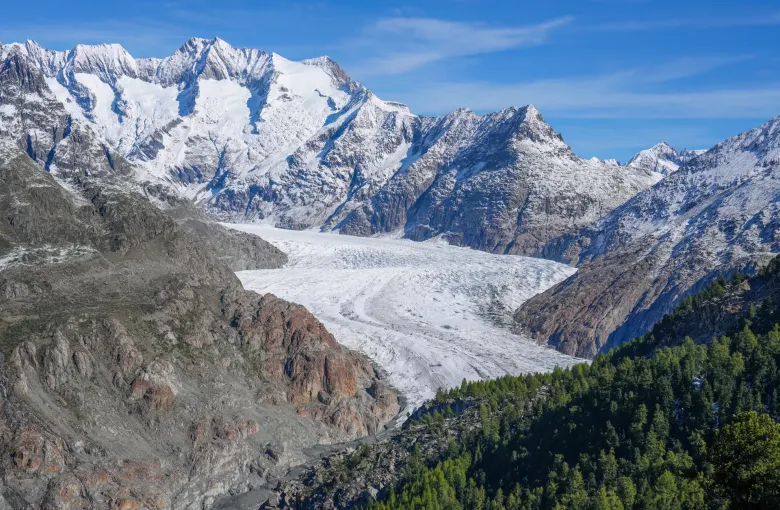
This is not editorial color. UNESCO's own inscription record for Swiss Alps Jungfrau-Aletsch says that the property features a wide diversity of ecosystems including successional stages due particularly to the retreat of glaciers resulting from climate change, and that the site is of outstanding universal value partly for the wealth of information it contains about ongoing climate change.
So the largest glacier in Eurasia is inscribed in part as a record of its own retreat. What that means for a visitor is simple and worth knowing: the glacier you see is not the glacier in the photographs, the access routes and viewpoints change as the ice moves, and a guide or an operator will know this year's arrangement when a guidebook does not.
The health side of Swiss weather
Three of the eight year-round hazards are medical rather than geological, and all three are weather items: altitude sickness, sun exposure and thunderstorms.
Altitude sickness is a risk in named parts of the country, including the Matterhorn, Saas-Fee, St Moritz, Corvatsch, Engelberg-Titlis, Belalp-Blatten, Chandolin, Hohensaas, Lauchernalp and the 4 Vallées. Sun exposure at altitude and on snow is far stronger than the same day would be at sea level. And the tick season the health page names runs April to October, which is the same stretch as the hiking season.
Verify Before You Travel
- The Swiss national weather service, and the avalanche bulletin in winter, on the morning of each mountain day rather than in advance.
- The UK Foreign, Commonwealth & Development Office Switzerland safety and security page, for the year-round hazard list and the alpine equipment advice.
- The UNESCO inscription record for Swiss Alps Jungfrau-Aletsch, for what it says about glacier retreat.
Sources
- UK Foreign, Commonwealth & Development Office: Switzerland travel advice. Accessed 16 September 2026.
- UK Foreign, Commonwealth & Development Office: Switzerland safety and security: the terrorism assessment, the crime picture, the drug penalties, the face-covering ban in two cantons, the adventure-sport insurance requirement and the year-round alpine hazards. Accessed 16 September 2026.
- UK Foreign, Commonwealth & Development Office: Switzerland health: the two emergency numbers, the eight week vaccination window, the April to October tick season and the named altitude-sickness areas. Accessed 16 September 2026.
- UNESCO World Heritage Centre: the inscription of Swiss Alps Jungfrau-Aletsch in 2001 under criteria (vii)(viii)(ix), extended in 2007 to 82,400 ha. Accessed 16 September 2026.
Other Articles
Best Time to Visit Switzerland
Switzerland Packing List