The short version
Be on time, be quiet, and remember that the rules can change when you cross a cantonal boundary. Those three cover most of a visitor's first week. Underneath them is a country that is genuinely plural: four national languages, twenty six cantons with real legislative power, and a political culture built on local decision rather than central instruction.
The four languages, and what to do about them
German, French, Italian and Romansh. In practice the country is divided into language regions rather than being individually multilingual: a person in Zurich speaks German, a person in Lausanne speaks French, and both may well speak English to you before they speak each other's language.
Two practical points. The German you hear is Swiss German, which is spoken rather than written and differs substantially from the standard German on the signs, so do not be surprised if the language you learned does not sound like the language you hear. And a few words in the language of the region you are in is appreciated precisely because nobody expects it of a visitor.
English is widely spoken in cities, in tourism and among younger people. Rail announcements, signage in stations and museum labeling are frequently multilingual.
⚠ Twenty six cantons, and rules that actually differ
This is the etiquette point with teeth, and the clearest example is a law. In Ticino and St Gallen it is illegal to cover your face in public, including for tourists, with a fine of 100 to 10,000 Swiss francs. Two cantons out of twenty six, which means a rule that applies in Lugano and not in Lucerne.
The general lesson is more useful than the specific law: Swiss federalism is not decorative. Shop opening hours, alcohol rules, quiet hours and local regulations are set locally, so "in Switzerland you can..." is often only true in some of it. If something matters to your trip, check it for the canton you will be in.
Punctuality, quiet and privacy
Punctuality is real and it is not a joke about trains. Arriving late to a reservation, a tour or a meeting is a discourtesy, and the system around you assumes you will be on time because it is. If a cable car leaves at a stated minute, it leaves at that minute.
Quiet is a shared expectation. Trains have quiet coaches and people use them. Residential quiet hours are taken seriously, including on Sundays, and a loud group in a hotel corridor or a mountain village at night is noticed in a way it would not be elsewhere.
Privacy and discretion run deep. Conversation with strangers is friendly and reserved rather than effusive, personal questions come later than many visitors expect, and conspicuous display is not admired. None of that is coldness; it is a different default.
What the Old City of Berne says about all this
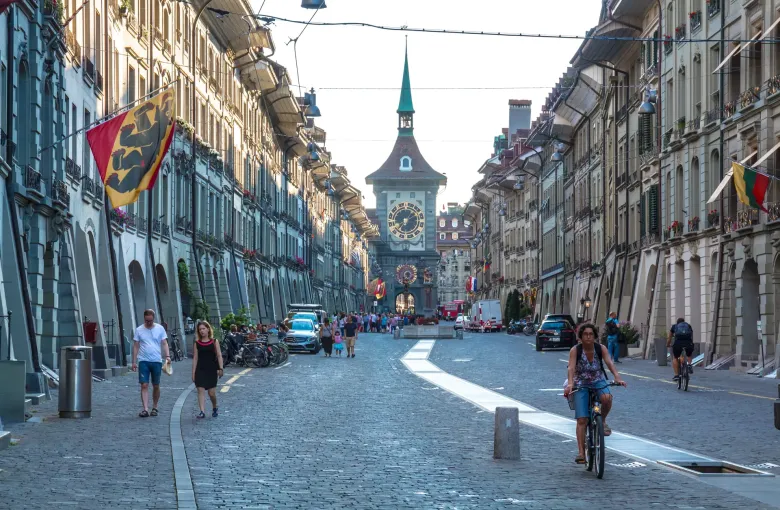
The federal capital's center is a World Heritage property and it is worth reading as a statement of the same values. The Old City of Berne was inscribed in 1983 under criterion (iii) alone, and UNESCO's reason is planning: founded in the twelfth century on a hill inside a bend of the Aare, it developed over the centuries in line with an exceptionally coherent planning concept.
Most of the medieval town was restored in the eighteenth century and retained its original character, and its arcades and fountains are still in daily use rather than preserved as exhibits. A capital city whose center is a continuous, coherent, six-kilometer run of arcaded shopfronts, quietly maintained for eight hundred years, is a fairly precise expression of how the country likes to do things. Our Old City of Berne guide covers it properly.
Everyday courtesies
- Greet with a handshake in a formal setting, and greet shopkeepers and bus drivers when you enter. Not greeting is the most common small rudeness a visitor commits.
- Use the formal address until invited otherwise, in German and in French alike.
- Take your rubbish with you, particularly in the mountains. Swiss waste rules are strict and littering a trail is a serious social offense.
- Greet people on a hiking path. It is standard and it is not optional.
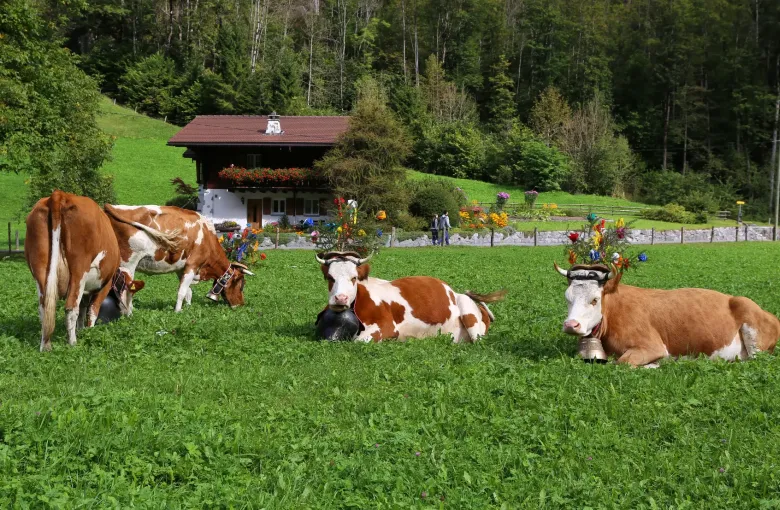
- Close gates on alpine pasture, and give cattle a wide berth: a working alp is a farm, not a park.
- Do not haggle. Prices are prices.
Drugs, in one paragraph
The advisory states that illegal drugs, including cannabis, carry severe penalties in Switzerland, with a long jail sentence and heavy fines for possessing, using or smuggling them, including when transiting through an airport. If your trip also includes the Netherlands, note that the Dutch arrangements are different and do not travel with you. We publish no reading of Swiss drug law of our own; our travel safety guide sets out what the advisory says.
Verify Before You Travel
- The UK Foreign, Commonwealth & Development Office Switzerland safety and security page, for the face-covering ban and its fine, and for the drug penalties as that office states them.
- The canton or commune you are visiting, for local rules, which genuinely differ.
- The UNESCO inscription record for the Old City of Berne, for the planning concept described above.
Sources
- UK Foreign, Commonwealth & Development Office: Switzerland travel advice. Accessed 16 September 2026.
- UK Foreign, Commonwealth & Development Office: Switzerland safety and security: the terrorism assessment, the crime picture, the drug penalties, the face-covering ban in two cantons, the adventure-sport insurance requirement and the year-round alpine hazards. Accessed 16 September 2026.
- UNESCO World Heritage Centre: the inscription of the Old City of Berne in 1983 under criterion (iii), 91.86 ha in the Canton of Berne. Accessed 16 September 2026.
Other Articles
Switzerland and Diaspora Reconnection
Switzerland Festivals and Celebrations