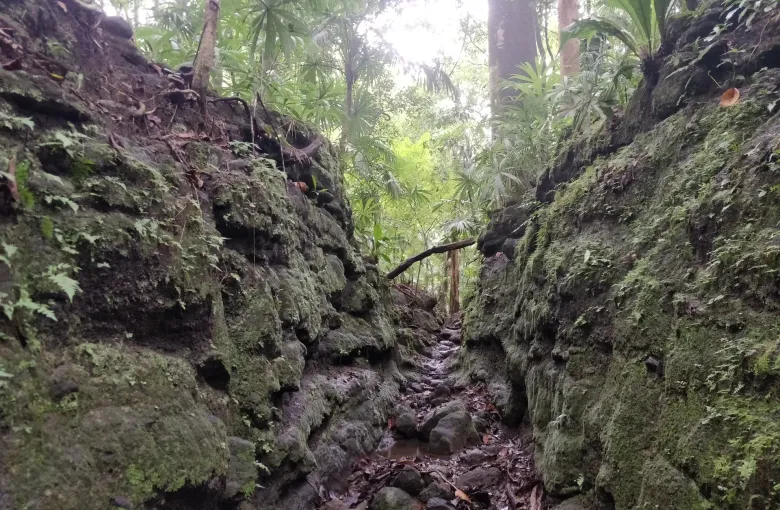
Fortifications on the Caribbean Side of Panama: Portobelo-San Lorenzo was inscribed in 1980 under criteria one and four, as a serial property. It is two places rather than one: the bay and batteries at Portobelo, and the cliff fort of San Lorenzo standing over the mouth of the Chagres river about eighty kilometers west.
⚠ It is on the List of World Heritage in Danger
The property was placed on the List of World Heritage in Danger in June 2012, and it has not come off. The reasons recorded against it are environmental decay, uncontrolled development around the monuments and the condition of the masonry itself. That is the property's current status, not a historical note, and a visitor should know it: what you are looking at is a World Heritage site that the Committee considers to be at risk, which changes how it feels to stand in it.
Going is not the problem and is arguably part of the answer. Going respectfully, with a local guide, spending money in the town rather than only in the bay, is the version of this visit worth making.
Why here
For close to two hundred years the silver of Peru was shipped up the Pacific coast, carried across the isthmus by mule and loaded onto the treasure fleets at Portobelo. The town held one of the great fairs of the Spanish empire, for a few weeks a year, and was a small malarial bay for the rest of it. That made it the richest target in the Americas, and it was sacked accordingly: Francis Drake died offshore and is buried somewhere in the bay; Henry Morgan took it in 1668; Admiral Vernon took it in 1739 and the news was celebrated in London so loudly that a street was named for it. San Lorenzo guarded the other route, the river, and was taken too.
What to see
- The batteries at Portobelo. Santiago and San Jeronimo sit right on the water, with their gun embrasures still facing the bay. You can walk them freely.
- The Real Aduana. The royal customs house on the square, where the silver was counted, restored and holding a small museum.
- The Church of San Felipe. Home of the Black Christ, the Nazareno, which is the focus of one of the largest pilgrimages in the Americas each October. See the festivals guide.
- Fort San Lorenzo. A separate trip, reached through the former Canal Zone forest at Sherman, and worth it for the position alone: a walled fort on a cliff above the river mouth with howler monkeys in the trees on the approach.
Practicalities
Portobelo is about two hours from Panama City by road and is an easy day trip, better as an overnight if you want the town rather than the forts. It is hot, humid and very green. San Lorenzo needs its own half day and a vehicle.
Portobelo is in Colon province, and the cited health source records malaria transmission in Colon among the provinces where it occurs, so bite avoidance applies here. See the travel safety guide. The town is also the home of Congo culture, which is a subject in its own right and has its own page: the Congo coast guide.
Sources
- UNESCO World Heritage Centre: Fortifications on the Caribbean Side of Panama: Portobelo-San Lorenzo, a serial property inscribed 1980 under criteria one and four, and placed on the List of World Heritage in Danger in June 2012. Accessed 17 September 2026.
- UNESCO World Heritage Centre: Panama States Party record: five properties inscribed on the World Heritage List. Accessed 17 September 2026.
- UK Foreign, Commonwealth & Development Office: Panama travel advice: the index to the entry, safety, regional and health pages this cluster draws on, and the standing guidance that no travel can be guaranteed safe. Accessed 17 September 2026.
- Centers for Disease Control and Prevention: Panama traveler health: yellow fever vaccine recommended for travelers aged nine months and over going to all mainland areas east of the Canal Zone including Darien Province and the comarcas of Embera and Guna Yala, and not recommended for travel limited to the Canal Zone, areas west of it, Panama City, the Pearl Islands of Panama Province or the San Blas Islands of Guna Yala; not required for direct travel from the United States and required for travelers aged one year and over arriving from a country with a risk of transmission; malaria transmission recorded in seven provinces and three comarcas with rare cases elsewhere, and no transmission in the Canal Zone or in Panama City. Accessed 17 September 2026.
Other Articles
Best Time to Visit Panama
What to Pack for Panama