Panama's African-descended population is not one community with one story. It is two, separated by roughly three hundred and fifty years, and telling them apart is the first courtesy a visitor can offer.
The Congos
From the sixteenth century, enslaved Africans brought to carry silver across the isthmus escaped into the forest behind the Caribbean coast and established free communities. The Spanish called them cimarrones. They fought the colonial authorities for decades, allied with English privateers against them, and eventually negotiated recognition and their own towns.
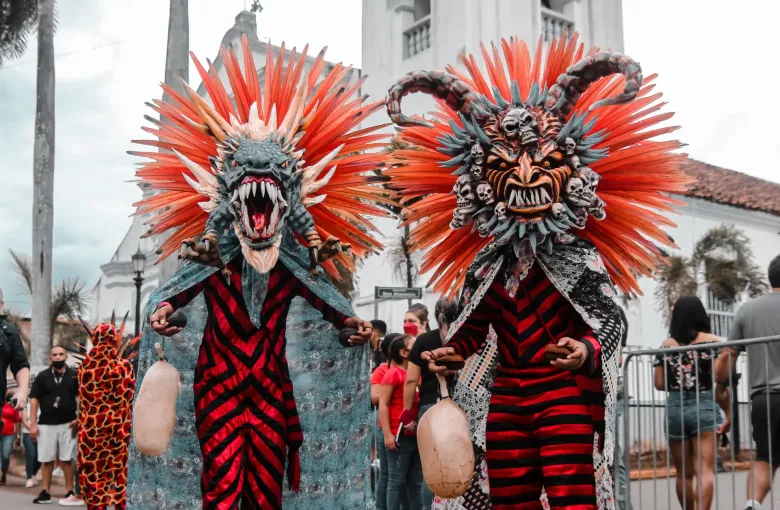
What survives is not a memory but a living practice. Congo is a tradition of drumming, call and response singing, dance and improvised theater performed along the Costa Arriba around Portobelo, most intensely between the middle of January and Ash Wednesday. Its language is a deliberately inverted Spanish, developed so that the enslavers could not follow it. Its characters satirise the colonial order: the queen, the devils, the escaped ancestors. It is funny, loud and pointed, and it is still performed by the descendants of the people who invented it.
The devil masks of the Congo tradition are made in the same towns and are a genuine art form. Buy one from the maker.
The Afro-Antillean community
The second history is industrial. From the 1850s, and above all between 1904 and 1914, tens of thousands of West Indian workers came to build first the railroad and then the canal, mostly from Barbados, Jamaica, Martinique and Guadeloupe. They did the most dangerous work on the project, were paid in silver while North American employees were paid in gold, and died in numbers nobody counted accurately.
Their descendants are a distinct Panamanian community with their own churches, their own English based creole, their own food and their own neighborhoods in Colon, in the old canal towns and in Panama City. The coconut rice, the saus and the patties on the Caribbean coast are theirs, and so is a great deal of Panamanian music.
Where to go
- Portobelo. The Congo heartland, and a World Heritage site in its own right. Casa Congo and the artist collectives in the town are the way in. See the Portobelo guide.
- The Afro-Antillean Museum, Panama City. Small, housed in a former church in the old canal quarter, and the clearest telling of the canal labor story anywhere in the country.
- Colon. The Caribbean terminus, the heart of the Afro-Antillean community and a city with a hard reputation. Go with a local guide, in daylight, and spend money there.
- The Costa Arriba. The string of coastal villages beyond Portobelo, where the Congo season is at its most alive.
Visiting well
- Congo performance is a tradition, not a floor show. Where it is presented for visitors it is presented deliberately, and that is fine; where it is not, watch from a distance or do not watch.
- Ask before photographing people, and accept no. See the culture guide.
- Hire local guides and eat in local kitchens. The money staying in the community is the difference between a visit and an extraction.
- The coast is hot, humid and in a province where the cited health source records malaria transmission. See the travel safety guide.
Sources
- UK Foreign, Commonwealth & Development Office: Panama travel advice: the index to the entry, safety, regional and health pages this cluster draws on, and the standing guidance that no travel can be guaranteed safe. Accessed 17 September 2026.
- UNESCO World Heritage Centre: Fortifications on the Caribbean Side of Panama: Portobelo-San Lorenzo, a serial property inscribed 1980 under criteria one and four, and placed on the List of World Heritage in Danger in June 2012. Accessed 17 September 2026.
- UNESCO World Heritage Centre: The Colonial Transisthmian Route of Panama, a serial property inscribed 2025 under criteria two and four, recording the settlements, historic towns, archaeological sites and stretches of road that connected the Caribbean Sea to the Pacific Ocean until the middle of the eighteenth century, with the Camino de Cruces recorded as the direct antecedent of the nineteenth century Panama Railroad and of the canal that opened in 1914. Accessed 17 September 2026.
- Centers for Disease Control and Prevention: Panama traveler health: yellow fever vaccine recommended for travelers aged nine months and over going to all mainland areas east of the Canal Zone including Darien Province and the comarcas of Embera and Guna Yala, and not recommended for travel limited to the Canal Zone, areas west of it, Panama City, the Pearl Islands of Panama Province or the San Blas Islands of Guna Yala; not required for direct travel from the United States and required for travelers aged one year and over arriving from a country with a risk of transmission; malaria transmission recorded in seven provinces and three comarcas with rare cases elsewhere, and no transmission in the Canal Zone or in Panama City. Accessed 17 September 2026.
Other Articles
Darien National Park
Panamanian Culture and Etiquette