Two decisions before you book
Mexico is visited comfortably by travelers in their sixties, seventies and beyond, and a substantial community of older North Americans spends part of every year there. Two things deserve real thought first, and both are easier to settle before flights than after.
Altitude
Mexico City is above 2,200 meters, and Puebla, San Miguel de Allende, Guanajuato and the Oaxaca valleys are comparable. That is high enough to matter to anyone with a heart or lung condition, and fitness is a poor predictor. Air quality in the capital in the dry months is a second factor for anyone with a respiratory condition.
Talk to your own clinician before booking. This page publishes no medication and no dose; that decision belongs to the person who knows your history. Give the trip a couple of quiet days at the start rather than arriving and going straight up a pyramid, and acclimatize before doing anything strenuous.
Worth knowing: a Mexico trip that stays low is a real trip, not a consolation. The Yucatan, Merida, the Caribbean coast and Baja California Sur are at or near sea level.
Surfaces
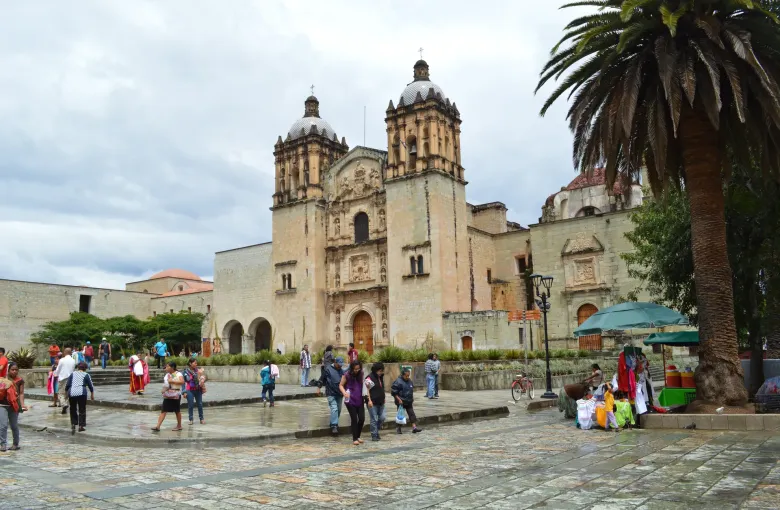
The second thing is more mundane and affects more people. Colonial centers are cobbled, curbs are high and uneven, and archaeological sites are stone. Supportive shoes with a real sole matter more here than they would at home, and a walking pole is not an admission of anything.
Pacing
- Two nights minimum in each place, and preferably three. Mexico rewards staying put more than it rewards covering ground.
- Half days. One site or one neighborhood in a morning, then lunch, is a better day than two of anything.
- Start early. Cooler, quieter, and in the rainy season ahead of the afternoon downpour.
- Consider a private guide and driver for the archaeological days. The cost difference is smaller than expected and the difference in tiredness is large.
- Fly the long legs. First class buses are excellent, but a twelve hour overnight coach is not the best use of a day at any age.
Merida, and why it suits this kind of trip
Worth naming specifically. Merida is flat, safe, at sea level, full of colonial architecture and good food, and is within reach of Uxmal, Chichen Itza, cenotes and the Gulf coast. As a single base for a week or two, with days out, it asks less of a traveler than a multi-city itinerary and gives up very little.
Teotihuacan realistically
The site is enormous. The Avenue of the Dead runs more than two kilometers between the main complexes, at altitude, with very little shade and an uneven surface. It is entirely doable and it is not a stroll.
What helps: go at opening, use the multiple entrance gates so you can start near what you most want to see rather than walking the whole avenue by default, take water and a hat, hire a guide who will set your pace, and accept that the pyramids themselves are usually closed to climbing now anyway. A half day done gently beats a full day endured.
Health and insurance
- Travel insurance covering pre-existing conditions and including medical evacuation. Medical services outside state capitals may be limited.
- Medication in original labeled packaging in your carry on, with more than the trip needs and a copy of the prescription. Some medicines available over the counter at home need a local prescription.
- A short written summary of your conditions and medication in Spanish.
- A travel clinic appointment about eight weeks ahead. The reassuring part: the CDC records yellow fever vaccine as neither recommended nor required for Mexico, and no malaria transmission in Quintana Roo, Yucatan or the capital.
- 911 for emergencies, the same number as at home.
- Food and water care matters more than any of the above: bottled or boiled water, and no ice outside established venues.
Comfort
- Highland nights are cold and rooms are often unheated. Ask about heating when booking.
- Carry your passport and entry stamp rather than a copy, as our Mexico visa and entry requirements guide explains.
- Small notes for tips, bathrooms and toll roads.
- Lunch is the main meal and is served late; dinner later still. Adjusting to that is more comfortable than fighting it.
Verify before you travel
Insurance terms, medical arrangements and site access change. Confirm each with the provider rather than relying on a summary.
Sources
- UK Foreign, Commonwealth & Development Office: Mexico health: the emergency number 911 and the emergency buttons on Mexico City street cameras, the eight week lead time before travel, the limits of medical and ambulance services outside state capitals, altitude sickness in parts of the country, dengue, chikungunya, Zika, air pollution and Cyclospora, and the advice to drink only boiled or bottled water and avoid ice. Accessed 16 September 2026.
- US Centers for Disease Control and Prevention: Travelers' Health, Mexico: the record that yellow fever vaccine is neither recommended nor required, and the malaria map limiting transmission to Campeche, Chiapas and the southern part of Chihuahua, recording it as rare in Oaxaca, Sinaloa, Sonora and Tabasco, and recording no transmission along the United States border. Accessed 16 September 2026.
- UK Foreign, Commonwealth & Development Office: Mexico safety and security: the requirement to carry the passport and entry stamp and the refusal of copies or photographs, the illegality of bringing in or selling vaping devices, robbery by unlicensed taxi drivers and the sitio and pre-paid airport alternatives, the Cancun taxi protests that have pulled visitors from ride hailing cars, theft and hijacking on buses and the case for first class services on toll roads, carjacking on the Pacific Highway, methanol in spirit drinks, low hotel balcony railings, the hurricane season from June to November and Hurricane Otis at Acapulco in 2023, and the LGBT+ legal position. Accessed 16 September 2026.
- UNESCO World Heritage Centre: the inscription of the Pre-Hispanic City of Teotihuacan in 1987, recording a settlement that grew between the first and seventh centuries into one of the largest ancient cities in the Americas with at least twenty five thousand inhabitants, its Avenue of the Dead aligned on the diverted San Juan River, the Pyramids of the Sun and the Moon, the Temple of Quetzalcoatl, and the talud-tablero architecture that spread from it. Accessed 16 September 2026.
Other Articles
Accessible Travel in Mexico
Getting Around Mexico