The short version
Two things are specific to France and the rest is ordinary European packing. The first is shoes, because the ground in the places you came to walk is rounded cobble, worn stone and stairs. The second is identification, because you are required to be able to produce it.
Identification, which is a legal requirement rather than advice
The safety advisory states that you must be able to prove your identity by providing documents when asked, or within four hours at a police station. What counts is a passport, a photo driver's license, or other documentation issued by a government body.
The practical consequence is a decision about your passport that most visitors would rather not make. Carrying it means risking the thing that is hardest to replace in a country whose advisory warns specifically about pickpockets. Leaving it in the room means relying on the four-hour provision. A photo driver's license is the compromise most travelers land on, and a photograph of the passport page on a phone is worth having either way as a fallback rather than as a substitute.
Shoes, which is the thing people get wrong
The surfaces are the argument. Vieux Lyon, the Marais, Montmartre, the Petite France quarter in Strasbourg, every walled town in Provence and the single street up Mont-Saint-Michel are rounded cobble, worn flagstone and steps, and they are what a French itinerary consists of. New sandals and smooth soles both fail.
Bring shoes you have already walked a long day in, with a sole that grips wet stone. Rain on polished cobble is the specific hazard, and it happens in every month in the north. One pair that handles a museum and a hill beats two that each do one job.
Layers, because the country has four climates
A trip that touches Paris and Provence, or the Loire and Brittany, crosses genuinely different weather. The reliable approach is a light insulating layer plus a windproof and showerproof shell rather than a single warm coat.
- Spring and autumn: a shell that handles wind and rain, one warm layer, and a scarf, which does more work than its weight anywhere in the north.
- Summer: light and loose, a hat, and something with sleeves for churches and for air conditioning. The advisory notes a risk of higher than normal temperatures in summer, so plan for heat rather than for warmth.
- Winter: a proper coat for the north and east, which is colder than its reputation, and much less for the Riviera.
- Mountains, any season: the mountain rule, because weather turns in an hour and altitude does most of the work.
Dress, which is about access rather than judgment
Nobody will stop you on a French street for what you are wearing, with one exception below. But churches and cathedrals are working buildings and a number of them are on your list, so covered shoulders and knees are worth being able to achieve without going back to the hotel. A light scarf and a layer you can put on solves it.
The exception is not about modesty and it is the law. Covering your face in a public place in France is illegal, the ban reaches any garment or mask used to hide the face, and the advisory states plainly that it applies to tourists. Not complying carries a fine of up to 150 euros. This is the one clothing question in France with a legal answer.
Health and small essentials
Bring your own medication in its original packaging with a copy of the prescription: the legal status of a medicine bought at home can be different in France, and the UK advisory points readers at guidance on traveling with medicines rather than assuming. Bring a health insurance card if you hold one, and understand that it is not a substitute for travel insurance, which the border may ask to see.
An insect repellent earns its space in summer, because the advisory names biting insects and ticks among French health risks, along with dengue and chikungunya. Sunscreen for the south. A refillable bottle, because tap water is drinkable and public fountains are common.
Electrical and connectivity
France uses the round two-pin European plug, and many sockets take the earthed variant with a pin in the socket rather than the appliance. Check the input rating printed on your own charger rather than trusting a table: almost everything modern is dual voltage and needs an adapter rather than a converter.
What to leave at home
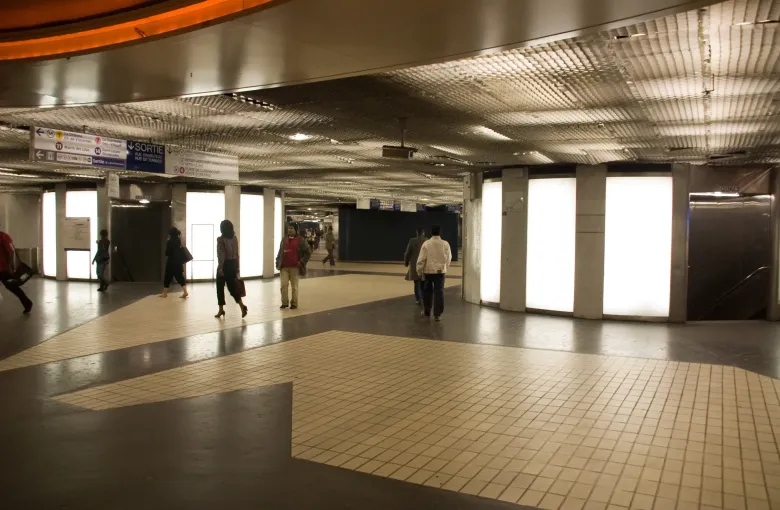
A separate camera bag that announces itself. Anything you would be distraught to lose on the Metro. Jewelry worth stealing. A suitcase with two wheels rather than four, on cobbles. And the assumption that a card covers everything, which our money guide corrects for markets and small bakeries.
Read this with our weather guide for what you are packing against, and our accessibility guide if the ground itself is the constraint rather than the footwear.
Sources
- UK Foreign, Commonwealth & Development Office: France safety and security: terrorism, industrial action and demonstrations, pickpocketing on the Metro and the RER, assaults on RER lines B and D, drink spiking, the identification requirement, the face-covering ban and its fines, swimming and riptides, driving law, winter equipment, pollution stickers, extreme heat and wildfires. Accessed 16 September 2026.
- UK Foreign, Commonwealth & Development Office: France health: the emergency number, vaccine timing, health risks including dengue, chikungunya, biting insects and ticks, altitude sickness, and what a health insurance card does and does not cover. Accessed 16 September 2026.
- UK Foreign, Commonwealth & Development Office: France entry requirements: Schengen area rules, visa-free stays of up to 90 days in any 180-day period counted across the whole area, the two passport validity tests, the attestation d’accueil, what a border officer may ask to see, the Entry/Exit System, and the cash declaration threshold. Accessed 16 September 2026.
Other Articles
France Weather Guide
Getting Around France