The short version
France uses the euro. Cards work in the overwhelming majority of places a visitor spends money, contactless is normal, and you do not need to arrive with cash. Carry a small amount anyway, for the handful of places below.
We publish no prices on this page. Access fees, tourist taxes, transport fares and restaurant costs all change, and our sources carry none of them, so a figure here would be a remembered number rather than a checked one. The only money figure on this page is the one the border cares about.
The declaration threshold
Declare cash or traveler's checks if the value is 10,000 euros or more when you enter France. You are given a certified declaration showing you brought it in, and that document is what you need when you take it out again. This is the whole of the customs money rule that reaches ordinary travelers.
Where cards work, and where they do not
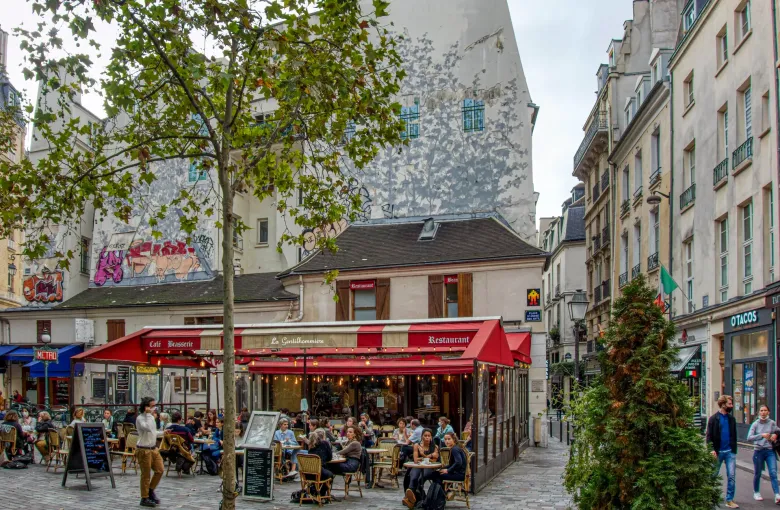
Cards are the default. Hotels, restaurants, supermarkets, rail tickets, museums, taxis and transport apps all take them, and small amounts by contactless are routine in a way that surprises visitors from places where a card is for large purchases.
The exceptions are worth carrying twenty euros for:
- Market stalls. Produce, cheese, flowers and bric-a-brac markets are often cash, and where a card is accepted there is frequently a minimum. This is the single most likely place a visitor gets caught.
- Small bakeries and cafes, particularly outside cities, sometimes set a card minimum that a coffee and a croissant do not reach.
- Rural tabacs and small village shops, where the terminal may exist and the signal may not.
- Public toilets, lockers and some parking meters, which want coins even where everything around them takes cards.
- Tips, which are easier in cash even in a card-first restaurant.
Cash machines, and the safety note attached to them
Machines are everywhere, including in the walls of banks on ordinary streets. Use one attached to a bank rather than a free-standing unit where you have a choice, and prefer daylight.
One line from the safety advisory belongs here rather than in a safety guide, because it is about the moment you are actually at the machine: the advice is not to get distracted around tourist attractions and cash machines. That is where the distraction method is used, and a cash machine is where a visitor is most reliably looking at a screen instead of at their bag.
Tipping, honestly
Service is included in a French restaurant bill by law, and the phrase on the bill says so. You are not filling a gap in someone's wages the way you may be at home.
What people actually do is round up or leave a small amount of change for good service in a cafe or a bistro, a few euros on a longer meal, and nothing at all for a coffee at a counter. Leaving a percentage calculated the way an American bill is calculated is generous rather than expected, and nobody will correct you. Taxis are rounded up. Hotel housekeeping is not tipped as a matter of routine.
Two practical notes
Tell your bank you are traveling, or expect a block on the first unfamiliar transaction. And choose to be charged in euros when a card terminal offers you your home currency instead, because the conversion offered at the terminal is rarely the better one.
Read this with our food guide, which is where most of the cash question actually arises, and our entry requirements for the rest of what the border asks about.
Sources
- UK Foreign, Commonwealth & Development Office: France entry requirements: Schengen area rules, visa-free stays of up to 90 days in any 180-day period counted across the whole area, the two passport validity tests, the attestation d’accueil, what a border officer may ask to see, the Entry/Exit System, and the cash declaration threshold. Accessed 16 September 2026.
- UK Foreign, Commonwealth & Development Office: France safety and security: terrorism, industrial action and demonstrations, pickpocketing on the Metro and the RER, assaults on RER lines B and D, drink spiking, the identification requirement, the face-covering ban and its fines, swimming and riptides, driving law, winter equipment, pollution stickers, extreme heat and wildfires. Accessed 16 September 2026.
Other Articles
Getting Around France
France Food Guide