The short version
France does not have a national cuisine so much as a set of regional ones that happen to share a border, and the difference between them is the fat they cook in. The north and west cook in butter and cream. The south cooks in olive oil. Alsace cooks like a German province, Brittany like an Atlantic one, and the south west like nowhere else in Europe.
The second thing to know is not about food at all. It is hours, and they are the reason visitors go hungry in the country with the best food in Europe.
The hours, which are the actual trap
Lunch runs roughly from noon to half past one, and dinner from half past seven to about half past nine. Outside those windows many kitchens are closed, and a restaurant with its lights on and its door open at four in the afternoon is often serving drinks rather than food.
The consequences are practical. Arriving in a small town at three with a train to catch at five means a bakery rather than a meal. A Sunday evening is the hardest slot of the week almost everywhere, and Monday is the most common closing day for a restaurant that opens Sunday. In August, add the holiday closures our guide to when to go describes.
Plan the day around lunch rather than fitting lunch into the day, which is also how the French do it.
The regions, briefly
- Normandy and Brittany. Butter, cream, apples and cider; oysters, mussels and scallops; buckwheat galettes in Brittany and sweet crepes everywhere. Camembert and Livarot are Norman.
- Alsace and the east. Pork, cabbage, potatoes, onion tart and dry Riesling. It reads German because the border moved back and forth across it for two centuries.
- Lyon and the Rhone. The offal-and-charcuterie capital, eaten in a bouchon, a small restaurant type specific to the city. The covered market is the argument for going.
- Provence and the Mediterranean. Olive oil, tomato, garlic, herbs, anchovy and fish. Lighter than the northern cooking and built on vegetables in a way the rest of France is not.
- The south west. Duck and goose, confit, cassoulet, walnuts and prunes. The richest regional cooking in the country and the one least like the French food served abroad.
- Burgundy. Beef, wine, mustard and snails, and the clearest example anywhere of a cuisine built around what the local wine wants.
Markets, which are worth building a day around
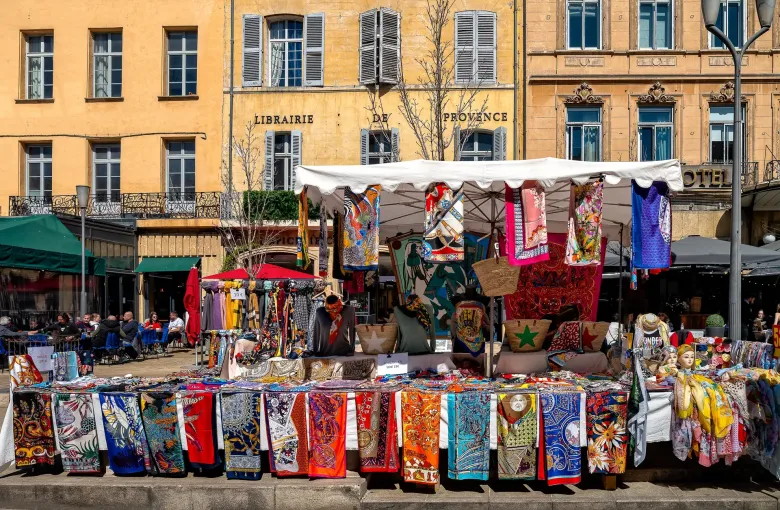
Almost every French town has a market on a fixed day of the week, in a square or under a hall, and it is where the regional difference above is visible rather than described. Cheese is the clearest case: a stall will carry thirty of them, most of which do not leave the region.
Two practical notes. Markets pack up by early afternoon, usually around one, so a market visit is a morning. And bring cash: stalls are often cash-only and a card, where accepted, may carry a minimum. Our money guide covers where else that applies.
How to eat well without trying hard
At lunch, look for the formule or menu du jour written on a board rather than printed. It is two or three courses at a fixed price, it is what the kitchen bought that morning, and it is the best value in French eating by a distance. A printed laminated menu in several languages in a tourist quarter is the opposite signal.
A boulangerie is a bakery and by law a place where the bread is baked on the premises if it calls itself that. A patisserie does pastry. A traiteur does prepared food to take away and is the best answer to a picnic. A brasserie serves food all day, which makes it the exception to the hours above and the thing to look for at four in the afternoon.
Bread, cheese and the order of things
Bread arrives without butter and is not a course. Cheese comes after the main and before dessert, not instead of it, and you take a small amount of two or three rather than a portion of one. Water is free if you ask for a carafe rather than a bottle. Coffee comes after dessert rather than with it, and asking for it with the meal marks you out more than anything else on this page.
None of that is enforced and nobody minds. It is simply the local order, and following it gets a better meal because the kitchen is built around it.
Dietary needs, honestly
Vegetarian eating in France has improved sharply in cities and remains difficult in rural restaurants of the classic kind, where the menu is built on meat and fish and a vegetable dish is a side. Provence is the easiest region by a wide margin. Learning to say what you do not eat in French matters more here than in most of Europe, because a server translating on your behalf may not.
One border note: there are restrictions on bringing food and drink into France, with narrow exceptions for powdered infant milk, infant food, special foods and pet feed required for medical reasons. If you are driving in with a cool box, read our entry requirements first.
Sources
- UK Foreign, Commonwealth & Development Office: France entry requirements: Schengen area rules, visa-free stays of up to 90 days in any 180-day period counted across the whole area, the two passport validity tests, the attestation d’accueil, what a border officer may ask to see, the Entry/Exit System, and the cash declaration threshold. Accessed 16 September 2026.
Other Articles
France Culture and Etiquette Guide
France Festivals and Celebrations