The short version
France is not one climate and it is not even two. It carries an Atlantic west, a continental center and east, a Mediterranean south, and two mountain ranges with weather of their own. A single packing decision covers none of that, and the most common mistake on a French trip is treating the country as its capital.
The Atlantic west and the Channel coast
Brittany, Normandy and the Atlantic coast get the weather the ocean sends them: mild, changeable, and wet in every month. Summers are comfortable rather than hot and rarely oppressive. Winters are gray and windy rather than freezing. Rain comes through in bands and clears, which is different in kind from a settled wet day, and it is why an umbrella is less use here than a jacket with a hood.
This is the part of France that reads as green, and the reason is that it is being watered all year.
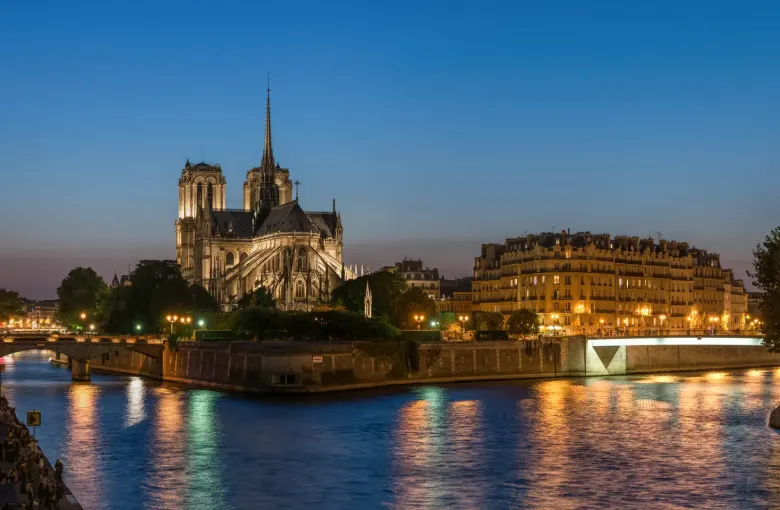
Paris and the continental middle
Paris, the Loire, Burgundy, Alsace and the east swing further than the coast in both directions. Summers are properly warm and can be hot. Winters are cold, damp and short of daylight, with the gloom rather than the temperature doing the damage. Spring and autumn are the transitional seasons that make the shoulder months work, and they are also unreliable week to week.
Alsace and the east are the coldest inhabited part of lowland France in winter, which is worth knowing if a Christmas market trip is the plan.
The Mediterranean south
Provence, Languedoc, the Riviera and Corsica run on a different calendar. Summers are hot and dry, with long rainless spells. Winters are mild, and the rain arrives in short violent bursts in autumn rather than being spread across the year.
The UK advisory carries two warnings that both belong here. In summer months there is a risk of higher than normal temperatures, with a pointer to the French weather service for forecasts. And the wildfire risk is highest in the south, along the Mediterranean coast, in Corsica, and in parts of the south west in hot dry weather.
The Mistral, which is a real planning factor
The wind that runs down the Rhone valley to the Mediterranean is cold, dry and persistent, and it blows hardest in winter and spring. It scours the sky to the hard blue that painters came to Provence for, and it can make a warm day feel cold and an exposed terrace unusable. It also blows for days at a time rather than hours.
Its practical effects are the ones nobody plans for: ferries to Corsica can be disrupted, a cliff-top walk can be genuinely unpleasant, and a lunch you imagined outside happens inside. It is not a hazard. It is a reason to have a plan that does not depend on being outdoors in a wind.
The mountains
The Alps and the Pyrenees make their own weather and change it fast. Altitude does most of the work: a summer afternoon in a valley is a different proposition at the top of a lift, and the UK advisory notes that altitude sickness is a risk in parts of France. Weather can turn inside an hour, which is the usual mountain rule and is no less true for being usual.
Winter driving in certain mountain regions requires winter tires or chains from the first of November to the end of March. That is law rather than advice and it carries a fine.
Season by season, briefly
- Spring. Unreliable everywhere and lovely when it works. The south warms first; the north stays cold into April. Mistral season in Provence.
- Summer. Hot in the south and the interior, comfortable on the Atlantic and the Channel. Heat warnings and the fire season. Storms build over the mountains most afternoons.
- Autumn. The best light of the year. September is warm and settling; October turns wet in the north. Mediterranean rain arrives hard and briefly.
- Winter. Gray and short-dayed in the north, mild on the Riviera, and in season in the mountains. The Alsace cold is the outlier.
What this means for a bag
A trip that touches two of these climates needs layers rather than a choice, and a trip in summer that includes the south needs a plan for heat and a plan for closed access. Our packing list works through it, and our guide to when to go sets the fire season against the holiday month.
Sources
- UK Foreign, Commonwealth & Development Office: France safety and security: terrorism, industrial action and demonstrations, pickpocketing on the Metro and the RER, assaults on RER lines B and D, drink spiking, the identification requirement, the face-covering ban and its fines, swimming and riptides, driving law, winter equipment, pollution stickers, extreme heat and wildfires. Accessed 16 September 2026.
- UK Foreign, Commonwealth & Development Office: France travel advice: no advisory against travel to any part of the country, and a wildfire warning at the head of the advisory covering the summer season from April to October. Accessed 16 September 2026.
Other Articles
Best Time to Visit France
France Packing List