The short version
South Luangwa is Zambia’s best-known park and, for many people who know African safari well, the finest walking-safari destination on the continent. It is reached through Mfuwe (MFU), and its season is defined by a river that floods.
⚠ One thing it is not
South Luangwa is not a UNESCO World Heritage Site, and it is not a Biosphere Reserve. We say so plainly because the assumption is easy to make and you will see it asserted casually elsewhere. Zambia has exactly one inscribed World Heritage Site, and it is Victoria Falls.
South Luangwa does not need the label. Its claim is better than a designation: it is where an entire way of experiencing Africa was invented.
The birthplace of the walking safari
The guided walking safari — on foot, in single file, behind an armed and licensed guide, in a park with no fences — is generally credited to Norman Carr, who pioneered it in the Luangwa Valley in the middle of the twentieth century, and to the Zambian guiding tradition that grew around him.
Zambia’s professional guiding qualification remains among the most demanding in Africa, and it shows. Walking changes the experience completely: you notice tracks, dung, birdsong, the smell of crushed leaves, the way the guide reads wind direction before deciding anything. You see fewer animals and you understand more.
It is also the activity with the most rules, for obvious reasons. Our safety guide sets them out; they are not negotiable and they are what makes the whole thing possible.
The river makes the park
The Luangwa is one of Africa’s great unspoiled rivers. It meanders hard across a broad valley, and as it shifts it abandons loops of its old course, leaving crescent-shaped oxbow lagoons scattered across the floodplain.
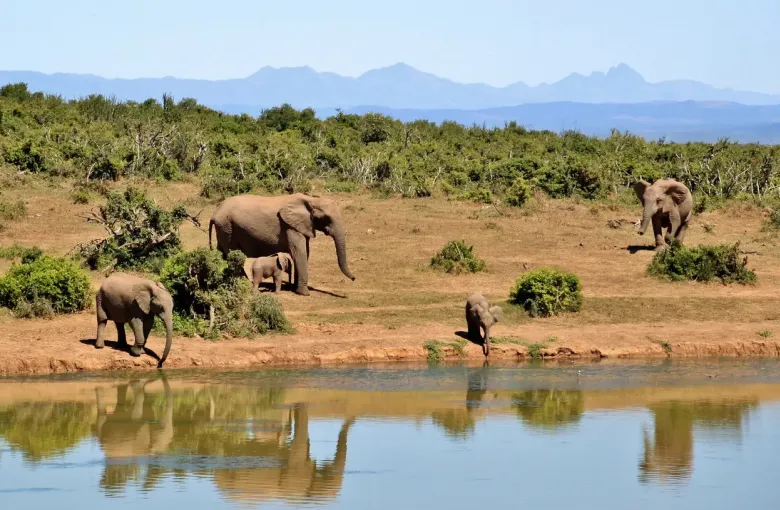
Those lagoons are the reason the game viewing is so concentrated. In the dry season they hold the last water for miles, and everything comes to them. Hippo pack into them in remarkable densities, crocodile line the banks, and elephant, buffalo and antelope come down in a steady procession through the afternoon.
Wildlife
- Leopard. South Luangwa is famous for them, and its night drives — another Zambian specialty, conducted with a filtered spotlight — are among the most reliable places in Africa to see one hunting.
- Thornicroft’s giraffe, a subspecies found essentially only in this valley.
- Crawshay’s zebra, with finer, more numerous stripes than the plains zebra elsewhere.
- Elephant, buffalo, hippo and crocodile in large numbers, along with lion and wild dog.
- Birds in abundance — the carmine bee-eater colonies that nest in the river banks from around August are a genuine spectacle, and the reason so many photographers time their trip for it.
When to go, and when the park shuts
The dry season, roughly May to October, is the classic window, improving steadily as water dries up and concentration increases. October is the peak for game viewing and the hardest on the body.
Many South Luangwa camps close entirely in the wet season, broadly November to April, because the roads become impassable. Some all-weather lodges stay open and run the “emerald season” on boats and from surfaced airstrips, with lush landscapes, extraordinary birding and much lower prices. That is a rewarding return visit and rarely the right first one.
Getting there
Fly to Mfuwe (MFU), generally via Lusaka, then transfer by road — anything from twenty minutes to a couple of hours depending on the camp. The light-aircraft baggage limit applies; see our packing list.
The road approach from Lusaka is long, and genuinely rough in its final stretch.
The Mfuwe elephants
One of the more charming things in African travel: at Mfuwe Lodge a family of elephants walks through the reception area in the wild-mango season, in about October, to reach a favorite tree. It is entirely their own idea and it has been going on for years.
Visiting with LABUSA Travel
If you want to walk, tell us — it changes which camps make sense, and the best walking operations are small and book early. We will also be honest about which months suit a first-time visitor and which reward someone coming back.
Other Articles
Best Time to Visit Zambia
Zambia Packing List