The quick answer
Zambia can absolutely be traveled by visitors with reduced mobility, and it takes more planning than a European city break. Livingstone is the most workable base in the country, and a river-and-falls itinerary is considerably more accessible than a bush-camp safari.
This page is written to be useful rather than encouraging. Where something is difficult, we say so.
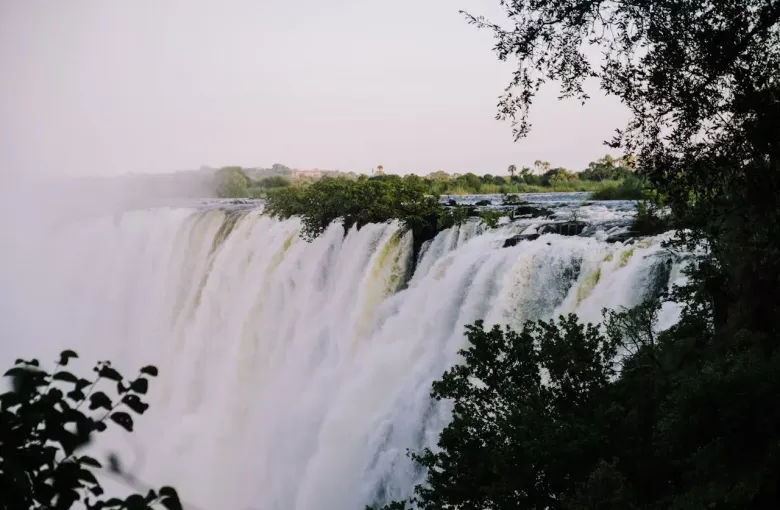
Victoria Falls and Livingstone
The Zambian side of the falls sits within Mosi-oa-Tunya National Park, and the entrance area, main paths and several of the principal viewpoints are paved and level. A visitor using a wheelchair or moving slowly can reach genuine views of the falls without leaving a made surface, which is not true everywhere along this river.
Two honest cautions:
- The Knife-Edge Bridge is exposed, narrow and wet. In the high-water months it is drenched in spray, and the surface is slippery. It offers the most dramatic view on the Zambian side and it is the least accessible part of the site.
- Spray is a hazard in its own right from roughly February to May. Wet paved stone is slick, and a mobility aid can slide.
Livingstone town has the country’s best concentration of hotels built to international standards, some with accessible rooms, and short flat distances between them and the falls.
River activities
A Zambezi cruise is often the most rewarding accessible activity in Zambia. Boarding varies enormously between operators — some board from a fixed jetty with a gentle ramp, others from a bank — so this is a question to ask specifically, with your actual requirements described, rather than a general one about “accessibility”.
Safari camps: the honest position
Most bush camps in South Luangwa and the Lower Zambezi are not step-free. They are built light, often on raised decks with steps, connected by sand or gravel paths, sometimes with short walks between tent and dining area that are unlit at night and shared with wildlife.
Some lodges — generally the larger, more permanent ones — have ground-level rooms, ramps and wider doorways. They exist and they need to be identified individually. There is no reliable national standard to filter by, and a camp’s own description of itself as “accessible” may mean only that it has a ramp at the restaurant.
Game drives are conducted in high-clearance open vehicles, which involve a significant step up. Operators can often help with a portable step or a transfer, and some vehicles can be adapted with notice. Ask before booking, not on arrival.
Light aircraft
The parks are reached by small aircraft, and boarding usually means a short flight of steps without a jetway. Cabin space is tight and there is no accessible lavatory on most types. Airlines and charter operators are generally helpful and need advance notice to arrange assistance; wheelchair stowage depends on the aircraft and on the size and type of chair.
Weight and balance calculations are real on these flights, which is why they ask direct questions. They are not being intrusive.
Traveling with a visual or hearing impairment
Guiding in Zambia is of a very high standard, and a good guide will narrate a sighting in extraordinary detail if you tell them that is what you need. Audio description, braille and hearing loops are not generally available; a private guide is the practical answer and is not expensive by international standards.
Medical practicalities
Facilities are good in Lusaka and limited in remote areas. Bring all medication and any consumable supplies for the whole trip with a margin; specialist items are unlikely to be available locally. Insurance with explicit medical evacuation cover matters more here than in most destinations — see our Zambia travel safety guide.
The questions worth asking before you book
- How many steps between the vehicle drop-off and the room, and between the room and dining?
- Is the path surfaced, and is it lit at night?
- What is the door width, and is there a roll-in shower or a fixed bath?
- How is the game-drive vehicle boarded, and can a step or transfer be arranged?
- How is the boat boarded, at what water level?
- What aircraft type, and what assistance is available at each airstrip?
Ask them of the specific camp, in writing, describing what you actually need. Generic questions get generic answers.
Planning with LABUSA Travel
Tell us your requirements in detail and we will check them property by property rather than filtering a list. If part of an itinerary will not work for you, we would far rather say so at the planning stage.
Other Articles
Zambia for Senior Travelers
Getting Around Zambia