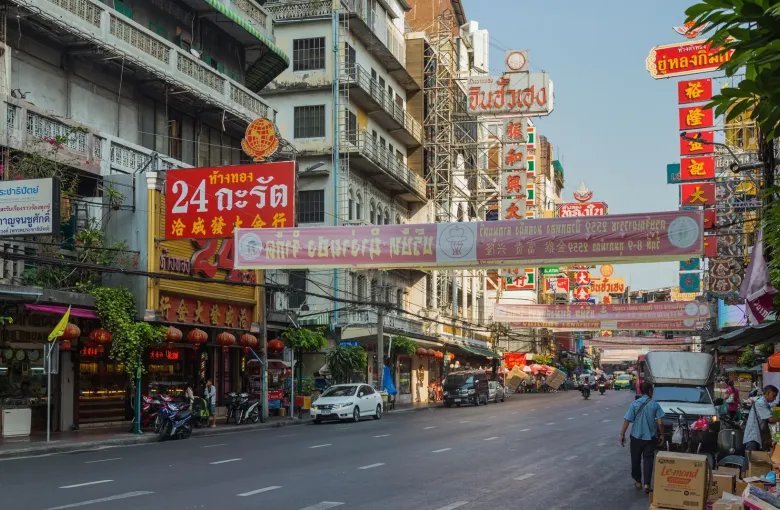
Begin with the thing that is not etiquette.
Criticizing the Thai monarchy is illegal. The UK Foreign, Commonwealth and Development Office states that the law can be interpreted broadly and carries a long prison sentence, and that journalists, human rights defenders and members of the public have faced charges for making political comments or sharing articles online that could be interpreted as criticism.
This page separates that from everything below it deliberately. The rest of this guide is courtesy, where the cost of an error is mild embarrassment. This is criminal law, the penalty is imprisonment, and it reaches things a visitor would not think of as publishing, including sharing a post. It is not a matter of being respectful; it is a matter of what is prosecuted.
Dress is a condition of entry at the major sites.
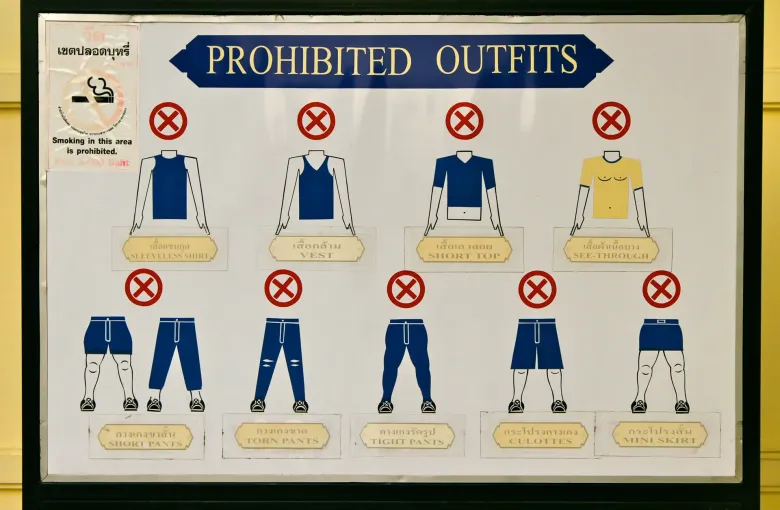
Thailand's principal royal and religious sites publish a dress standard and enforce it at the gate. The sign at the Grand Palace in Bangkok shows sleeveless shirts, vests, short tops, see-through tops, short trousers, torn trousers, tight trousers, culottes and mini skirts, each crossed out.
Covered shoulders and a hem below the knee will clear the standard at most sites. This is a rule about specific places rather than about how to dress in the country generally, and the packing list treats it as an item to bring rather than a thing to discover on the day.
At a temple.
Shoes come off before you enter a building. Images of the Buddha are objects of reverence rather than scenery, which bears on how people pose beside them. Monks are ordained rather than staff, and in the Thai tradition a monk does not take an object directly from a woman's hand; if you are unsure, put it down and let it be picked up.
The general principle underneath all of that is to watch what Thai visitors do and do the same thing a beat later. It is more reliable than any list, including this one.
The ordinary social texture.
The Thai greeting, the wai, is a small bow with the palms together. A visitor is not expected to initiate it and will not cause offense by returning one clumsily. Volume and visible anger carry further here than they do in much of the West, and composure is read as competence rather than coldness.
The head and the feet sit at opposite ends of a real social hierarchy: the head is not casually touched and the feet are not pointed at people or at images. None of that is difficult once you know it, and none of it is tested very hard on a visitor who is evidently trying.
Photographs.
Ask before photographing people, particularly monks and particularly at a moment of devotion. Signage at temples and palaces sometimes restricts photography inside specific buildings, and it is worth reading rather than assuming. Where a sign and a habit conflict, follow the sign.
What this page does not cover.
It gives no list of gestures to avoid beyond those above, and no account of regional difference in custom, because no source in this cluster publishes either and a list assembled from general knowledge would be indistinguishable from one that had been checked. The heritage and community guide covers the Chinese-Thai community and its quarter in Bangkok, which has its own traditions and its own calendar.
Sources
- UK Foreign, Commonwealth and Development Office: the Thailand safety and security page: that criticizing the Thai monarchy is illegal, that the law can be interpreted broadly and carries a long prison sentence, and that journalists, human rights defenders and members of the public have faced charges over political comments and shared articles; that travelers should not hand a passport over as a guarantee, for example to motorcycle or jet-ski rental businesses, because companies may hold on to passports against claimed damage; that people have arrived in Thailand and been illegally transported to neighboring countries on the promise of high-paying jobs that turn out to be scams, and may then be detained on re-entry while their immigration status is validated; that drink spiking and drug-assisted sexual assault happen in tourist areas with both male and female victims, that attacks are most common during full moon parties or similar events and near bars late at night, and that drinks served in bars are often stronger than those at home; that there have been incidents of ATM skimming and that a traveler should use an ATM in a bank and protect the PIN; and that people have drowned in strong riptides, that Thailand has lifeguards at designated beaches and operates a flag system for safe swimming, and that warning signs and especially red flags should be followed. Accessed 22 September 2026.
- UK Foreign, Commonwealth and Development Office: the Thailand entry requirements page, which describes the rules Thailand applies and writes them for people traveling on a full British citizen passport, so the framing is the British position rather than a general one: that a passport must have an expiry date at least 6 months after the date of arrival and at least 1 blank page; that from 1 May 2025 all foreign nationals entering Thailand, whether by air, land or sea, must complete a digital arrival card online before arrival, and that it can be registered within 3 days before arrival; that from 15 September 2026 entry under the visa exemption scheme allows a stay of up to 30 days for tourism only, and that visa-exempt entry does not cover business travel including conferences and meetings; that a traveler may be asked to show funds of at least 10,000 Thai baht per person or 20,000 per family together with evidence of onward or return travel, and that British nationals have been refused entry for failing to provide it; and that overstaying carries a fine of 500 Thai baht a day up to a maximum of 20,000 baht, with detention, deportation at the traveler own expense and a ban from re-entering Thailand for up to 10 years, adding that conditions in detention centers can be harsh. Accessed 22 September 2026.
Other Articles
Thailand Packing List
The Historic City of Ayutthaya: Visitor and Heritage Guide