The short version
Switzerland is the mountain country you can see without climbing anything. Cog railways, cable cars, funiculars and lake steamers were built in the nineteenth century to bring visitors to viewpoints, and they still do exactly that: you can be at a glacier viewpoint in the morning and back at a lakeside hotel for lunch, seated the whole way.
Three things to plan around: altitude, paving, and the seasonal timetables.
What makes it easy
- The transport does the ascent. This is the entire argument. Nowhere else in this program puts high mountains within reach of someone who cannot walk up them.
- Everything connects. Trains, postbuses, boats and mountain railways are one timetabled system, so a day out can be arranged without improvisation.
- Short distances and a single base. You can see a different valley each day and sleep in the same bed.
- Station assistance exists if you ask the operator in advance.
- Healthcare is excellent and English is widely spoken, including in medical settings.
- The lake boats are the easiest good day out in the country: scheduled, seated, level and scenic.
⚠ Altitude, which is the one to take seriously
Altitude sickness is a risk in parts of Switzerland and the advisory names the ski and hiking areas, including the Matterhorn, Saas-Fee, St Moritz, Corvatsch, Engelberg-Titlis, Belalp-Blatten, Chandolin, Hohensaas, Lauchernalp and the 4 Vallées. That list contains most of the places a visitor would choose.
The reason it matters more at a slower pace is the cable car: it can lift you two thousand meters in twenty minutes, which is far faster than a body acclimatizes. If you have a cardiac or respiratory condition, that is a question for your own doctor before you book rather than something to discover at the top station.
Practical habits: go high on the second or third day rather than the first, do not go from sea-level arrival to a high viewpoint in the same day, come down if you feel unwell rather than waiting to see, and remember that sun exposure at altitude is on the advisory's hazard list too.
⚠ The other two things to plan around
Paving. Historic Swiss centers are cobbled and uneven, and Berne's old city slopes toward the river on most streets. Shoes with grip, a stick if you use one on uncertain ground, and a slower pace when it is wet.
Seasonal timetables. The cheap shoulder weeks in spring and late autumn are cheap because lifts, cog railways and passes close between seasons. A trip built around a mountain railway that is not running is a wasted trip, so check the specific operator before booking, and read our best time to visit guide, which sets out why we publish no opening dates.
Pacing a trip
The Swiss mistake is not distance, it is ambition: the transport makes so much reachable that it is easy to plan three mountains in three days and enjoy none of them. What works:
- One mountain excursion a day, with a long lunch at the top.
- Alternate high and low days. A valley or lake day between two summit days is better than three summits.
- Take the boat at least once. Lucerne, Geneva or Thun, seated, level, and the best value in the country.
- Use the first-class option on trains if the budget allows: quieter, less crowded, and easier to get a seat at a busy interchange.
- Book mountain restaurants in season; many are small.
The heritage properties at an easier pace
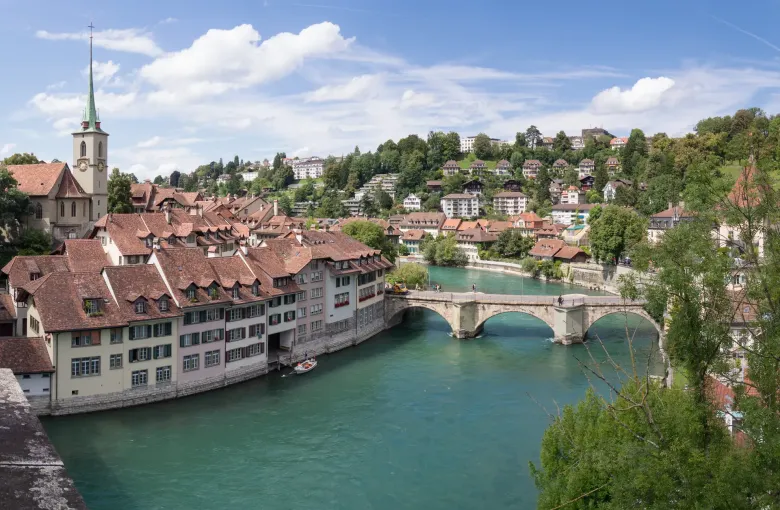
The Old City of Berne is the recommendation: compact, level in stretches, arcaded so the weather does not stop you, and reachable in minutes from a major station. One arcaded street end to end plus a coffee is a complete visit.
Lavaux works beautifully from the lakeshore: the railway between Lausanne and Montreux runs through the terraces with small stations, and a boat along the shore sees the property from below without the climb. The paths among the terraces are steep.
Swiss Alps Jungfrau-Aletsch is where the transport argument pays off. A railway or cable car to a viewpoint over the largest glacier in Eurasia is a seated excursion. Do not walk onto a glacier, and note that this is exactly where the altitude advice above applies.
Health, insurance and documents
The emergency medical number is 112 or 144: dial either and ask for an ambulance. Get appropriate travel insurance for local treatment or unexpected medical evacuation, which the advisory notes is particularly important if you have a health condition, and contact your insurer quickly if you are referred for treatment. If your itinerary includes any mountain activity beyond a cable car, check the three-item mountain clause in our safety guide.
At least eight weeks before the trip, check the current vaccine recommendations. The CDC asks travelers to be up to date on routine vaccines, notes the importance of MMR given rising measles cases, suggests considering hepatitis A, and recommends hepatitis B for unvaccinated travelers younger than sixty, which is worth raising if that applies to you. The health risks the advisory names are biting insects and ticks, especially between April and October, and tick-borne encephalitis.
Bring medication in its original packaging with a copy of the prescription. And two document notes: check your passport's date of issue as well as its expiry, and be able to show a booking, insurance and a card, because the Swiss entry page may ask for them along with proof of around 100 Swiss francs a day.
Verify Before You Travel
- Each mountain railway and cable car operator, for seasonal opening and for accessibility.
- The Swiss rail operator, for station assistance and notice periods.
- Your own doctor, about altitude, before booking a high excursion.
- The UK Foreign, Commonwealth & Development Office Switzerland health page, for the emergency numbers, the insurance advice, the named altitude areas and the tick season.
- Your own insurer, for what is covered at your age and with your conditions.
Sources
- UK Foreign, Commonwealth & Development Office: Switzerland travel advice. Accessed 16 September 2026.
- UK Foreign, Commonwealth & Development Office: Switzerland safety and security: the terrorism assessment, the crime picture, the drug penalties, the face-covering ban in two cantons, the adventure-sport insurance requirement and the year-round alpine hazards. Accessed 16 September 2026.
- UK Foreign, Commonwealth & Development Office: Switzerland health: the two emergency numbers, the eight week vaccination window, the April to October tick season and the named altitude-sickness areas. Accessed 16 September 2026.
- US Centers for Disease Control and Prevention: Travelers’ Health, Switzerland: routine vaccines, hepatitis A and B, measles, rabies and tick-borne encephalitis. Accessed 16 September 2026.
Other Articles
Accessible Travel in Switzerland
Getting Around Switzerland