The short version
Switzerland is one of the better European countries to travel in with a disability, and the reasons are institutional rather than accidental: the rail network is modern and integrated, staff expect to be asked, and the country takes service standards seriously.
⚠ And there is a starting point better than this page. The travel advisory points out that the official Switzerland Tourism website has useful information for travelers in wheelchairs or with impaired mobility. That is a national tourist board publishing on the subject itself, which is rare enough to be worth naming, and it is where to go for specifics.
We publish no assistance booking windows, fares or facility lists, because those change and an out-of-date figure would be worse than none.
What genuinely helps
- Modern rolling stock and level boarding on much of the mainline network, with newer trains designed for step-free access rather than retrofitted.
- One integrated system. Trains, buses, boats and mountain transport are planned and ticketed together, so a journey with three legs can be arranged as one conversation.
- Short distances. A single base plus day trips works, which avoids the repeated hotel transfers that are often the hardest part of a trip.
- Staff who expect to be asked, and widely spoken English alongside German, French and Italian.
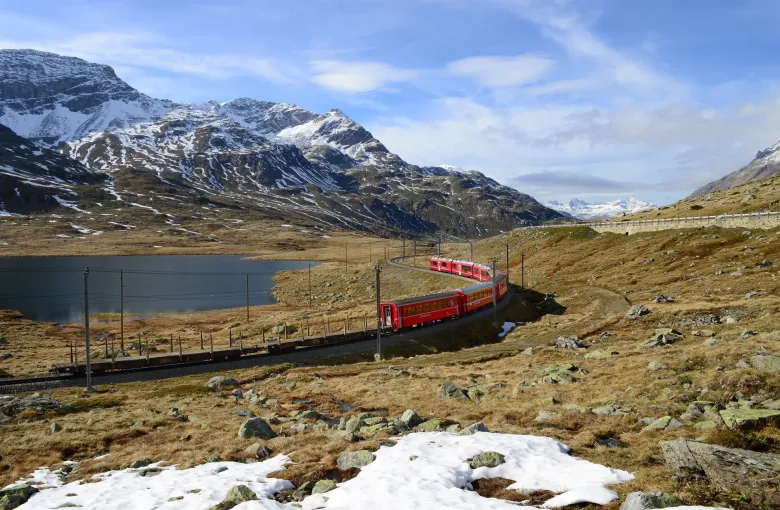
- Some mountain transport is genuinely accessible. Cable cars and cog railways built or rebuilt recently often take a wheelchair, which puts high-altitude viewpoints within reach in a way a mountain usually is not. Confirm with the specific operator.
⚠ The obstacles, which are geographical
Gradient. This is the fundamental one and no service fixes it. Swiss towns are built on slopes, lakeside promenades climb, and a short distance on a map can be a serious ascent. Berne's old city slopes toward the Aare on nearly every street.
Historic paving. The Old City of Berne is cobbled and uneven, which is the inevitable cost of an eight-hundred-year-old street surface. It is hard work in a manual chair and uncertain with a stick, particularly wet.
Altitude. Altitude sickness is a risk in named parts of the country, and it affects anyone. If you have a cardiac or respiratory condition, a cable car can take you higher in twenty minutes than most people ascend in a week, and that deserves a conversation with your own doctor before you book.
Older mountain infrastructure. The network is excellent on average and old in places. A historic funicular, a small village station or a mountain hut may have steps and nothing else, and the difference between two cable cars on the same mountain can be complete.
Transport, and the one thing to arrange in advance
Swiss rail operates station assistance, and the pattern across Europe is that assistance must be requested ahead of travel rather than on the day. Contact the operator and ask what their current notice period is, station by station, because a major interchange and a village halt are not comparable.
Lake boats vary: the modern vessels are generally accessible and the historic paddle steamers, which are part of the pleasure of Swiss lakes, frequently are not. Postbuses are generally accessible with ramps. For airports, request assistance through your airline when you book.
The three heritage properties, honestly assessed
The Old City of Berne is compact, walkable and flat in stretches, and its arcades mean a great deal of it is under cover, which matters in bad weather. Against that: cobbles, slopes down to the river, and historic buildings with steps at the door. It is the most approachable of the three and it is not an easy surface.
Lavaux is a steep terraced hillside, and that is the property rather than an obstacle in it. The lakeshore railway and the lakeside path are level and give real views of the terraces from below; the paths among the terraces are sustained climbs. A boat along the shore is the option that sees the property without the gradient.
Swiss Alps Jungfrau-Aletsch is the hardest and also, in one respect, the most surprising. High mountain trails and glacier routes are not adaptable. But several of the railways and cable cars into the region are modern and accessible, so a viewpoint over the largest glacier in Eurasia can be reachable when a walk is not. Check each operator individually; the variation is large.
Health and insurance
The emergency medical number is 112 or 144: dial either and ask for an ambulance. Take appropriate travel insurance for local treatment or unexpected medical evacuation, which the advisory notes is particularly important if you have a health condition. Swiss healthcare is excellent and it is billed.
If your trip includes mountain activity, the policy needs the three-item mountain clause from our safety guide: mountain rescue services, helicopter costs, and repatriation or transfer to a neighboring country.
Bring medication in its original packaging with a copy of the prescription, and check the legal status of anything unusual before you travel, because the regulation of some medicines differs between countries. If you rely on equipment, confirm before you fly how your airline handles it and whether repair or replacement is available locally.
Verify Before You Travel
- The official Switzerland Tourism website's own information for travelers in wheelchairs or with impaired mobility, which the travel advisory points to.
- The Swiss rail operator, for station assistance and current notice periods.
- Each mountain railway, cable car, boat operator and hotel directly, because the variation between a modern cable car and a historic funicular is total.
- Your own doctor, about altitude, before booking anything high.
Sources
- UK Foreign, Commonwealth & Development Office: Switzerland travel advice. Accessed 16 September 2026.
- UK Foreign, Commonwealth & Development Office: Switzerland safety and security: the terrorism assessment, the crime picture, the drug penalties, the face-covering ban in two cantons, the adventure-sport insurance requirement and the year-round alpine hazards. Accessed 16 September 2026.
- UK Foreign, Commonwealth & Development Office: Switzerland health: the two emergency numbers, the eight week vaccination window, the April to October tick season and the named altitude-sickness areas. Accessed 16 September 2026.
Other Articles
Switzerland for Senior Travelers
Old City of Berne: Visitor and Heritage Guide