The short version
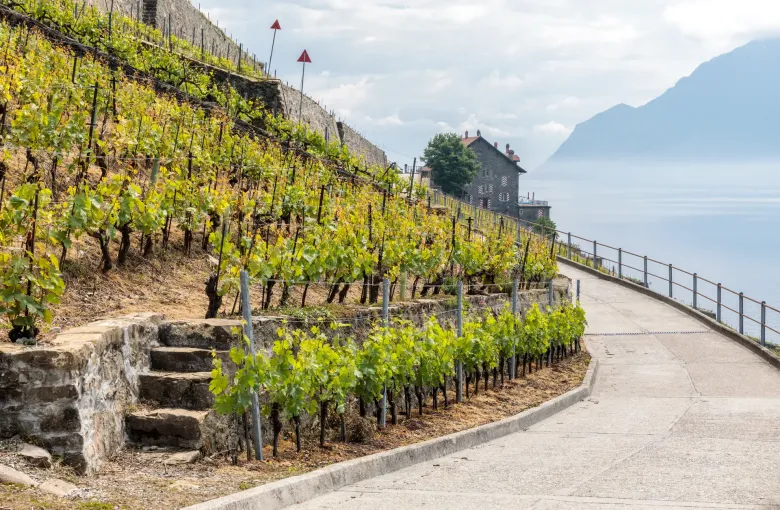
The property is Lavaux, Vineyard Terraces, inscribed in 2007 under criteria (iii)(iv)(v). It covers 898 hectares with a 1,408 hectare buffer zone, and it stretches for about 30 km along the south-facing northern shore of Lake Geneva.
The extent is worth stating precisely, because it explains the place: from the Chateau de Chillon to the eastern outskirts of Lausanne, in the Vaud region, covering the lower slopes of the mountainside between the villages and the lake.
⚠ It was inscribed for the farming, not for the view
The view is extraordinary and it is not the reason. UNESCO's stated reason is an outstanding example of a centuries-long interaction between people and their environment, developed to optimize local resources so as to produce a highly valued wine that has always been important to the economy.
That is a claim about work. The slope faces south, above a lake that reflects light and holds heat, below mountains that shelter it: three advantages that only become a wine region if somebody builds and maintains several hundred hectares of stone terracing on a hillside and keeps doing it for a thousand years. The terraces are the technology.
The dates, and who did it
The record is careful about the chronology and so are we. There is some evidence that vines were grown in the area in Roman times. But the present vine terraces can be traced back to the 11th century, when Benedictine and Cistercian monasteries controlled the area.
So the thing you are looking at is a medieval monastic project that was never abandoned. The walls have been rebuilt many times, the ownership has changed completely, and the layout persists because the reasons for it persist.
How to visit, which is easier than it looks
By train, and then on foot. The railway along the north shore of Lake Geneva runs through the property between Lausanne and Montreux, with small stations among the terraces, and the lake boats stop along the same shore. No car is needed and a car is a nuisance here: the roads between the terraces are narrow working lanes.
Practical suggestions:
- Walk between two villages rather than visiting one. The paths run along and between the terraces and the walking is the experience.
- Late summer and early autumn are the best weeks: the vines are in leaf and then in harvest, and the light across the lake is at its best.
- The cellars sell and pour. Very little Swiss wine is exported, so a Chasselas here is something you cannot easily drink at home. Our food guide covers Swiss wine.
- It is a working landscape, not a park. Stay on the paths, close gates, and remember that a tractor on a narrow lane has priority over a visitor.
- The slope is steep and the paths are paved but sustained. It is more of a walk than the photographs suggest.
What the terraces are doing structurally
Worth understanding while you walk: the stone walls are retaining walls, holding soil on a slope that would otherwise be on the lake shore. They also store heat during the day and release it at night, which is part of why a vineyard this far north works at all. Maintaining them is the continuing cost of the property, and it is the reason the inscription is about interaction rather than about a moment.
Safety, briefly
This is the gentlest of the three properties in this guide and the hazards are ordinary: a steep slope, paved paths that are slippery when wet, sun on an exposed hillside with no shade, and working farm vehicles. Sun exposure is on the advisory's year-round hazard list and a south-facing terrace in July is exactly where it applies.
Verify Before You Travel
- The UNESCO World Heritage Centre inscription record for Lavaux, Vineyard Terraces, for the date, the criteria, the areas and the description.
- The UNESCO World Heritage Centre State Party record for Switzerland, for the full list of thirteen properties.
- The lakeshore railway and boat timetables, and individual cellars for opening hours.
Sources
- UNESCO World Heritage Centre: the inscription of Lavaux, Vineyard Terraces in 2007 under criteria (iii)(iv)(v), 898 ha with a 1,408 ha buffer zone. Accessed 16 September 2026.
- UNESCO World Heritage Centre: Switzerland’s State Party record: thirteen properties inscribed on the World Heritage List, nine cultural and four natural. Accessed 16 September 2026.
- UK Foreign, Commonwealth & Development Office: Switzerland safety and security: the terrorism assessment, the crime picture, the drug penalties, the face-covering ban in two cantons, the adventure-sport insurance requirement and the year-round alpine hazards. Accessed 16 September 2026.
Other Articles
Switzerland Food Guide
Best Time to Visit Switzerland