The short version
The property is the Seventeenth-Century Canal Ring Area of Amsterdam inside the Singelgracht, inscribed in 2010 under criteria (i)(ii)(iv). It covers 198.2 ha, with a 481.7 ha buffer zone.
Read that name once more, because it contains the boundary. What is inscribed is the canal ring, and the ring is defined by the Singelgracht. The medieval old town that the canals encircle is not part of the property, and neither is the rest of the city.
⚠ The distinction that most guides drop
It is common to see the whole of Amsterdam described as a World Heritage Site. That is wrong, and the error matters more here than it usually would, because the boundary is the achievement. The inscription is not about a city being old and attractive. It is about a specific, documented, seventeenth century program of urban extension, and about the line that program drew.
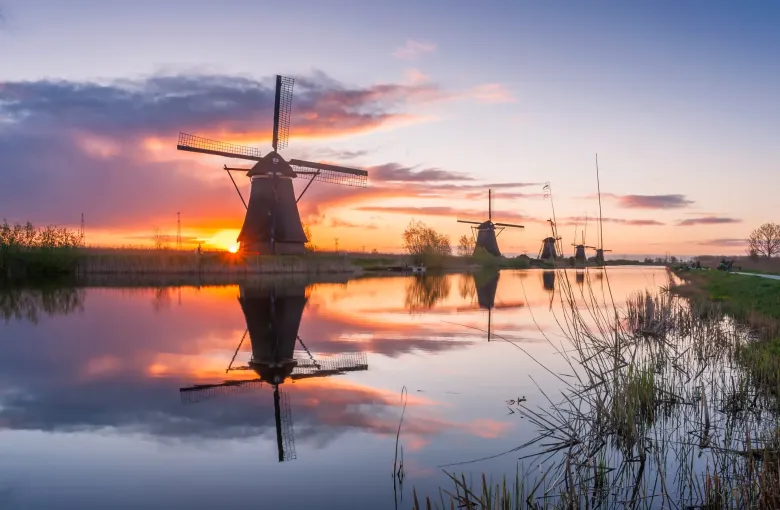
The Netherlands has thirteen properties on the World Heritage List, twelve of them cultural, and the canal ring is one of them. Two other places visitors regularly hear described as heritage sites, the great flower gardens and the village of canals north east of Amsterdam, appear on no World Heritage list at all. They are worth visiting. They are not this.
What was actually built, and why it counts
The inscription record describes the canal district as a project for a new port city, built at the end of the sixteenth and the beginning of the seventeenth centuries. The mechanics of it are the interesting part:
- A network of canals was laid to the west and south of the historic old town and the medieval port that encircled it.
- The city's fortified boundary was repositioned inland, and that new boundary is the Singelgracht.
- The extension was a long term program: draining the swampland, cutting canals in concentric arcs, and filling in the intermediate spaces.
- Those filled spaces are where the gabled houses and the monuments went, and the result is a homogeneous urban ensemble rather than a collection of buildings.
UNESCO's own summary calls this urban extension the largest and most homogeneous of its time, and a model for large scale town planning. That is the claim the criteria rest on: not beauty, but the fact that somebody planned a city this way and then carried it out.
The homogeneity is a social fact as well as an architectural one
Walk the Herengracht, the Keizersgracht and the Prinsengracht and the houses are narrow, tall and individually restrained, built to a repeating pattern by merchants who were among the richest people in the world at the time and who could have built anything. That restraint is not a limitation of the period. It is a Dutch preference, and you will meet the same instinct in ordinary conversation four centuries later, which is why our culture guide points back at this page.
How to see it properly
On foot, slowly, and preferably twice. A boat gives you the water level view the canals were built for and is worth doing once. Walking is what lets you read the pattern: the concentric arcs, the radial streets that cut across them, the way the ring closes at the Singelgracht.
Three suggestions. Start at the Singelgracht rather than in the middle, so the boundary means something. Walk one arc from end to end instead of crossing between them, which is how most visitors accidentally see the same two hundred meters five times. And go early or late, because the light down a canal is the whole experience and the crowds are not.
The interiors are as significant as the frontages, and several canal houses are open as museums, including houses kept close to their period arrangement. If you only go into one building in the property, make it a house rather than a church.
⚠ Safety on the canals, which is not a decorative warning
There are no railings along most of these canals. They sit at the edge of narrow streets that are also carrying bicycles, and the travel advisory records that people drown in them every year, with the majority of drownings happening after heavy drinking or smoking cannabis. Take care walking beside them, particularly at night.
Two other advisory points apply squarely inside this property, because it is also the busiest tourist area in the country. Pickpocketing and bag snatching are common, particularly in central Amsterdam and around Amsterdam Central Station. And if police catch you swimming in the canals they will fine you 160 euros.
Conservation, on the record
The property has a State of Conservation report on file with the World Heritage Centre from 2011, the year after inscription. A living city center that is also one of Europe's most visited places is a conservation problem by definition, and the pressures are the obvious ones: traffic, tourism volume, and the use of historic houses for things they were not built for. We publish no visitor figure, because nothing we read for this build states one.
Verify Before You Travel
- The UNESCO World Heritage Centre inscription record for the Seventeenth-Century Canal Ring Area of Amsterdam inside the Singelgracht, for the date, the criteria, the areas and the description.
- The UNESCO World Heritage Centre State Party record for the Netherlands, for the full list of thirteen properties.
- The UK Foreign, Commonwealth & Development Office Netherlands safety and security page, for the canal and theft warnings.
Sources
- UNESCO World Heritage Centre: the inscription of the Seventeenth-Century Canal Ring Area of Amsterdam inside the Singelgracht in 2010 under criteria (i)(ii)(iv), 198.2 ha with a 481.7 ha buffer zone. Accessed 16 September 2026.
- UNESCO World Heritage Centre: the Netherlands’ State Party record: thirteen properties inscribed on the World Heritage List, twelve cultural and one natural. Accessed 16 September 2026.
- UK Foreign, Commonwealth & Development Office: Netherlands safety and security: the terrorism assessment, the identification requirement from age fourteen, the drug laws, the fake police warning, the canal fines and the road rules. Accessed 16 September 2026.
Other Articles
Best Time to Visit the Netherlands

Netherlands Packing List