The short version
The Netherlands is one of the better European countries to travel in with a disability, and the reason is structural rather than attitudinal: there are no hills, the distances are short, the trains are frequent, and a great deal of the built environment is new. Rotterdam, rebuilt after the war, is a genuinely modern city to move around in.
What flatness does not fix is surfaces, thresholds and old buildings, and those are the things to plan around. Everything below is either a structural fact about the country or a pointer to the operator who can actually answer your question. We publish no assistance booking windows, fares or facility lists, because those change and an out of date figure would be worse than none.
What genuinely helps
- No gradients. The single largest physical barrier in most European cities is simply absent here, which changes how far a day can reach.
- Short distances and dense rail. A base plus day trips works, which avoids the repeated hotel transfers that are often the hardest part of a trip.
- Modern stock and modern buildings. Newer stations, museums and hotels are designed to be used rather than retrofitted, and staff expect to be asked.
- Almost everyone speaks English, which makes asking for what you need straightforward.
- A cycling country is also a wheeling country in one respect: the network of smooth, separated paths that exists for bicycles is often the best surface available.
⚠ The four obstacles flatness does not solve
Cobbles and brick. Historic streets are paved in brick and cobble, often uneven and frequently wet. This is hard work in a manual wheelchair, painful with a walking stick, and genuinely slippery. It is the single most underestimated barrier in the country.
Bridges and canals. A canal ring is crossed by a great many small bridges, and an old bridge has a camber and sometimes steps. Routes that look direct on a map can involve several rises, and a canal quay usually has no railing, which matters for a visually impaired traveler as much as for a wheelchair user.
Canal houses. The seventeenth century houses that make Amsterdam what it is were built narrow and tall, with steep, winding internal stairs and often a step up from the street. Many are museums. Some have made real adaptations and some structurally cannot. Never assume: ask the specific building.
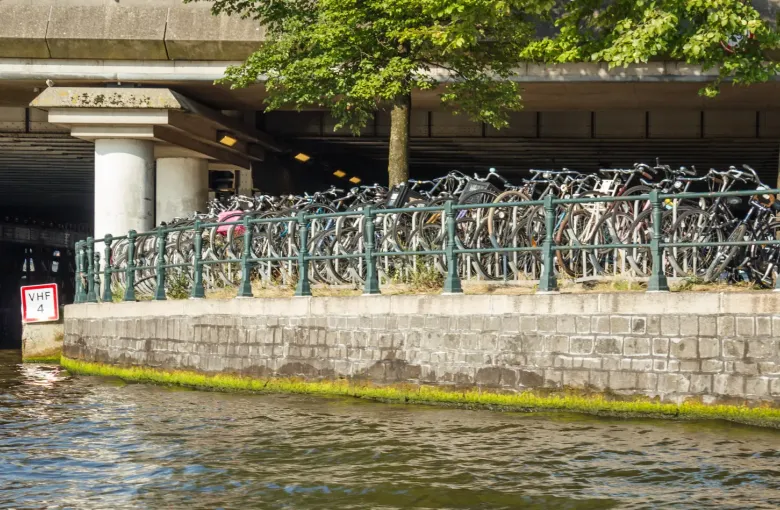
Bicycles. Cyclists and mopeds have right of way over motor vehicles and often ignore red lights, and cycle paths are busy and fast. For anyone who cannot move quickly or cannot see or hear an approaching bicycle, crossing a Dutch street is a real hazard rather than an inconvenience, and it deserves the same planning as any other part of the day.
Transport, and the one thing to arrange in advance
Dutch rail operates an assistance service at stations, and the pattern across Europe is that assistance needs to be requested ahead of travel rather than on the day. Contact the operator directly and ask what their current notice period is, station by station, because not every stop is staffed and the answer differs between a major interchange and a village halt.
Trams and older metro stock vary: some have level boarding and some have steps. Newer vehicles are better. Buses are generally accessible and drivers are used to deploying ramps. Accessible taxis exist in the cities and should be booked rather than hailed.
Schiphol is a large, modern airport with a well developed assistance operation, and the railway station is under the terminal, which removes a transfer that is often the worst part of an arrival. Request assistance through your airline when you book.
The heritage sites in this cluster, honestly assessed
The Amsterdam canal ring is walkable and level but is paved in the surfaces described above and crossed by bridges. A canal boat is often the most comfortable way to experience the property, and several operators have accessible boarding; confirm with the operator.
The Mill Network at Kinderdijk-Elshout has level paths along the water and is much more approachable than a site full of historic machinery sounds. The mills themselves are another matter: a working windmill has a ladder rather than a staircase inside. The site's own visitor information is the place to check which buildings can be entered.
The Wadden Sea is the hardest of the three. Ferries to the islands are modern and generally accessible, and island paths and beaches vary. Walking onto the tidal flats is a guided activity over soft, uneven ground and cannot be adapted in practice; a boat trip is the alternative that sees the same property.
Health and insurance
The emergency medical number is 112: dial it and ask for an ambulance. Take appropriate travel insurance for local treatment or unexpected medical evacuation, which the advisory notes is particularly important if you have a health condition.
Bring medication in its original packaging with a copy of the prescription, and check the legal status of anything unusual before you travel rather than at the border, because the regulation of some medicines differs between countries. If you rely on equipment, confirm before you fly how your airline handles it and whether repair or replacement is available locally.
Verify Before You Travel
- The Dutch rail operator, for station assistance, current notice periods and which stations are staffed.
- Each museum, hotel and boat operator directly, for its own access arrangements, because a canal house and a modern museum are not comparable.
- Your airline, for assistance and for equipment handling.
- The UK Foreign, Commonwealth & Development Office Netherlands health page, for the emergency number, insurance and medication guidance.
Sources
- UK Foreign, Commonwealth & Development Office: Netherlands travel advice, including the standing pointer to separate advice for the Dutch Caribbean. Accessed 16 September 2026.
- UK Foreign, Commonwealth & Development Office: Netherlands safety and security: the terrorism assessment, the identification requirement from age fourteen, the drug laws, the fake police warning, the canal fines and the road rules. Accessed 16 September 2026.
- UK Foreign, Commonwealth & Development Office: Netherlands health: the emergency medical number, the eight week vaccination window and the biting insects and ticks. Accessed 16 September 2026.
Other Articles
The Netherlands for Senior Travelers
Kinderdijk: Visitor and Heritage Guide