The short version
The currency is the peso. Cards work in cities, resorts and established restaurants. Cash runs markets, small restaurants, local transport, tips and most of rural Mexico. Always pay in pesos when a terminal offers you a choice.
The conversion trap
This is the one that quietly costs the most and nobody notices. A card terminal, or an ATM, will frequently offer to charge you in your own currency rather than in pesos. It sounds helpful. It is dynamic currency conversion, the rate is chosen by the merchant's payment provider, and it is reliably worse than the rate your own bank would give you.
Decline it every time. Choose to be charged in pesos and let your own bank do the conversion. This applies in resorts more than anywhere, because the prompt is designed for exactly that audience.
The same logic applies to prices quoted in United States currency in tourist areas. You can usually pay in pesos, and the rate the venue applies to a dollar price is theirs rather than the market's.
Getting cash
ATMs are everywhere. Use machines inside a bank or a supermarket during business hours rather than a street facing machine, and be aware of who is around you. A bank's own machine is also less likely to carry the high fixed fees that the standalone machines in tourist areas charge.
Take pesos rather than dollars, take more small notes than you think you need, and break large notes in supermarkets rather than in markets, where change is genuinely scarce.
Cards
Visa and Mastercard are widely accepted; American Express less so. Tell your bank you are traveling. Keep a second card somewhere separate from the first.
Contactless is common in cities. Keep the card in sight during a transaction, and be wary of a terminal being taken away from the table.
What needs cash
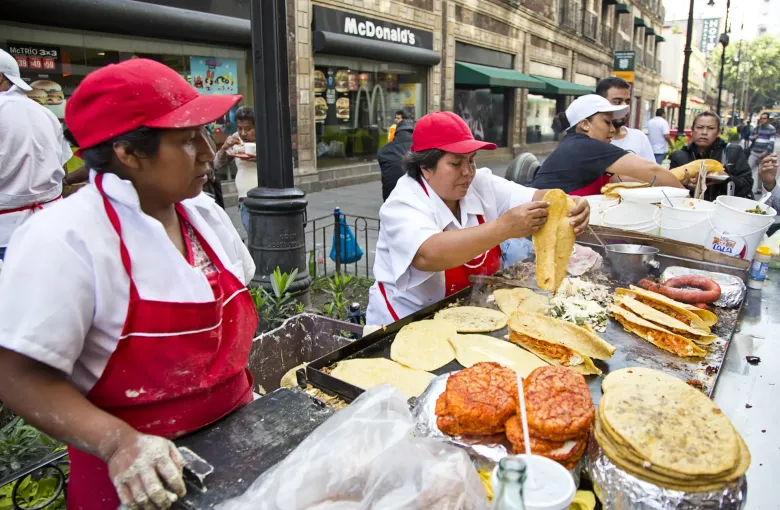
- Markets, street food and anything bought from a stall.
- Local buses, colectivos and most taxis.
- Small restaurants and comida corrida lunches.
- Tips, including for the person who bags your shopping and the attendant at a fuel station.
- Entry to smaller archaeological sites and museums.
- Toll roads, if you are driving. Keep a reserve of notes specifically for these.
Tipping
Tipping is normal and more established than in much of Latin America, partly because of the proximity to the United States. Around ten to fifteen percent in a restaurant, a few pesos for a supermarket bagger, something for a hotel housekeeper, and a small amount for a fuel station attendant, who will fill the car for you.
Check the bill before adding anything: in resort areas a service charge is sometimes included already, and in that case a second tip is a choice rather than an obligation.
Counterfeits and scams
Look at large notes you are handed as change. Card skimming is a risk at standalone machines in tourist areas, which is the practical argument for using a machine inside a bank. And a fuel station is worth watching: make sure the pump is zeroed before it starts.
Costs, in relative terms
No figures appear here, because a price published on a page reviewed once a year is wrong within months and gets read as a quote. What is stable is the shape. Mexico is inexpensive by North American standards for food, local transport and domestic travel, and the exceptions are narrow and predictable: the Caribbean resort corridor in high season, and anything sold inside a large all-inclusive property.
The gap between resort prices and the prices two streets away is larger in Mexico than in most countries, and closing it is mostly a matter of walking.
Verify before you travel
Bank charges, withdrawal limits and site entry fees change. Confirm them with your own bank and with official ticketing close to travel.
Sources
- UK Foreign, Commonwealth & Development Office: Mexico safety and security: the requirement to carry the passport and entry stamp and the refusal of copies or photographs, the illegality of bringing in or selling vaping devices, robbery by unlicensed taxi drivers and the sitio and pre-paid airport alternatives, the Cancun taxi protests that have pulled visitors from ride hailing cars, theft and hijacking on buses and the case for first class services on toll roads, carjacking on the Pacific Highway, methanol in spirit drinks, low hotel balcony railings, the hurricane season from June to November and Hurricane Otis at Acapulco in 2023, and the LGBT+ legal position. Accessed 16 September 2026.
- UK Foreign, Commonwealth & Development Office: Mexico travel advice: the eleven states carrying an advisory against all but essential travel and the explicit exceptions within them, including the Copper Canyon rail route in Chihuahua and Sinaloa, Los Mochis and Mazatlan, Morelia and Patzcuaro in Michoacan, Manzanillo in Colima and Zihuatanejo and Ixtapa in Guerrero, and the statement that no travel can be guaranteed safe. Accessed 16 September 2026.
Other Articles
Getting Around Mexico
Mexico Food Guide