There is no single Mexican cuisine
The most useful thing to know before a first trip is that the food changes completely every few hundred kilometers, and that almost none of it resembles the version exported across the northern border.
- Oaxaca: the moles, seven of them by tradition, plus tlayudas, string cheese, mezcal and grasshoppers. Widely considered the country's best regional kitchen.
- Yucatan: Mayan and Caribbean, with achiote, sour orange and habanero. Cochinita pibil, pork marinated and slow cooked wrapped in banana leaf, is the dish to look for.
- Puebla: mole poblano and, in season, chiles en nogada, a stuffed chilli under a walnut sauce with pomegranate, in the colors of the flag and available for only a few weeks a year.
- The north: beef, wheat flour tortillas rather than corn, and grilling. This is the region the exported version came from, which is why it feels familiar.
- The coasts: ceviches, aguachile, fish tacos, and the Veracruz style with olives and capers that records three centuries of Spanish and Caribbean trade.
Tacos, properly
A taco is a small soft corn tortilla with a filling, eaten in two or three bites, garnished by you from what is on the counter. It is not a crisp shell and it is not a full plate. Two or three different ones is an order.
Al pastor, pork cooked on a vertical spit with pineapple, descends from the shawarma brought by Lebanese migrants to Puebla, and is the clearest example of how readily this cuisine absorbs things. Carnitas, suadero, barbacoa, cochinita and pescado are the others worth ordering by name.
Eating from a stall, which is where the good food is
Diarrhoeal illness from food or water is a real risk, and Cyclospora has been reported in travelers returning from Mexico. That is an argument for choosing carefully rather than for avoiding street food, which would mean missing most of the country's cooking.
- Go where the line is. High turnover means the food has not been sitting, and local people are better judges of a stall than any list.
- Eat things cooked to order in front of you and served hot.
- Be more careful with raw garnishes and salsas at a very quiet stall than at a busy one.
- Only drink boiled or bottled water, and avoid ice outside established venues. Most restaurants in cities and resorts use purified ice, and a quiet roadside stall may not.
- Fruit you peel yourself is safer than fruit already cut.
The market is the other half
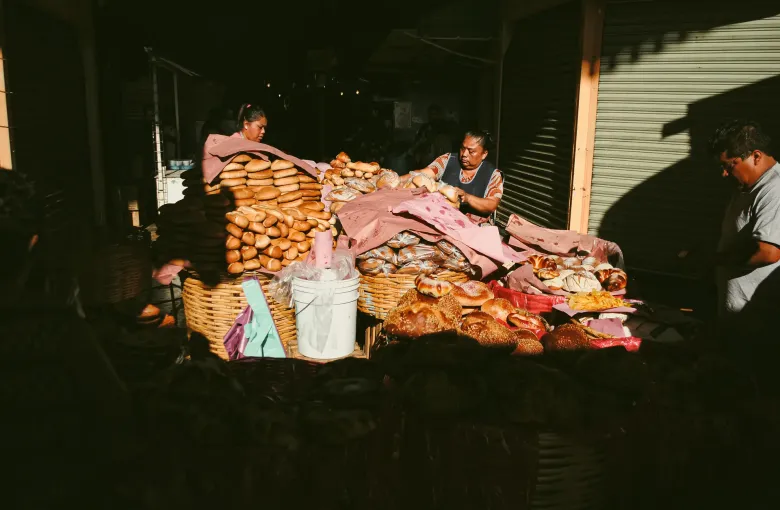
Every town has one, and it is where to eat lunch. The cooked food aisles serve the same dishes as restaurants at a fraction of the price to the people who work there. Oaxaca's markets in particular are an attraction in their own right, in a city whose historic center is inscribed on the World Heritage List together with Monte Alban.
What to drink
- Mezcal and tequila are both agave spirits; tequila is the one made from blue agave in a defined region. Mezcal is broader, smokier and more varied, and is sipped rather than shot.
- Aguas frescas, fruit waters, sold by the glass from big glass jars. Hibiscus, tamarind and horchata are the classics.
- Atole and champurrado, warm corn based drinks, sold in the mornings and at festivals.
- Coffee from Chiapas and Veracruz, and cafe de olla, brewed with cinnamon and unrefined sugar in a clay pot.
One serious warning: there have been deaths and cases of serious illness in Mexico from alcoholic drinks containing methanol, which cannot be detected by taste or smell. Buy spirits from licensed premises and watch drinks being poured.
Heat
Chiles here are used for flavor at least as much as for heat, and a great deal of Mexican food is not hot at all. The heat is usually in the salsa on the counter, which is under your control. Ask which is picante and start with a little.
Dietary requirements
Vegetarian eating is straightforward in cities and harder in small towns, where beans may be cooked with lard and a dish described as vegetarian may not be. A written explanation in Spanish helps. A serious allergy needs a written card in Spanish, because a phrase learned on the plane will not survive a noisy kitchen.
Verify before you travel
Openings and conditions change. Ask your accommodation what is busy and current rather than following a list written a year ago.
Sources
- UK Foreign, Commonwealth & Development Office: Mexico health: the emergency number 911 and the emergency buttons on Mexico City street cameras, the eight week lead time before travel, the limits of medical and ambulance services outside state capitals, altitude sickness in parts of the country, dengue, chikungunya, Zika, air pollution and Cyclospora, and the advice to drink only boiled or bottled water and avoid ice. Accessed 16 September 2026.
- UK Foreign, Commonwealth & Development Office: Mexico safety and security: the requirement to carry the passport and entry stamp and the refusal of copies or photographs, the illegality of bringing in or selling vaping devices, robbery by unlicensed taxi drivers and the sitio and pre-paid airport alternatives, the Cancun taxi protests that have pulled visitors from ride hailing cars, theft and hijacking on buses and the case for first class services on toll roads, carjacking on the Pacific Highway, methanol in spirit drinks, low hotel balcony railings, the hurricane season from June to November and Hurricane Otis at Acapulco in 2023, and the LGBT+ legal position. Accessed 16 September 2026.
- UNESCO World Heritage Centre: the inscription of the Historic Centre of Oaxaca and the Archaeological Site of Monte Alban in 1987 as a single property composed of two distinct sites, and the founding of the city as Antequera in 1529 on a checkerboard plan laid out by Alonso Garcia Bravo. Accessed 16 September 2026.
Other Articles
Mexico Culture and Etiquette Guide
Mexico Festivals and Celebrations