What the record actually says.
The UNESCO record for Malaysia lists six World Heritage properties and three sites on its Tentative List. One of the six is Melaka and George Town, Historic Cities of the Straits of Malacca, inscribed in 2008.
Read that title carefully, because it is a single inscription covering two cities together, in two different states, roughly four hundred kilometers apart. It is not two listings and it is not one place. The thing being recognized is what the two ports have in common: centuries of trade through the Straits of Malacca, and the layered town they each grew into as a result.
This page cites the national record for the inscription name and year. It does not quote the individual property page, because that page cannot currently be fetched and verified from here, and a citation this cluster cannot reproduce is not one it will publish.
The two cities are not interchangeable.
Melaka sits on the peninsula's west coast, south of Kuala Lumpur, and wears its Portuguese and Dutch history on the surface: the deep red buildings around Dutch Square, the church above them, the remains of the fort. It is compact and can be walked in a day, and it is busiest at weekends.
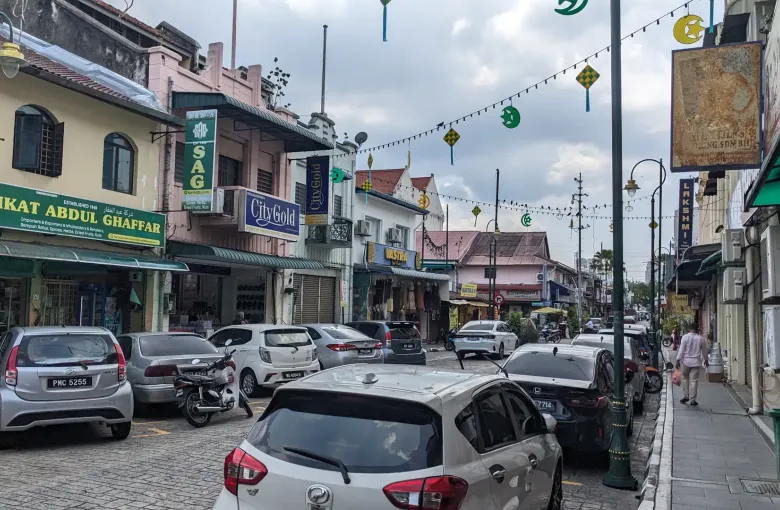
George Town is on Penang island, to the north, and is a larger and more continuous historic fabric: streets of shophouses, clan temples, mosques and Hindu temples on the same blocks, trades still operating out of the same buildings. It rewards more time and is the better of the two for simply walking without a plan.
Seeing one does not mean you have seen the inscription. They were listed together because they are two halves of one story, and the contrast between them is a large part of what the listing is about.
How to visit.
Both are walked rather than driven, and both are lowland tropical cities, which makes the middle of the day the hardest part of it. Early morning and late afternoon are the hours that work, and a long lunch in the middle is not a lost afternoon. This page publishes no temperature figure, for the reason the weather guide gives.
Neither city is a site with a gate. They are living towns, so much of what you are looking at is somebody's home or business. That shapes the etiquette: ask before photographing people or into doorways, keep to the streets and the buildings that invite visitors, and treat working places of worship as working places of worship rather than as exhibits.
Practical notes the sources support.
The safety advice this cluster cites records that bag-snatching is common particularly in major cities, that thieves on motorbikes cut straps or pull off bags carried on the shoulder nearest the road, and that people have been injured or killed holding on. Both of these quarters are walked along narrow streets with traffic, which is the exact situation described. Carry a bag across the body and on the inside.
The same advice states that by law you must carry identification and to always carry your passport, which applies on a day of walking as much as anywhere else. And the health advice names rabies among the risks in the states of Perlis, Kedah, Penang and Sarawak, which includes Penang: that is a reason not to approach animals, and a reason to have had the conversation with a clinician before the trip.
What else is on the list.
The other five inscriptions are spread wide and are a different kind of trip. Two are archaeological, in the Lenggong Valley on the peninsula and at the Niah caves in Sarawak. One is a forest park in Selangor. Two are natural properties in Borneo, Gunung Mulu National Park and Kinabalu Park, whose access differs sector by sector and where the health advice records altitude sickness as a risk including on Mount Kinabalu.
Two of the six were inscribed within the last couple of years, which is the reason this page read the record rather than recalling it. An inscription records a place judged of value to everyone; it is not a ranking of what is worth your week.
Sources
- UNESCO World Heritage Centre: records six properties inscribed on the World Heritage List for Malaysia and three sites on its Tentative List, among them Melaka and George Town, Historic Cities of the Straits of Malacca, inscribed in 2008. Accessed 22 September 2026.
- UK Foreign, Commonwealth and Development Office: records a kidnapping threat in coastal eastern Sabah, that it is illegal under Malaysian law for foreign nationals to take part in demonstrations, that bag-snatching by thieves on motorbikes is common and has injured and killed people who held on, that credit card and ATM fraud is widespread, that drink spiking and methanol poisoning occur, and that by law you must carry identification. Accessed 22 September 2026.
- UK Foreign, Commonwealth and Development Office: advises seeing a health professional at least 8 weeks before travel, names malaria, dengue and rabies in the states of Perlis, Kedah, Penang and Sarawak among the health risks, records altitude sickness as a risk including on Mount Kinabalu, and notes that forest fires in Indonesia can cause haze between June and October. Accessed 22 September 2026.
Other Articles

Malaysia Food Guide
Malaysia, Heritage and Community