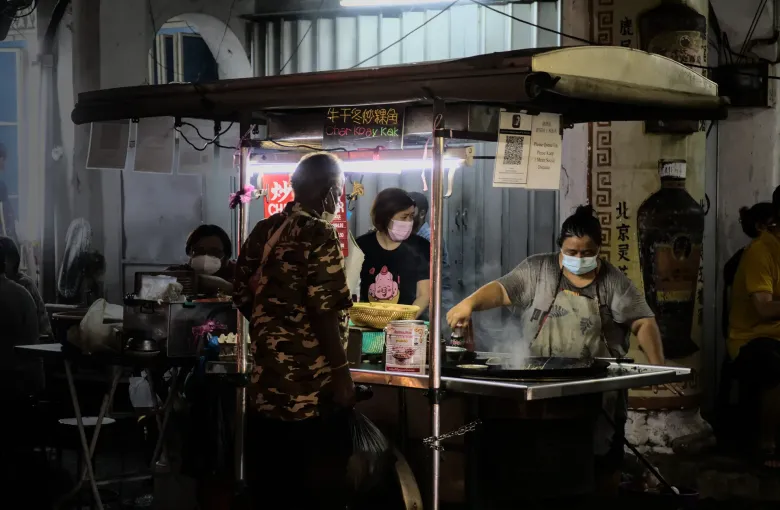
The country this is about.
The safety advice this cluster cites describes Malaysia as a multicultural, majority Muslim country, and asks visitors to respect local laws, cultures, traditions and religions. That sentence does more work than it looks like. Malay, Chinese and Indian communities have lived alongside each other here for generations, several religions are practiced openly, and the public calendar carries festivals from all of them. A visitor is not entering one culture but a place where several are ordinary at once.
The item on this page that is not etiquette.
It is illegal under Malaysian law for foreign nationals to take part in demonstrations or protests. The same advice records peaceful demonstrations in some Malaysian cities, including outside some western embassies, and that police can use tear gas and water cannons to control public protests.
This is stated as law, deliberately, and not folded into a note about sensitivity. Framing a criminal matter as a question of respect would leave a reader thinking the risk is causing offense. The instruction the source gives is to monitor local and international media and avoid all demonstrations, and because taking part is unlawful for a foreign national, stopping to watch or film one is how a visitor crosses the line without meaning to.
Alongside it, the advice notes that if you are a Muslim you may be subject to local Sharia law, which is a matter of personal status law and applies differently from the criminal law that covers everyone.
Dress, and the places that enforce it.
Dress modestly, particularly in conservative and rural areas. The advice is specific about the consequence: you may be refused entry to places of worship or government offices if your shoulders and knees are not covered or you are not wearing closed shoes, and it tells you to check the signs displayed at the entrance.
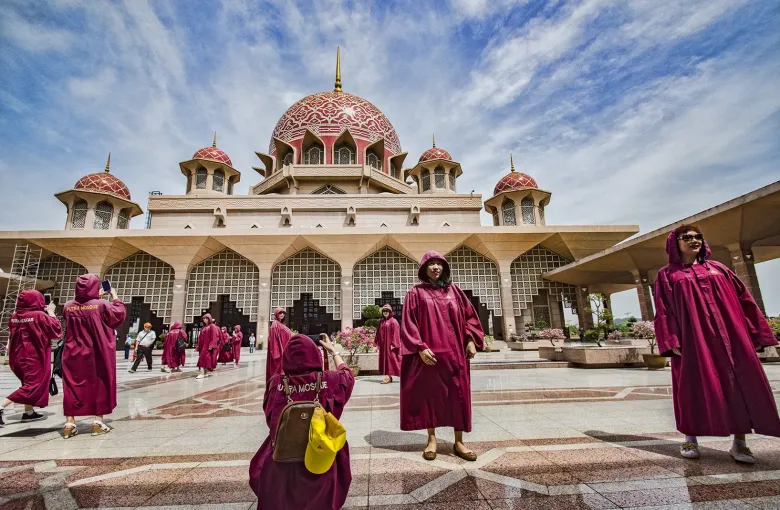
The closed-shoes clause is the one people are caught by, because sandals are the obvious choice in this climate. Many mosques that receive visitors lend robes to guests who arrive uncovered, and taking one is a courtesy being extended rather than the system working as intended. Arriving dressed for where you are going is better manners and is quicker.
Religious sites.
Remove shoes where you are asked to, which is most places of worship. Ask before photographing people, particularly at prayer. Keep to the areas visitors are invited into, since some parts of a mosque or temple are not among them. Keep your voice down and your phone silent. None of this is Malaysia-specific, and the reason it matters more here is the density: a single street in George Town can hold a mosque, a Chinese temple and a Hindu temple, and each of them is a working place of worship rather than a monument.
Ramadan.
The advice records Ramadan as a holy month for Muslims whose dates vary by year and by country, and suggests checking the opening hours of shops and restaurants and following local dress codes during it. It is worth traveling during: the evening markets that appear before the fast is broken are among the best eating of the year.
This page prints no date for it. The advice's own example refers to a year already past, which is a reminder that a source being authoritative does not make every sentence on it current. The dates move each year on a lunar calendar, so check them for the year you are traveling.
Ordinary courtesies worth knowing.
Use the right hand for giving, receiving and eating, which is the convention across Malay and Indian practice here. Accept an offer of food or drink even if only to taste it. Dress a little more formally than you would at home when meeting people, since casual reads as careless rather than relaxed. And treat photography of people as something to ask about rather than assume, especially at a religious observance, where a camera turns a participant into a subject.
Language.
Malay is the national language and English is very widely spoken, particularly in the cities and in anything to do with travel. Learning a few words is still worth it for the same reason it is anywhere: it is a signal about how you are arriving rather than a practical necessity.
Sources
- UK Foreign, Commonwealth and Development Office: records a kidnapping threat in coastal eastern Sabah, that it is illegal under Malaysian law for foreign nationals to take part in demonstrations, that bag-snatching by thieves on motorbikes is common and has injured and killed people who held on, that credit card and ATM fraud is widespread, that drink spiking and methanol poisoning occur, and that by law you must carry identification. Accessed 22 September 2026.
- UNESCO World Heritage Centre: records six properties inscribed on the World Heritage List for Malaysia and three sites on its Tentative List, among them Melaka and George Town, Historic Cities of the Straits of Malacca, inscribed in 2008. Accessed 22 September 2026.
- UK Foreign, Commonwealth and Development Office: sets out Malaysia's entry rules as the UK government understands them: a passport valid for at least 6 months after arrival, normally 90 days on arrival for tourism without a visa, an arrival card submitted online before travel, immigration control between Peninsular Malaysia and East Malaysia, and a customs declaration for cash worth 10,000 US dollars or more. Accessed 22 September 2026.
Other Articles
Malaysia Packing List
Malaysia Festivals and Celebrations