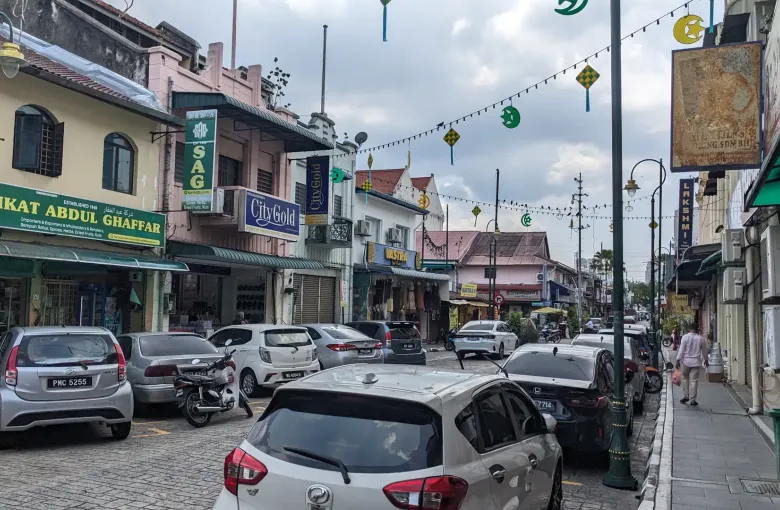
Why no dates appear on this page.
Most Malaysian festivals follow lunar or luni-solar calendars, so they move against the Gregorian year. A date printed here would be right for one year and quietly wrong afterward, and a reader has no way of telling which they are looking at.
The source register makes the point better than an argument could. The safety advice this cluster cites records Ramadan as a holy month for Muslims and states that the dates vary by year and by country, and then gives an example referring to a year already past. An authoritative source is not the same as a current sentence. So this page describes what happens and sends you to check when.
Several calendars, at the same time.
This is the part that makes Malaysia unusual rather than merely festive. Malay Muslim, Chinese and Indian communities each keep their own observances, and the public holiday calendar carries all of them. In a single year a visitor may run into Hari Raya at the end of Ramadan, Chinese New Year, Deepavali, Thaipusam, Wesak and Christmas, along with state holidays that differ between states because several have their own rulers.
The practical reading is that there is no reliable quiet season defined by festivals, and that the busy weeks move. Two of those observances close much of the country for travel as families move between cities, which fills flights and trains including the crossing between the peninsula and Borneo.
What it means for a trip.
Book earlier than you would otherwise for any date near a major festival, particularly internal flights. Expect some businesses to close for several days rather than one. Check opening hours rather than assuming, which is exactly what the advice says about Ramadan. And understand that a festival week is both the best time to be here and the hardest time to move around, which is a trade rather than a problem.
Observances are not performances.
Much of what a visitor will see is religious practice rather than spectacle, and a great deal of it takes place at working temples and mosques. Ask before photographing people, especially anyone taking part rather than watching. Dress for the place, which the culture and etiquette guide in this cluster covers, and stay in the areas visitors are invited into. At a large observance the crowds are genuinely large, which is a reason to keep valuables on your body given what the safety advice records about bag-snatching in cities.
Where the festivals are most visible.
The historic quarters inscribed by UNESCO as Melaka and George Town are where the country's communities have lived alongside each other longest, and they remain among the most visible places to see that. A single street can hold a mosque, a Chinese clan temple and a Hindu temple, and during a festival the one that is celebrating is unmistakable. Temples elsewhere mark the same occasions at scale, with lanterns and lights that transform a site for a few weeks a year.
How to find the dates.
Check the Malaysian public holiday calendar for the year you are traveling, and check it by state, since holidays are not uniform across the country. Then confirm anything you are building a trip around with the specific temple, mosque or organizer, because the public holiday and the observance are not always the same day.
Sources
- UK Foreign, Commonwealth and Development Office: records a kidnapping threat in coastal eastern Sabah, that it is illegal under Malaysian law for foreign nationals to take part in demonstrations, that bag-snatching by thieves on motorbikes is common and has injured and killed people who held on, that credit card and ATM fraud is widespread, that drink spiking and methanol poisoning occur, and that by law you must carry identification. Accessed 22 September 2026.
- UNESCO World Heritage Centre: records six properties inscribed on the World Heritage List for Malaysia and three sites on its Tentative List, among them Melaka and George Town, Historic Cities of the Straits of Malacca, inscribed in 2008. Accessed 22 September 2026.
- UK Foreign, Commonwealth and Development Office: advises against all but essential travel to parts of Malaysia, and states that no travel can be guaranteed safe and that travelers should get appropriate travel insurance. Accessed 22 September 2026.
Other Articles
Malaysia Culture and Etiquette Guide
The Best Time to Visit Malaysia