The short version
UNESCO calls the Acropolis of Athens the most striking and complete ancient Greek monumental complex still existing in our times. It was inscribed on the World Heritage List in 1987 under criteria (i)(ii)(iii)(iv)(vi), a five-criterion inscription that is unusual in itself.
The rock
It is a hill of average height, 156 m, rising from the basin of Athens, rocky and steep on every side except the west, with a nearly flat top measuring roughly 170 by 350 m. That flat top is the whole reason for the site's history: it is defensible, visible from the sea, and just large enough to build on.
Three thousand three hundred years of fortification
Walls have surrounded the summit for more than 3,300 years. The first was built in the thirteenth century BC around the residence of the local Mycenaean ruler, which means the Acropolis was a fortress and a palace long before it was a sanctuary. From the eighth century BC it gradually took on religious character with the establishment of the cult of Athena, the city's patron goddess, and the sanctuary reached its first peak in the archaic period, from the middle of the sixth century to the early fifth.
Fifty years that produced everything you came to see
In the fifth century BC, the Athenians, emboldened by victory over the Persians, carried out an ambitious building program under the leadership of Perikles. Four buildings from that program stand on the summit today, and the dates are worth having, because they show how fast it happened:
- the Parthenon, by Iktinos and Kallikrates with the sculptor Pheidias, 447 to 432 BC
- the Propylaia, the monumental gateway, by Mnesikles, 437 to 432 BC
- the Temple of Athena Nike, by Mnesikles and Kallikrates, 427 to 424 BC
- the Erechtheion, 421 to 406 BC
UNESCO's first criterion calls the result the supreme expression of the adaptation of architecture to a natural site, and its second records that these monuments have exerted an exceptional influence on building ever since. That is the quiet claim underneath a famous view: what was worked out on this rock about proportion, correction and setting is still in use.
What the inscription says about ideas
The record is unusually direct for a technical document. It states that on this hill were born democracy, philosophy, theater, and freedom of expression and speech, and that these provide the intellectual and spiritual foundation of the contemporary world. It also records that the monuments survived nearly twenty-five centuries of wars, explosions, bombardments, fires, earthquakes, sackings, interventions and alterations, adapting to different uses and to the civilizations, myths and religions that followed one another in Greece.
Both halves matter when you are standing there. The building is not a ruin that was left alone. It is a building that was fought over, converted, blown up and repaired.
Visiting well
The summit is bare rock and worn marble with almost no shade. Go early or late rather than in the middle of the day, wear shoes with grip rather than smooth soles, and carry water, a hat and sunscreen. Every sensible sentence in our packing list was written with this hill in mind.
Two more practical notes. Greek police may ask for identification and may not accept a copy, so carry your passport. And the approach from Plaka is steeper than it looks on a map; anyone who would rather not climb it should read our accessible travel guide first, because the arrangements at archaeological sites change and are worth confirming for the day you are going.
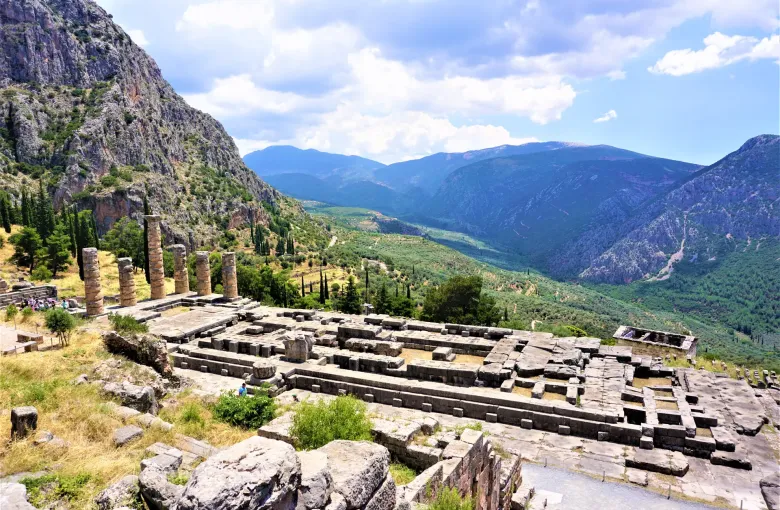
Read this with Delphi and Meteora, the other two inscribed properties in this guide. Greece has twenty-one in all.
Sources
- UNESCO World Heritage Centre: the inscription of the Acropolis, Athens in 1987 under criteria (i)(ii)(iii)(iv)(vi). Accessed 15 September 2026.
- UNESCO World Heritage Centre: Greece’s State Party record: twenty-one properties inscribed on the World Heritage List. Accessed 15 September 2026.
- UK Foreign, Commonwealth & Development Office: Greece safety and security: terrorism, strikes and demonstrations, theft on the Athens metro, water safety, road rules, wildfires and earthquakes. Accessed 15 September 2026.
Other Articles
Best Time to Visit Greece
Greece Packing List