The short version
April to June and September to October are the months we build most Greek itineraries around. They give you workable temperatures on open archaeological sites, sea that is warm enough at the later end, and a country that is not running at capacity.
Why high summer is a real trade and not a snobbery
Two of the reasons are comfort and crowds, and you can decide about those yourself. The third is not a matter of taste. The FCDO records a high risk of wildfires during the summer season from April to October, and lists extreme heat alongside wildfires among the extreme natural phenomena Greece experiences.
That does not make July and August a no. It makes them months to travel with a phone set to receive emergency alerts, a plan that is not committed to a single road out of a single valley, and sightseeing done in the first and last hours of daylight. Plenty of people have a wonderful August in Greece. It is simply a different set of decisions.
What each part of the country wants
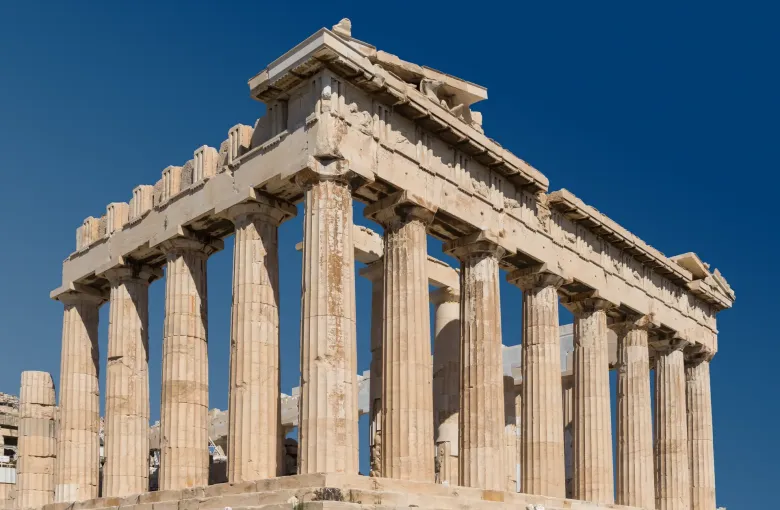
Athens and the classical sites. Spring and autumn, without much argument. The Acropolis summit, Delphi's slope and most of the great sites are bare rock with almost no shade, and the FCDO's own hiking guidance for Greece warns that trails often lack shade and that you should avoid the peak hours of sun. A site visit in April is a pleasure. The same visit at two in the afternoon in July is an endurance test that you will remember for the wrong reason.
The islands. Late spring and early autumn give you swimming and a working island rather than a performing one. Out of season, schedules thin: ferries and flights run less often, and some places close. That is a reason to plan rather than a reason not to go.
Meteora and the mainland interior. These carry their own weather and are good for longer. Spring brings green and cloud that suits the monasteries; autumn is clear; winter can be striking and cold, and the steps between the rocks are a different proposition wet.
Three dates to know before you book
Strikes in Greece are regular and sometimes called at short notice, and they can affect buses, trains, ferries, flights, roads and borders. Demonstrations gather in central Athens, especially Syntagma Square, and the FCDO names three recurring dates: 1 May, 17 November and 6 December. None is a reason to stay away. All three are reasons not to schedule a tight transfer or a once-only flight connection on that day.
Give island days slack, whenever you come
An Aegean itinerary is a chain, and every link is a boat. Between strike action and the steady summer north wind, sailings can be canceled at short notice, which matters most on the last leg before an international flight. We build Greek island trips with a night of margin at the end for exactly this reason, and it is the single most useful thing a traveler can insist on.
What we do not publish here
No monthly temperature table. Nothing we can cite gives one for Greece, and a number carried over from memory is worse than an honest gap. What the sources do establish is the shape of the year: wildfire season from April to October, extreme heat, flash floods that can arrive quickly, and earthquakes at any time. Our weather guide works through each of those.
Read this with festivals and celebrations, which is where the calendar question usually ends up, and what to pack.
Sources
- UK Foreign, Commonwealth & Development Office: Greece travel advice: no advisory against travel to any part of the country, and a high risk of wildfires from April to October. Accessed 15 September 2026.
- UK Foreign, Commonwealth & Development Office: Greece safety and security: terrorism, strikes and demonstrations, theft on the Athens metro, water safety, road rules, wildfires and earthquakes. Accessed 15 September 2026.
- UNESCO World Heritage Centre: Greece’s State Party record: twenty-one properties inscribed on the World Heritage List. Accessed 15 September 2026.
Other Articles
Greece Weather Guide
Acropolis of Athens: Visitor and Heritage Guide