The short version
Greece is one of the best countries we take older travelers to: the food is gentle, the days can be short, the sitting is excellent and the history rewards a slow pace more than a fast one. Four decisions do most of the work: when you come, how much you attempt in a day, how you handle the heat, and how far you are from a hospital.
Come in the shoulder season
April to June and September to October. Sites are walkable in the middle of the day, the crowds on the Acropolis approach are thinner, and the sea is still warm at the later end. High summer brings extreme heat, and the wildfire season runs April to October, with both peaking in the months we would steer you away from anyway.
One major site a day
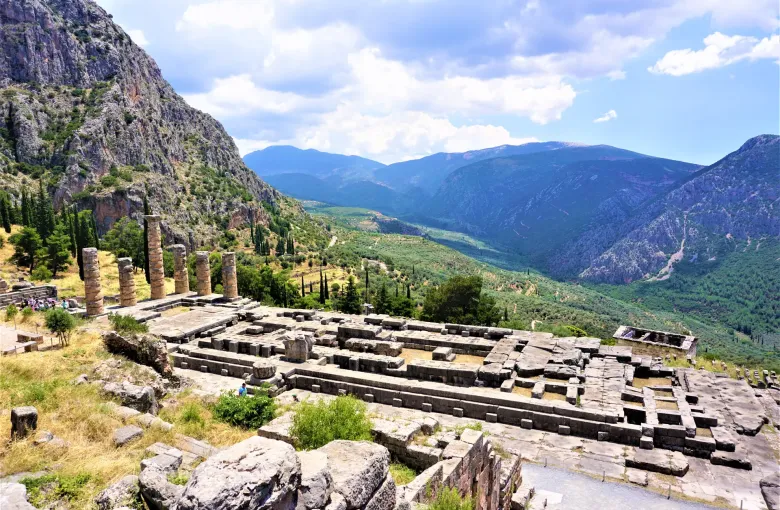
This is the single change that improves a Greek trip most. The Acropolis is a hill of bare rock and polished marble; Delphi is a continuous climb on uneven paving; Meteora is steps cut into stone. Any one of them is a morning. Two in a day is a route march that leaves nothing for the evening, which is when Greece is at its best.
Build in the museum as the afternoon rather than as an extra. The Acropolis Museum and the site museum at Delphi are air-conditioned, seated and hold most of what was found, so they are a genuine half of the experience rather than a fallback.
Heat, water and the middle of the day
Treat the hours around midday as indoor time between spring and autumn. Carry a hat, sunscreen and plenty of water, and expect sites and trails to lack shade. If you take medication daily, note the official point that changes to your routine when traveling, including coping with heat and a different diet, can affect how it works. Ask your doctor about that specifically before you go, not in general.
Where the hospital is, before you choose the island
Do this part first if anyone in the party has a heart, lung or mobility condition. Treatment and facilities in Greece are generally good on the mainland but may be limited on the islands. The public ambulance service is basic, and there are serious shortages of ambulances on some islands. Standards of nursing and aftercare in the state sector are not what you are used to.
That does not rule islands out. It decides which islands, and it makes medical evacuation cover a line item you confirm rather than assume. A Global Health Insurance Card, which British travelers hold, is not travel insurance and does not cover repatriation, private clinics or treatment ruled non-urgent. On a US passport, your policy is the whole of your cover.
The FCDO maintains a list of medical providers in Greece where some staff speak English. It also notes that on some islands local staff may direct visitors to private first aid centers rather than to a public hospital, which is worth knowing when you are the one being helped into a car. For an ambulance, dial 112 or 166.
Bring the pharmacy with you
Pack your prescription medicines in the original containers with the labels, carry a doctor's letter stating the quantity you need for the trip, and make sure the name on the prescription matches the name on your passport. Greek pharmacies are well stocked but dispensing rules for some medicines, including antibiotics, are strict. Take more than the exact number of days, in case a ferry does not sail.
Check vaccines with a travel clinic at least eight weeks before departure. The CDC's Greece page lists routine vaccines, including measles, mumps and rubella, and suggests considering hepatitis A for most travelers.
Transport that respects the pace
Pre-arranged transport rather than hailed taxis, ferries rather than coach transfers where the route allows, and a hotel chosen for the walk from its door rather than for its lobby. Strikes are called at short notice in Greece and can stop ferries and flights, so we put a night of margin before any international departure. Read getting around for the detail, and accessible travel in Greece if steps, distance or surfaces are a real constraint rather than a preference.
Two small things worth doing
Set your phone to receive Greek emergency alerts before you travel, and keep it with you: the instructions are in our weather guide. And carry your passport rather than a copy, because police may ask for identification and may not accept one.
Read this with the best time to visit and what to pack.
Sources
- UK Foreign, Commonwealth & Development Office: Greece health: the emergency numbers, vaccine timing, prescription medicine rules, and healthcare that is good on the mainland and limited on some islands. Accessed 15 September 2026.
- UK Foreign, Commonwealth & Development Office: Greece safety and security: terrorism, strikes and demonstrations, theft on the Athens metro, water safety, road rules, wildfires and earthquakes. Accessed 15 September 2026.
- UK Foreign, Commonwealth & Development Office: Greece travel advice: no advisory against travel to any part of the country, and a high risk of wildfires from April to October. Accessed 15 September 2026.
- US Centers for Disease Control and Prevention: Travelers’ Health, Greece: routine vaccines, hepatitis A and B, measles, rabies, tick-borne encephalitis and insect bite prevention. Accessed 15 September 2026.
Other Articles

Accessible Travel in Greece

Getting Around Greece